Friday, December 31, 2010

Saving the Savages = Breaking the System

I just finished reading The Wayfinders - Why Ancient Wisdom Matters in the Modern World by Wade Davis. Besides being one of the best arguments I've read on why sustainability matters and where we might "relearn" how to achieve it, there was a section on the consequences, however well intended, of misunderstanding the context of a culture and of applying the wrong solution to a problem because of it.

The story is of the people of the Kasuit desert in northern Kenya. For hundreds of years, they lived in this desert. They developed a culture that embraced the difficulties of living in the desert and, therefore, did just fine. Until severe drought, combined with nearby wars brought this region to the attention of the West. At which point, the United Nations took actions to "save" them from themselves.
Following is my summary of Wade's story.

The culture the originally developed worked like this:

To ensure that enough livestock survived severe drought, large herds of livestock were required.
To maintain large herds required large families, stewardship of the land and a nomadic lifestyle (so that the carrying capacity of any one area was not exceeded).
The requirement to have large families resulted in polygamy being common. But to maintain social harmony among the young men in a group where there were not enough women for every man, the culture developed rites around sending young men away to tend the herds. These rites bound together the men involved in them, creating life-long social bonds which reinforced the "commonness" of their use of the land (avoiding the "tragedy of the commons"). These rites also instilled a large amount of prestige in the men, allowing them to accept the situation which supported the large families.

Then the UN intervened and added a few things:
First they added the idea of private ownership of the land and, thereby, permanent settlement. This required the reduction of herd size which quickly led to dependence of outside aid to keep the people alive.
Outside aid included western education. The education broke the traditional rites of passage (by instilling the idea that such a life was "beneath" an educated man), which broke the personal ties which were necessary, among the other factors, to allow life in the harsh environment.

The entire culture collapsed and, along with it, the ability to sustain life in that place.
All with the best intentions...
...but without sufficient respect for the wisdom of the people who had learned to live within the limits of the place they inhabited.

Monday, November 15, 2010

Sustainable business - Thoughts about Zero Growth

In a previous post, I was thinking about how the law almost prescribes that businesses grow and put growth ahead of any other social or environmental concern.

Recently I ran into this article about zero-growth economics: an area that is about understanding how an economy might work that is not based on constant growth. One in which productivity gains are used to reduce working hours while keeping output constant rather than using increased productivity to increase output and increase demand in a never ending cycle.

Below are several quotes that I took from the article that I found particularly interesting. The most important of which is probably this:
  • no-growthers regard their job not as promoting specific policies, but widening the field of debate. 
That captures the idea of Dis-enthrallment rather well.
Other thoughts:
  • "We've had 125,000 generations of humans, but it's only been the last eight that have had growth," Victor told me. "So what's considered normal? I think we live in very abnormal times.
  • he [Peter Victor] created a computer model replicating the modern Canadian economy. Then he tweaked it so that crucial elements—including consumption, productivity, and population—gradually stopped growing after 2010. To stave off unemployment, he shortened the workweek to roughly four days, creating more jobs. ... It took a couple of decades, but unemployment eventually fell to 4 percent, most people's standards of living actually rose, and greenhouse gas emissions decreased to well below Kyoto levels. The economy reached a "steady state."
  • Even Adam Smith, ...  acknowledged that it might be possible for an economy to max out its natural resources and stop growing.
  • In 1930, John Maynard Keynes likewise predicted a period in the future...when the economy wouldn't need to grow (pdf) further to meet our basic needs. Man's "economic problem" would be solved, and people would "prefer to devote our further energies to non-economic purposes." Things like art, child rearing, and leisure.
  • When Franklin Roosevelt supported grappling with Great Depression unemployment by decreasing the workweek to 30 hours, the largest corporations fought back fiercely. America, they argued, would be saved only by the new "gospel of consumption." The administration would need to pursue flat-out growth, loosening labor laws and so forth, so that the industrialists could revive the nation. Roosevelt backed down.
  •  it seemed obvious that when nations virtualized, shifting to service economies, they didn't stop gobbling natural resources or even, really, curb their appetites. They merely outsourced the problem to Asia, Africa, and South America or found cheap new sources at home
  •  the happiness of Americans, as reported by social scientists, rose steadily after World War II as GDP grew. But by the late '50s, that connection broke down: Although our median family incomes have nearly doubled since 1957, the proportion of people who say they are "very happy" has barely budged (pdf). Daly thinks we simply hit the point of diminishing returns. Our growth turned uneconomic: GDP now keeps growing mainly because we are producing gewgaws and services that don't significantly add to our happiness. Or worse: It grows because we are spending money to solve problems that growth itself created.
  •  no-growth economists agree with mainstream economists on one big point: Technological advances make workers more productive every year. In the mainstream view, these labor efficiencies make goods cheaper, which leaves consumers with more disposable incomewhich they invest or spend on more stuff, leading to more hiring to fulfill demand. By contrast, the no-growthers would do things differently; they would use those efficiencies to shorten the workweek, so that most people would stay employed and bring home a reasonable salary.
  •  Indeed, some countries have already edged towards this vision. In 1982, labor unions in the Netherlands agreed to limit demands for higher pay in exchange for policies encouraging people to work less. Within a decade, the proportion of Dutch citizens working part-time soared from 19 percent to 27 percent, the average workweek fell from 30 to 27 hours, and unemployment had plummeted from 10 percent to 5 percent. (They called it "the Dutch miracle.")
  •  Western consumption rates would need to shrink disproportionately so that citizens of countries like India and El Salvador could enjoy a lifestyle upgrade. Why? The no-growthers argue that a world with fewer yawning inequities between the rich and poor would be more stable; but quite apart from that, their models require stabilizing world population, and raising the economic lot of the poor is a proven way to do that.
  • Given the shift in wealth needed to accomplish this, Americans would ... be pretty lucky even to find ourselves where we were in 1960—when the median family made $35,994 in today's dollars (versus $61,932 in 2008).
  • technological advances mean that your dollar buys a lot more than it did back then. For a couple of bucks, you can score a pocket calculator that does things it once took a million-dollar university machine to accomplish. "We're better at making things now," Victor says, so our living standards would be considerably higher than this figure suggests.
  •  But when you take the thought experiment a few steps further, no-growth theory raises a host of questions about psychology and motivation. ... Would innovation cease if entrepreneurs didn't think they would sell a million widgets? Could individual companies still grow—and if not, who would want to invest in them?
  • There are other aspects of no-growth theory—like the population-stabilizing business—that could chill partisans of any stripe. To halt population growth, you need to reduce global fertility rates to an average of about two children per couple. But if boosting poor people's means doesn't defuse the population bomb, what then? Population control by mandate is essentially totalitarianism.
  • Daly ... has begun to think that only the Earth itself will compel people to act. In a few decades, if basic resources become scarce, prices spike, and climate change is causing global conflict, no-growth thinking could arrive whether we like it or not. "It'll be forced on us," he says. In the end, when it comes to determining the shape of our economy, the planet may possess the most powerful invisible hand of all.

Thursday, November 11, 2010

ESLs - Comparison to other lighting technologies

In a previous post I compared several light sources to understand why a person might choose one over the other.

I bumped into this story on treehugger about Electron Stimulated Luminescence (ESL) bulbs. These lights use an approach like a CRT television to cause a phosphor to light up.


Technical specs for the bulbs are:
  • efficacy = 30.7 lm/W
  • lifetime = 10,000 hrs
  • CRI = 85
  • Color Temp = 2700K, 2900K, 4000K
Other points which the makers heavily emphasize:
  • Fully linear dimming with household dimmers (vs CFLs)
  • Mercury-free, environmentally-friendly materials throughout (vs CFLs)
  • Mount in any orientation [heat issues] (vs CFLs and probably LEDs)
  • Instant on at full brightness (vs CFLs)
  • Lasts approximately 3-6 times longer than an ordinary incandescent bulb
They don't post a price but do say about price: "it will be price competitive against LED products."
If I take "price competitive" to mean 25% less than an equivalent LED bulb, that leads to an expensive bulb... (~$136/klm ESL vs $5/klm CFL).

Plotting that information in the same charts I used earlier gives the following:


The ESL bulb falls into a pretty good space in terms of visual quality. However, its efficacy is quite low compared to the other choices in the space.

Assuming that the FAQ comparison with LED lighting is any indication of how they intend to price the bulbs, then a more serious problem emerges.

The price | performance ratio is quite poor for the ESL. Its lifetime and efficacy values are FAR too low to be priced anything like an LED light. To be competitive, the price would have to be closer to that of a CFL (1/30th the current estimate).
Being Hg free, made from environmental friendly materials, dimmable, providing instant on and lacking heat issues are all very nice but, given it is only about 1/3 as energy efficient as a CFL, a 30x price premium is not warranted ... it would be hard to justify a 2x price premium I suspect.

So unless the pricing comparison with LEDs is highly misleading, ESL is likey to be DOA.
Mass market will buy CFLs because of price | performance.
Specialty applications focused on "green" creds will use LEDs because they are far superior in those aspects.

Tuesday, November 9, 2010

Saving the World is Like a WoW Raid?


TED recently posted another interesting talk about games and social change by Tom Chatfield.


One big take away from his talk is seven lessons from games that you can take and use outside of games to engage people with game-like rapture.
  1. Experience bars measuring progress - show progress towards a single, large, long term goal.
  2. Multiple long and short term aims - lots and lots of different tasks at a level that is still engaging. Break down a huge problem into interesting slices.
  3. Reward effort - credit for trying. No punishment for failure.
  4. Feedback - link consequence to action. Even when they are distant in time and space.
  5. Element of uncertainty - uncertain rewards at the right level of occurrence (intermittent reinforcement).
  6. Windows of enhanced attention - provide the lessons at the right time when attention is focused.
  7. Other people - doing things with your peers.

The mention of EverQuest did get me to thinking about games for sustainability in a slightly different way. I had been trying to answer how you bride the gap from games to changed behavior.
  • In games about sustainability, there is some attempt to educate, but no real requirement to actually change. Here is an example ("Fate of the World") that lets the player experiment with different policies to understand how those policies affect outcomes that are not readily apparent in a short time frame.
  • In crowdsourced efforts, like zooniverse's "old weather" project and the Great Backyard Bird Count,  people expend effort at processing data that can be used to understand our environment. That is arguably a change in behavior, but one that is of an information processing nature rather than a lifestyle change.
  • In augmented reality, an objective is overlaid on some real environment as a way to change your interaction with that environment. But it leaves the problem of making sustainability related behavior changes exciting enough to play in and of itself on a long term basis.
The answer (of the hour): Raids.
A focused game mechanic that closely coordinates people to act towards a common goal that can require a large amount of preparation outside of the specific event in order to achieve.
  • The game sets a target (e.g. kill bad guy X)
  • People gather to achieve it (e.g. clan N and clan Y decides to take on this raid for the greater glory)
  • The game could set up a mechanic whereby the first team to reduce electricity usage over baseline by 100kWhr opens the dungeon required to start the raid. Or the more energy saved by the group, the more powerful a summoned assistant the team gets (with tiers and drastic changes to powers and appearance as the tiers are achieved). As part of this mechanic, the game would:
    • Show each player's contribution towards the goal
    • Suggest approaches for achieving the goal
    • Provide some in-game feedback about the effect of this goal 
      • e.g. the saved energy builds up in a visual form somewhere in-game
      • e.g. provide tiered but randomized rewards as players' contributions reach certain levels.
    • Provide real world context of what the energy savings means (e.g. $x of savings)
    • Keep a public record of what was achieved for all groups attempting the raid to see.
  •  Rinse and repeat
Instead of trying to make a game entirely about sustainability, build it into a game that people want to play (like WoW).

One huge opportunity that comes from this is establishing the systems by which you get accurate feedback from the real world on the actions that you really want to drive. Smart meters are one example (leaving open the question of how you establish a "baseline"). But, as noted in this post, car mileage is a much larger contribution to overall energy usage. How would you monitor miles reduced? Similar questions for green buying decisions, water use, etc... some probably easier to solve (and easier to tie to a product promotional campaign) than others.

Thursday, September 23, 2010

More Energy Efficiency and Leverage - It's STILL not about caulking.


I can't make a good decision about how to make my energy usage sustainable unless I know which activities are using the most energy. The chart presented here attempts to give an idea of the scales of energy I've been talking about in previous blog posts.

The total energy usage in the US per year (as noted in this blog post) is ~1x10^20J. For comparison, that is:
Closer to home, the total electricity used per year by the average US household is about 4x10^10J. While media focus has been on making our homes more energy efficient as a good way to tackle sustainability, it turns out that driving a single car each year uses ~5x more energy than our homes consume*.
Increasing fuel efficiency or reducing miles driven by 20% would be the equivalent of reducing your home electricity usage by 100%. That's big leverage. Better than caulk or fluorescent light bulbs.

Flying is also pretty energy intensive. A single flight from SanFrancisco to Tokyo uses about the same energy as driving a car for a year** or ~3.5x the average annual electricity usage of a home. With about 4 flights per day 365 days/yr that is ~5100x the average annual electricity usage of a home per year of flights... and that's just one destination from one airport...

So shooting for 30% reductions in energy usage in the home may not be entirely where the leverage lies.

*assuming 15,000 mi/yr @ CAFE standard 27.5 mpg.
** assuming 5148 miles @ 5.29 mpg of kerosene.

Wednesday, September 15, 2010

Energy Efficiency and Leverage - It's not about caulking and insulation.

Lawrence Livermore National Labs published a very interesting diagram of energy usage in the US for 2009 (above picture).
One thing to take away from it is that most of the inefficiencies ("rejected energy") come from:
  • transportation (37%)
  • losses during electricity generation (48%)
Combined commercial and residential losses amount to about only 7%.
So even if I could make all commercial buildings and houses 30% more efficient through energy efficiency retrofits, new appliances, smart monitoring, lighting and HVAC feedback controls, etc, that would only reduce the rejected energy by 2%.

Leverage comes from addressing transportation and energy generation and transmission.
  • Electric Cars:
    • LLNL assumes 25% efficiency for conversion of petroleum energy to useful transportation energy. If you assume that electrifying all transportation could improve this to 90%, that would reduce rejected energy by 24%. That's 12x the impact of green building on energy usage.
  • Distributed Generation: Solar panels and wind in your backyard.
    • Transmission losses are estimated at about 6.5% for 2007. If those losses were eliminated (optimistically) by putting solar panels and wind farms near the consumers, that would reduce rejected energy by ~1.5%, or slightly less than making all buildings "green" with respect to their energy usage.
    • A much bigger deal is the reduction in fossil fuel usage this would allow. Assuming that wind, hydro, geothermal, nuclear and solar are 100% "efficient"(no rejected energy), that means fossil fuels are only about 24% efficient. If you could replace all the coal with some combination of these other sources (preferably wind or solar to allow for distributed generation), that would reduce rejected energy by ~25%. That's 12x the impact of green building (albeit at potentially high cost).
This is not to say that green building is unimportant but, if this analysis is correct (or even in the ballpark), then it's far less important in the big picture of energy efficiency than I thought.
It is important to concede that the changing all transportation to electric drive and replacing all coal with solar or wind is a HUGE hurdle to overcome. Making buildings greener may not be the longest lever but it's one that is easier to deal with.

Thursday, September 9, 2010

A World of Connected Strangers Feels Bad

Here is perhaps an interesting way to look at how the world has become increasingly networked (connected) yet somehow we still remain strangers to each other.
Our livelihoods are either:
  • Dependent on others = My ability to survive and live the lifestyle I have become accustomed to depends the work output of others (or at least some specific others). 
  • Independent of others = My survival and/or lifestyle does not really require these other people.
Our ties to other people (on whom we depend or not) are either:
  • Intimate = I know these people well. I probably care about their well being.
  • Strangers = I don't know these people... maybe I've never even met them. Their well being is certainly not a deeply personal issue.
 This gives:
  • Independent Strangers = Groups of people who can live on their own and keep to themselves. The "outsiders" don't really matter.
  • Dependent Intimates = Groups of people who know each other very well and who live (and die) for each other. Fellow soldiers in battle captures the extreme of this idea. Members within a tribe would also qualify.
  • Independent Intimates = Groups of people who know each other well but whose relationship does not really affect their ability to live. It's very nice to be friends, or maybe they know too much about each other, but when they move away, nothing really changes.
  • Dependent Strangers = Groups of people who may not even know each other exist but whose lives depend on the existence and actions of each other. Who grows your food? Who makes the clothes you wear? Who buys the goods that pay for the services that your company pays you to deliver?
 My thought is that we're biologically wired to be dependent intimates and social units which meet that model have been the basis for humanity for most of our history.  In the modern world, however, we've become dependent strangers with occasional access to independent intimates.

Where it was once normal to be in a band of brothers, now it is a rare exception. That we treasure it when it happens speaks to the deepness of it's importance.

What does this have to do with sustainable business?
In this post, I was thinking about a sustainable business process. One that " makes my people and customers more fulfilled rather than just "less abused" in pursuit of the company's goals."
In a world of dependent strangers, I'm not sure this is possible.
So having some framework to assess the alternatives is helpful.

Friday, September 3, 2010

More about games and sustainability

In a previous post, I was thinking about how to connect the game world to the real world so that the game was not ABOUT sustainability, but actually required sustainable behaviors in order to play. In that post, I mentioned using smart meters as "input devices" and augmented reality as two possible approaches.

Here are a couple more thoughts:
Tweet-a-Watt
 Use the Kill-a-Watt product, modified to tweet your electricity usage, in order to easily report energy usage over time. By tracking usage changes, giving points for number of connected electricity monitors, creating special achievements that require certain energy usage behaviors and teaming up with others to pool points to perform in-game actions, you can link real energy usage to the game's outcome. By making the interface a tweet instead of a manual entry the game can focus on action rather than data entry.

Reverse my thought - pay for sustainability through proceeds of the game's sales or in-game economy
Maybe my thinking about requiring sustainable behaviors to play isn't the right way. Maybe a good alternative is to fund other peoples' sustainability activities by playing games. Puff Puff : Gulf Spill is an iPhone game that donates 10% (or 30% depending on whether the article or the video is correct) to habitat restoration. Donating proceeds from sales to a charitable cause is not a new thing, but attaching it to a game is new.
Attach it to a game with an in-game economy (e.g. World of Warcraft, Second Life, EvE Online, etc.) and give the option to the player to donate some of their in-game money to real world causes (instead of cashing it out as real-world money or selling it to someone else for real world money as is done on eBay) and it might be useful.

Friday, August 20, 2010

(more) TED on games as a way to make change

I posted earlier (here and here) about sustainability and using games to try to change peoples' behaviors toward the more sustainable.

Following is a TED video about that same topic (driving behavior changes with games) from someone whose work it is to drive business by getting people to play games that require interaction with the real world: in this case the companies that want you to visit them and buy their products.

Key take aways for me:
  • Last decade was the decade of social. This is the decade of games.
  • With 7 dynamics, you can get people to do anything.
  • Four dynamics presented in the video (the other 3 are "secret" so that the speaker still has a competitive advantage at the end of the talk :P).
    • Appointment dynamic = Do something at a certain time and place.
    • Influence and status = Offer things that convey social status
    • Progression dynamic = Offer a definition of "100% complete" and track progress against it. Level-up.  Unlock rewards over time.
    • Communal discovery = Everyone works together to achieve a common goal.

Saturday, August 14, 2010

Solar chargers for electric cars?

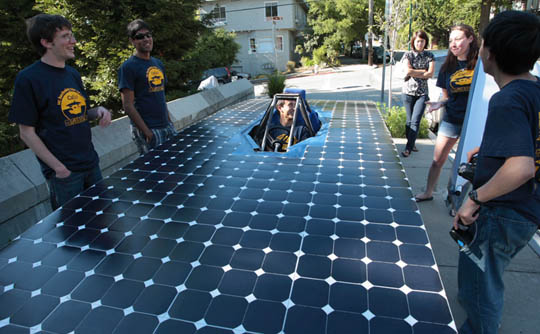
OK. This picture isn't what I'm actually talking about, but it does highlight part of the problem that would need to be solved:

Could you reasonably make a passenger car that charged itself using solar panels?

A few assumptions:
That would result in  ~16MJ of energy per day.
So you could recharge 11% of the battery a day, which would yield a range of ~10.8 miles.

If you assume the average commute is 33 miles each day (16.5 miles each way), that would mean:
  • To allow for a full trip home would take ~12 hrs of recharge time or
  • A panel that could generate ~0.9kW and be ~86 ft^2. That's more than 1.5x the area available on the car roof.
To give a sense of the size of the problem of solar charging exclusively:
  • To fully charge the battery would take ~73 hours or 
  • A panel that could generate 5.2 kW and be ~519 ft^2. That's more than 9x the area available on the car roof.
Most houses that get solar PV only go for 2 - 3 kW.

So self powered cars ALMOST make sense as long as you can recharge them from the grid after you get home. Fully self powered solar cars don't make sense.
It also strongly suggests that solar powered EV recharging stations (e.g. with the panels on a nearby roof or on the parking lot roof) actually make quite a bit sense.

Thursday, August 12, 2010

A better way for electric cars? A Better Place.

What are the two main things you worry about with electric cars?
  1. Price
  2. Range
Gasoline is great because it is a well established, subsidized fuel with very high energy density (1.3x10^8 J//kg). That makes it easy to carry around and get pretty far with. Plus, when you run out, there's always a gas station somewhere nearby. Price and range... not a problem.

Electric cars are limited by their batteries. Li-Ion battery's energy density is nowhere near as high as gasoline (5.2x10^5 - 7.2x10^5 J/kg - gasoline has >180 times more energy per kg of "fuel"). Even accepting that a gasoline engine is 30% efficient vs a 90% efficient electric motor (i.e. total energy that would be converted to work per kg of fuel is 3.9x10^7 J/kg for gasoline vs 6.5x10^5 J/kg for Li-ion), that yields ~60 times more energy per kg of "fuel" from gasoline than from batteries. So to get the same range as a gasoline car (from one tank of fuel), requires either:
  1. A very large battery -or-
    • If a typical car holds 15 gal of gasoline (@ ~2.7kg/gal = 40.5 kg) , a battery that contains the same effective energy would need to weigh ~2430kg ... where a Honda Civic weighs about 1270 kg... not practical to carry or to pay for.
  2. The ability to "refuel" the battery in less time than refueling a car 
    •  Even with the best recharger possible, it takes hours (~4 hrs for a Tesla roadster) vs maybe 5 minutes to refill a gas tank.
    • With a 100 mile range per battery charge, that would require about 4 battery charges per tank of gas (assuming CAFE standard of 27.5 mpg and 15 gal tank = 412 mile range). Sixteen hours (battery) vs 5 minutes (gasoline) (assuming both cars start empty).
 Those are pretty bad starting places to catch up from.

So Shai Agassi has an idea: Treat the electric car like a cell phone.
The customer buys miles and gets a subsidized car. The batteries are the medium for the "minutes." You never own them, you just use them.
Which means you can now swap batteries because you don't care about the specific battery that you have, only that you're getting the mileage you're paying for.
Suddenly the range problem goes away (~1min to change the battery).
Suddenly the price has a means of being subsidized (ala cell phone contracts that keep the price of the phone low for the end user).

Kind of like Blue Rhino propane tanks ... but way cooler.

And he created a company Better Place to do it:
  • Get the cars built
  • Get the battery swap system figured out
  • Get the infrastructure in place
  • Prove to the world that it can work
Check out this video (or the video below) of the system working in Tokyo. It's real.


So, admittedly, it only works where you have the infrastructure, but it certainly gives a new direction for addressing the two big problems of EVs.

Friday, August 6, 2010

Biking to work and energy efficiency

Bike to work and stop global warming.
Bike to work and get healthy.
Ok. Since it's so good for me and my planet and I'm only about 6 miles from work, I finally decided that I should give this a try.

I used a cool iPhone app (Runkeeper) to log how far I went and how fast I went there. As part of the app I got an estimated calorie usage... and that got me thinking about energy efficiency:

So my bicycle commute is more than 18 times more energy efficient than driving.
...And I drive a Prius.
If you use the CAFE Standard fuel efficiency for a passenger car in 2010 (27.5 mpg), then that bicycle commute is more than 28 times more energy efficient than driving.

To be as energy efficient as cycling, the car would need to use 0.01gal of gas for the 6 mile trip, which is 600 mpg! Whereas the current automotive X-Prize is only looking for 100 mpg... 6x short of what is needed.

So we REALLY need to be doing more of what Copenhagen is doing with making cycling mainstream:
"If you make the bicycle the fastest way to get around the city ... you're going to get everyone and their dog to do it."
  • Pervasive use of dedicated bicycle lanes.
  • 37% of all people commuting to work or school use bicycles.
  • 50% of all trips in the city are made by bicycle.
  • Double bike lanes to accommodate bike traffic volume in some places.
  • "Green wave" timed to give cyclists a no-stoplight flow into the center of the city for 6km (3.7mi).
  • Red LED lights on the bicycle lane demarcation that sense coming bicycles and flash to warn cars to avoid right turn conflicts.
  • Dedicated parking spots for cargo bikes (taking away 1 car parking spot for 4 cargo bike spots).


Picture credit: Adam Stein (terapass blog)

The Value of Uncertainty - Subjectivity and High Dynamic Range

It is generally agreed that 24 bit color provides more shades (~16.7 million) than the human eye can perceive (~10 million).
For grayscale, only about 100 shades can be distinguished while typical monitors can display 256 shades (8 bit).

Twenty four bit color is generated on a computer monitor by having 3 colored pixels (Red, Green and Blue) displaying up to 256 shades of brightness each (8 bits). Three colors x 8 bits per color = 24 bit color.

A typical digital camera uses 12 - 14 bit sensors, one for each color. This yields 36 - 42 bit color images. Why is this helpful? Even though the eye cannot see all the colors, a computer can still process them. By saving the additional information (i.e. saving the image in RAW format, instead of a compressed format like JPEG), the programs can rescale and process the images with much lower levels of artifacts. e.g. stretching the contrast can introduce bands in the colors called posturization.
 Another image processing option that the extra colors and range make more effective is High Dynamic Range (HDR) photography. In this computational photographic method multiple images of the same scene are combined to maximize the visibility of all areas of the photo. This can result in some very striking images but often only after a significant amount of manual tweaking to get just the right effect. Here-in lies the value.

"Existing tools are therefore likely to improve significantly; there is not currently, and may never be, an automated single-step process which converts all HDR images into those which look pleasing on screen, or in a print.  Good HDR conversions therefore require significant work and experimentation in order to achieve realistic and pleasing final images."

There is no simple answer to getting the "best" HDR rendering. Therefore hobbyists will pay for tools, new tools and more new tools to let them conquer the uncertainty - that there might be a better picture somewhere in the data.

Inspection Equipment
How can KLA-Tencor get away with a 60% gross margin selling hardware with substantial COGS?
That comes largely from the defect inspection groups vs the metrology groups. Why?
Value, in this case, comes from the lack of a definitive base-line. In metrology the standard is defined: a micron is a micron. Differentiation is hard because there is a clear definition of success. In inspection, there is always the fear that there might be a better result somewhere in the data... You don't know if it's good enough.

What does HDR have to do with this?
Humans can't see the difference between 10,000 gray levels but machines can. Setting up the algorithms to properly deal with this difference is hard. For example, one aspect of tuning comes from the bit depth of the sensor. Combinations of possible parameters increase from 8 bit (multiply combinations by 256) to, say, 14 bit (multiply combinations by 16384). Increasing the bit depth increases the amount of information and the possibility that there may be good results in the data, but it also makes comparisons even more difficult, i.e. higher risk.  Proving that you are the best at reducing this risk is hard. Customers pay a premium for what is hard to do.

Medical Imaging
Why are medical imaging devices constructed to such demanding specifications, particularly native bit depth (12 bit grayscale) processing and display, when the human eye can't see that many shades?

My guess (I have not seen a definitive answer): Liability - if a diagnosis was missed or rendered incorrect because of a conversion artifact or loss of data that would be bad.

The risk caused by subjective interpretation of images, particularly if those images have been modified in some way by the system, drives mitigation through rigorous technical specs (extended bit depth, color temperature control, white level balance, color matching, multiple monitor matching). Those specs increase material, installation and maintenance costs directly. They also reduce the number of vendors who can meet those specs further driving up price.
Are those specs and the associated costs really necessary? Fear (and / of lawyers) say "yes" so medical grade display systems sell at a significant premium vs commercial displays.