Showing posts with label systems dynamics. Show all posts

Friday, June 8, 2012

What is Agile Development an Answer to?

I got to thinking about some of the problems I see at work around software development & roadmap and decided to apply some systems thinking to the situation. This is the result.


The key learning:

  • Really good use case validation is probably the largest leverage point.
  • Agile development can be an alternative to really good use case validation.
No surprises there but it is interesting to see the dynamics that lead to those conclusions. The feedback loops suggest alternative paths to address the customer acceptance problem when neither use case validation improvements nor agile development are feasible. For example:
  • What if you refused to add late features and managed the initial urgency to gain product acceptance? As long as the gaps are fixed in the medium term, the improved roadmap credibility may be enough to gain acceptance in the face of gaps next time because the customer believes your roadmap claims.
  • If apps and product managers are failing to validate use cases sufficiently, can you increase scrutiny on requirements by engineering and increase insistence on complete test case details by SQC to minimize factors which cause schedule slips and perhaps offset the slips caused by feature adds?

Friday, April 9, 2010

Japanese Traditional Building, Sustainability and the Industrial Revolution

I stumbled on an essay written about traditional Japanese building practices by Azby Brown. The author points out some striking parallels to the challenges faced by the world today. Following are some excerpts that I found particularly relevant and reflective of the ideas I blogged about earlier on re-learning lessons about sustainability. These people clearly understood and leveraged the system dynamics of the place in which they lived to make the most of the resources they had.

It is an interesting observation, the same one made by William McDonough & Michael Braungart in Cradle to Cradle, that Azby makes towards the end of his essay: that easy access to large amounts of cheap power brought this need to use leverage to an end. With the loss of that need, so too was (nearly) lost the knowledge of the leverage itself.

"During the Edo period, from the early 17th to the mid 19th centuries, Japan faced environmental problems similar to ours: large population, fuel scarcity, limited arable land, deforestation, a damaged watershed. Through well-thought-out policies that reinforced existing cultural values, and through technical and economic innovation, the nation brought itself back from the brink, and did it in beautiful ways.
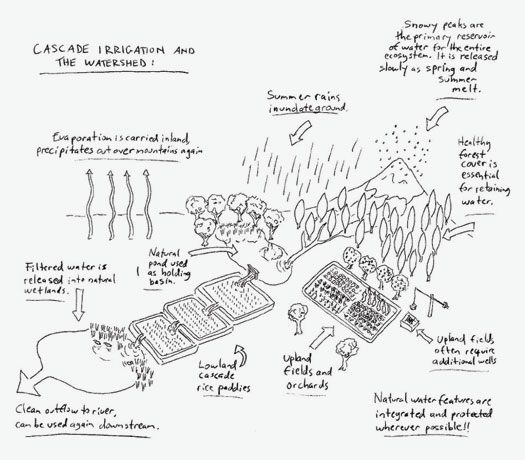
 One of the most important lessons is that the primary design response to material and energy shortages of the era was to seek multiform solutions, designs that solved many problems at once. ... the same attitude led to the development of rice paddy irrigation systems, which were almost entirely gravity-fed, acted as cascading filters for the water supply, and could function as solar-heated warm-water tanks for processing hemp and other plant-based textile fibers. The system allowed the paddies themselves to function as wetland habitat for many species in addition to growing food.

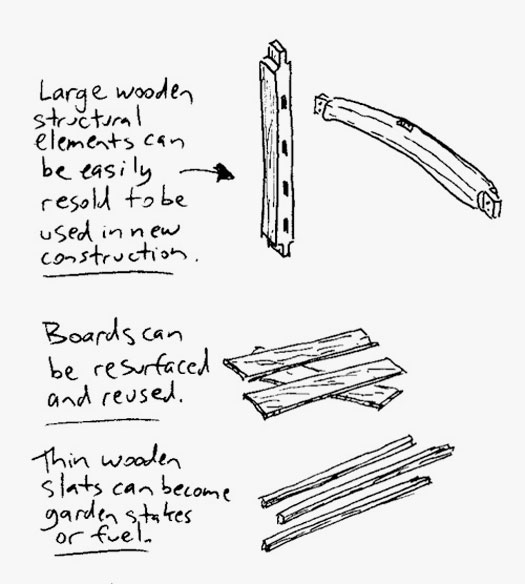
The design of the ubiquitous dismantleable Japanese jointed wooden building frame facilitated reusing the posts and beams elsewhere, helping to reduce the stress on forests for lumber supplies.

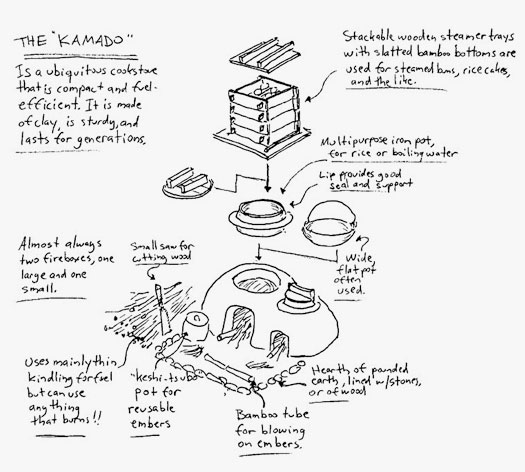
The constantly refined design of earthen cookstoves minimized fuel use and helped keep fuel consumption well within the available supply, further minimizing the stress on forests.

Forest management was recognized early on as essential for preserving the health of waterways that were vital for transportation and as a food source

 Metal, mainly iron, whose production depended upon a high expenditure of energy in the form of large quantities of charcoal, was an extremely valuable commodity.... The near total absence of metal nails in architectural structures, depending instead on mortises, tenons, pegs and wedges, and the fact that nails were carefully salvaged and reused whenever possible, attests as much to the desire to minimize energy consumption in the form of embodied energy as it does anything else.
 Can this be done without consuming fuel (like weaving)? Can it be made from a rapidly renewed material (bamboo for baskets, or reeds for thatch)? Can it take advantage of recycled material (a broken iron pot becomes a blade)? Is it scalable and able to be customized to suit specific regions, households or individuals (like kimono)? What is the desired degree of durability — is it better to make it last for generations (like cabinetry) or remade every year (like straw boots)? Is there a way to use the material at end-of-life (use the straw as fuel, convert worn cotton fabric to pouches)?
...by and large the intricately interconnected sustainable material production system broke down with the advent of the industrial revolution in Japan in the late 19th century. The widespread introduction of fossil fuels, coal primarily, broke the bond between people and the forests that had supported them..."

Wednesday, April 7, 2010

A Model of Sustainable Management : People

There are a few books and authors whose messages have resonated with me lately. I haven't stopped to consider what they have in common with each other or with my own interests until recently.
The books / authors are:
I've put together a picture of the key messages I took from each and how I see them as relating to each other.

Prof Griffith has a very useful model (TOP Management) for thinking about how business problems are solved most effectively by considering them in the context of Technological capabilities, Organizational structures and limitations and People's capabilities and motivations. I have used this as the overlay for my model.

Dan Pink has convincingly described how intrinsic motivation is key to increased productivity in the new work world. Central to fostering intrinsic motivation (Type I work) are mastery seeking behaviors, personally meaningful purpose and autonomy of task, time and team.

Seth Godin takes a slightly different approach to looking at motivation and the new world of work through the concept of the "linchpin." This is a person who, through mastery of subject (his "superpower"), through his ability to define his own roadmap regardless of outside pressures to "just do his job" and through his ability to motivate and lead teams towards those ends, becomes essential to the organization.

Peter Senge provides a framework derived from System Dynamics that emphasizes many of the same mastery and purpose aspects as previously mentioned though through a different lens: Personal Mastery (forever accepting that there is more to know), Mental Models (understanding that you have models in your head and that they may be incomplete or wrong) and Shared Vision (ensuring that everyone is basically working towards the same goals). He also emphasizes Dialog (real trading of ideas rather than just defending your own) and Team Learning (practicing for and reflecting on scenarios, not just reacting to them) as important organizational practices.
These disciplines sit on top of the discipline of systems thinking (the 5th discipline). Which Senge elaborates on to define as the analysis of how the parts relate to each other and thereby create the whole; often with unintended, but predictable, side-effects. This provides a nice link back to Prof Griffith's TOP management model which is, essentially, a systems model.