Showing posts with label business. Show all posts

Monday, May 15, 2017

Healthcare Spending in the US - What is the Problem?


thanks to fodey.com for the imageIt's not news that healthcare is expensive. Here is a quick look into what is going on. Why this is going on is a different question that I'll come back to.

I looked through World Bank WDI data (link) to visualize three spending areas that get significant attention: 
- Education expenditures
- Healthcare expenditures 
- Military spending. 

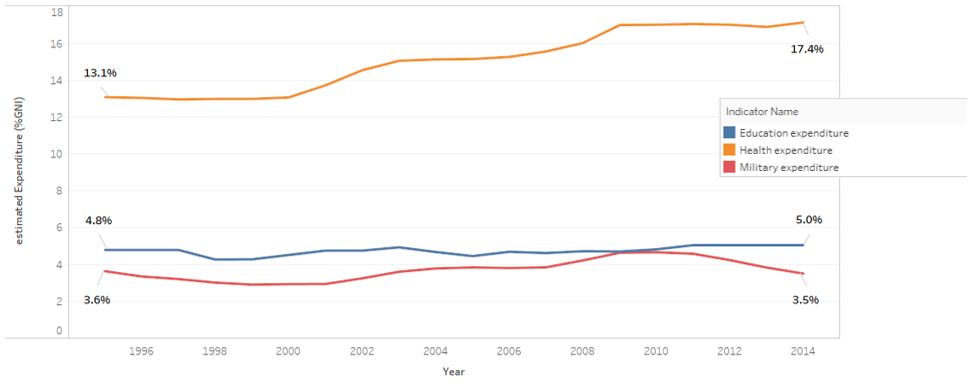
This data is limited to the United States from 1995 - 2014. Figures 1 and 2 below show the results.

Education and military spending, as a percentage of gross national product (GNI), has remained flat for the last 20 years. Education has remained around 5% and military spending has remaining around 3.5% (with a temporary jump in 2009 to almost 5%).

However, healthcare spending has risen as a percentage of GNI over this same time by 4% (from around 13% to over 17%).
Fig 1 - Expenditures as % of GNI (note: for the US, GNI and GDP are very close so I have used the two interchangeably)

When converted to dollars, the increase can be seen more clearly.
  • Education increases from ~$364 billion to $904 billion
  • Military increases from ~$271 billion to ~$627 billion
  • Healthcare increases from ~$995 billion to over $3 trillion
Fig 2- Expenditures in US$

The Centers for Medicare and Medicaid Services maintains a breakdown of healthcare spending (link). The summary of spending (PDF) shows that over 50% goes towards hospital and physician services.
Fig 3 - Breakdown of healthcare spending in the US in 2015
The CMS summary report states that:
  • Hospital care spending increased by 5.6% in 2015 while prices only increased 0.9%. This means hospital spending was driven by increased usage and intensity of services.
  • Physician services increased by 6.3% in 2015 while prices declined by 1.1%. This means that physician spending was driven by increased demand.
Taken together this suggests that most of the expenditures are occurring in areas that are being driven up by people needing more or more intensive (and expensive) care. 
The interesting next question is: what is driving that increased need or intensity of care and how can those root causes be addressed?


Bonus stuff: A Tableau Public visualization of this data (here).


Sunday, May 22, 2016

Why we Can't Kill Email - The Essence of Knowledge Work

Knowledge vs manufacturing workflowI was thinking about Getting Things Done by David Allen and a course I had taken about Outlook best practices. The main idea behind both is this - Get it out of your brain by applying "The 4 Ds:"

  1. Do it now (in less than 2 minutes)
  2. Delegate it to someone else
  3. Defer it (to a date)
  4. Delete it
I have been tweaking how I implement this process over the years and have settled on a process which works for me:
  • Use email as a buffer to manage messages. 
    • Information from others usually comes in this way. I'll also email myself things that need to be dealt with as they come up.
  • Deal with the content of the email immediately, delete it or create / edit a task related to the content of the email. 
    • I will usually break down each task into multiple steps required to achieve the desired outcome to the degree possible at the time.
  • Use the task list as a work queue. 
    • I review the list regularly to understand everything that needs to be done and by when. 
    • I amend the details of each task to use as a record of communications and actions.
  • Put working blocks into my calendar based on the tasks.
    • Depending on the task scope and timeline, this means blocking out many chunks across many days. 
    • It ensures that I strike the right balance between standing meetings, appointments and the "real" work... If the balance is off, the calendar will bring that fact forward quickly.
This flow, I realized, is parallel to the flow used to manufacture goods in a factory:
  • Incoming materials are buffered in trucks and at the dock.
  • The materials are queued at the appropriate stations in the factory according to what they are used to  manufacture.
  • Processing is scheduled and performed.
  • The end result is shipped out (or re-queued for a subsequent process).
You don't have a manufacturing line that can't do these things: Buffer, queue, schedule.

Knowledge work is similar: communications are queued into tasks which then must be scheduled and performed.
The problem is that the overhead of working this way is high. It's "easier" to just remember what you heard, what you have to do and then do it.
Up to a point...
When there is too much to do this system breaks.

Email helps because it seamlessly buffers the communications and CAN be used as a task list. Email won't die because a reasonably low friction replacement that does the end-to-end job doesn't exist.
Chat clients don't replace email because email, as it is used at work, isn't about communication. It's about the entire Knowledge workflow.

Make the whole workflow better and you'll kill email (as it is used today).
Though, I suspect, if you make the workflow sufficiently good, you'll find that email is a friend, not an enemy.

Friday, March 8, 2013

Wait... There's a Genie in my Economy!


What do the following have in common?
  • International Paper
  • United Airlines
  • Google
  • Facebook
  • Twitter
  • Amazon EC2
  • Kickstarter
  • 3D Printing
  • Genies
Friction.

More specifically, they each help to reduce the friction between all of the things that must be in place to get something that you want.
  • International Paper - What does it take to get the paper in your printer? 
    • Rights to log trees. The labor to log them. The tools to cut down a tree. The knowledge to use those tools. The transports to move the trees. The machines to pulp the tree. The labor and knowledge to use the pulping equipment. The chemicals to process the pulp into paper... you get the idea...
  • United Airlines - What does it take to move yourself to Japan?
    • The money to buy an airplane. The knowledge to fly it. The contacts required and hours spent to negotiate the rights to take off from SFO and land at NRT. The labor and knowledge to service the aircraft... etc...
  • Google - What does it take to find out about everything on the internet?
    • The knowledge to create an algorithm that is helpful at finding what you want amid tons of stuff you don't. The programming skills to implement it. The knowledge to build the IT infrastructure to process and store all of the data required to run the algorithm. The servers and real-estate required to hold the servers... how easy would those be to get on your own?
  • Facebook - What does it take to find all of your long lost high school friends?
    • The hours and hours of phone calls to numbers in your old day runner (they still make these?) hoping that their parents still remember you and still live there. Or trawling through phone directories looking for the right Joe Smith... ugh...
    • OR build your own content site which will attract half of the planet AND get them to list their high school... pretty simple...
The remaining companies or topics flip the equation a bit as they are more general tools for reducing friction towards the end of doing something else.
  • Twitter - How could I publish my thoughts to "everyone" at a reasonable cost?
    • I could never mail a letter, call by phone or place enough radio and TV ads to do this. What would it cost to generate the lead list and qualify the leads to do this in a more focused way?
  • Amazon EC2 - How do I start a s/w business that scales without major capital outlays?
    • How else can I get enough computers to scale my SaaS business to profitability without the friction of convincing someone to front a significant amount of money to purchase and administer a server farm?
  • Kickstarter - How do I find funding to raise capital to do something people want to see done?
    • Am I lucky enough to be born rich? Did I get lucky enough to know powerful, rich people? Am I a good enough social engineer to find these people? Do know the right VCs? Is my product profitable enough to a VC for them to consider? What would it cost to build the audience of millions who are engaged enough to put money on the table - sight unseen?
  • 3D Printing - How do I make a complicated, custom physical part in low volume (qty 1)?
    • The money and space to buy a CNC machine plus the experience and knowledge to operate it? Or the hours spent to find a machine shop that will do a low volume run, now, for a reasonable price?
  • Genies - How do I do anything with anyone, anywhere at any time?
    • You have 3 wishes...
The interesting thing about removing the friction around doing "something else" is that it enables new ways for people to do things for themselves and, ultimately, find others who might want those things. Which they then might trade something for (like money). Which sounds sort of like an economy.
Take that to its logical conclusion where friction is, genie-like, reduced to near zero between all people and the resources / skills they hold and what is the purpose of a corporation as we know it today? We could do anything for ourselves by finding and coordinating the right people.

Maybe this does not happen in my lifetime, but the idea of friction seems like a powerful filter for looking at the value of any product or service that you are trying to create today. If it is not reducing friction then you're heading the wrong way.

-----------------------------------------------------------------------------------------------------

Thanks to Gabe Newell for throwing the lightning bolt which fused the 10,000 threads in my brain into a coherent idea.

Take a look at this talk if you have an hour to spare.
Why is Valve structured as it is?
What is the purpose of a corporation in recent history and today?

Good stuff. 


Saturday, July 7, 2012

The Essence of Vision

One of the best summaries I have seen of what implementing one's vision means.

  • Experience many things in order to distill your vision
  • Make it your mission
  • Reduce it to a question
  • Apply the question relentlessly to your actions.


Quote extracted from the talk at this link.

Bret Victor - Inventing on Principle from CUSEC on Vimeo.

Thursday, May 10, 2012

Google Marketing - A Short Analysis

This is what happens when you dedicate a few hours to intensively trying to answer a single question about a single company (in a slightly modified version to remove work related info).

Thanks to Kwok Ng for his help on this.


 By the way... Does anyone know a GOOD way to get PPT slides onto the web with no conversion artifacts? Neither SlideShare nor Google Docs did it for me.

Saturday, February 4, 2012

Cloud Computing, Virtualization, IaaS, PaaS and SaaS - Part 2

In part one of this post, I looked in to the question of why cloud computing is important. In this post, I will look into the question of what cloud computing is.

NIST's definition of cloud computing gives a useful model for deciding what is and is not a cloud deployment:
 "cloud computing is a model for enabling ubiquitous, convenient, on-demand network access to a shared pool of configurable computing resources (e.g., networks, servers, storage, applications and services) that can be rapidly provisioned and released with minimal management effort or service provider interaction."

But to understand what "the cloud" is really made up of, it helps to look at how cloud computing is packaged and sold.

  • Infrastructure as a Service (IaaS)
  • Platform as a Service (PaaS)
  • Software as a Service (SaaS)

Infrastructure as a Service (Iaas)
In this cloud offering, the seller provisions virtualized compute, network and storage upon which the buyer installs his own operating system and software. This is most easily thought of as buying bare computers and storage onto which your own IT dept will put everything required for your specific uses.
A few major vendors who offer these products are: Amazon Web Services, RackSpace and AT&T Synaptic Hosting.

Virtualization software is key to making IaaS feasible. Without virtualization, physical hardware would need to be provisioned for each customer. This would make it prohibitively expensive to quickly provision, re-provision and scale resources to meet customer needs.
The major virtualization s/w vendors include VMWare (ESX), Microsoft (HyperV) and an open source virtualization solution Xen.

More on virtualization in another post.

Platform as a Service (Paas)
In the platform level cloud offering, the seller provisions some combination of operating system, middleware and runtime packages which enable the buyer to develop and run applications of their choosing. This can be thought of as buying access to services which enable programs to easily access the resources they need to run.
Vendors provide a variety of offerings in this space. A few major offerings are below:

  • Google App Engine provides a number of runtime environments for web application developers.
  • Amazon Simple Storage Service (S3) provides file based storage to any application which needs it while Amazon Elastic Block Store (EBS) provides block level storage for applications the need direct storage access (like DBs).
  • Microsoft Azure provides access to a few runtime envrionments,  SQL DB services for applications which need DB services and the virtual network fabric required to link together multiple server's services.
Software as a Service (Saas)
In this level of cloud offering, the seller provides the buyer with access to end applications while hiding the infrastructure, middleware and runtime components. Pretty much every time you hear about a "web application" being offered by a company, you are seeing a SaaS product.
There are probably thousands of SaaS offerings available so covering any significant fraction of the space here is futile. But here are a few examples of SaaS offerings:
  • Web email - from google, Yahoo, etc
  • Office 365 and Google Apps - On line productivity apps for creating, accessing and collaborating with others on a variety of document types (word processing, presentations, spreadsheets, picture editing, etc).
  • Sustainable Supply Chain (SSC) - Supply chain survey management for corporate social responsibility reporting from CSRware.
  • Facebook and Google + - public social networking tools for keeping tabs on your friends around the world.
  • Socialcast, Clearvale , Jive and Spigit -  Enterprise social networking tools for keeping abreast of news and status, smoothing workflow, fostering collaboration and spurring idea generation in a corporate context.
One additional consideration is which user base a cloud deployment is intended to serve. This leads to the ideas of: Private, Public and Hybrid Clouds

  • Private cloud = services and (often hardware) are strictly for a single company's use. Frequently this implies that the company consuming the services will deploy the cloud services on hardware behind their corporate firewall.
  • Public cloud = services are available for all users anywhere. Though users may need to pay for services... This is the context in which most people experience the cloud because of the heavy reliance start-ups offering SaaS products have on public cloud services.
  • Hybrid cloud = multiple cloud systems connected in such a way as to allow programs and data to be easily moved between private to public clouds.

Tuesday, January 31, 2012

Cloud Computing, Virtualization, IaaS, PaaS and SaaS - Part 1

What is cloud computing and why is it important?

On the question of importance, cloud computing addresses several business problems.

Perhaps the most mundane problem that cloud computing addresses is one of cost for getting applications up and keeping them running.

  • Availability 
    • Because of the underlying technology used in cloud computing (Virtualization - more on this next post.) it becomes relatively easy to implement failover and high availability for servers. This makes the customer experience better (fewer interruptions) and allows more routes to addressing business critical applications (lowers barrier to entry on some enterprise applications).
  • Application deployment & maintenance 
    • Depending on the level of the cloud you engage at (Infrastructure, Platform or Software - more on this next post), the level of IT expertise required to use the applications / services you want can be greatly reduced. Software patching, upgrades, hardware provisioning and maintenance is left to the cloud providers who have this expertise on staff.
These "mundane" aspects of cloud computing enable significantly less mundane capabilities. The most immediate of which are the new business models that become feasible.
  • Software start ups galore
    • Because compute power can be purchased on-demand and in relatively small units, capital costs for starting a software company are significantly reduced. This enables more players to try more things in search of the next big thing.
  • F2P (Free to Play), Freemiums and ad-driven businesses
    • Because the marginal cost of adding users to a centralized s/w application can be nearly zero when deployed in a dynamically scalable infrastructure such as the cloud provides, companies can explore business models that "give away" software, or more precisely: give away access to software, while closely tracking and tailoring the user experience more easily. This leads to businesses that thrive on micro transactions within the software or on ad revenue instead of from sales of the software itself.
  • On-line special events
    • Relatively low cost and rapid provisioning of compute, network and storage resources allows for companies to generate increased community engagement or media attention by using this burst capacity to host periodic special events. For a small fraction of the cost of buying and setting up the h/w and software required to gain this capacity, the same buzz generating potential can be realized.
  • Mobile
    • By using the relatively limited compute power of networked mobile devices to drive the user interface and pushing the computationally intensive tasks to servers in the cloud, the capabilities of mobile devices become nearly unlimited. This creates a new class of applications (e.g. voice recognition, navigation, etc) for entrepreneurs to explore and market, driving sales of mobile computing hardware (e.g. smart phones and tablets) or of the applications (as apps or as services) themselves.
  • Distributed work force, virtual desktops and collaboration
    • Because public cloud resources can be accessed from any internet connected device and data storage is easily centralized, the cloud makes it more feasible than ever to provision specialized applications to anyone, anywhere, to keep company data centralized and provide tools by which physically separated groups can easily interact and exchange information in real time in order to improve productivity.
As Corporate Social Responsibility (CSR) and sustainability concerns increase, the "green" aspects of cloud computing also become more important.

  • Economies of scale in "green" data centers may mean that renting capacity via "the cloud" is greener than you can afford on your own.  
    • Making an efficient data center requires high up front capital and expertise costs. Considerations like the ones below are more affordable by large businesses or by dedicated cloud hosting companies where the risk associated with the capital costs are more acceptable for the long term return.
      • efficient server h/w
      • low energy and passive cooling strategies
      • occupancy based lighting, energy efficient lighting fixtures and daylighting strategies
      • green power purchase agreements
      • on-site generation via renewables (e.g. co-gen, bio-fuel based fuel cells, PV, Solar thermal, etc.)

Next time some details about the the "what" part of the question.

Tuesday, January 3, 2012

B-Corporations are Real in California

It looks like the legislation making B-Corporations legal in California has passed and one big name corporation has signed up.

Read this previous post for more thoughts on what this means.

It's a good step towards making it legal, by changing the focus on shareholder primacy, for a public corporation to even consider doing what you or I would see as mandatory in our dealings with other people and with our communities.

Monday, February 14, 2011

Flexible Purpose Corporations - California making it legal for corporations to "care" about something other than money

In a previous post, I wrote about shareholder primacy (the law governing corporations actually requires the CEO to pursue shareholder profit even at the expense of other corporate goals or values) and how that makes it very difficult for a corporation to pursue goals that are not directly tied to increasing bottom line profits.

According to this Green Biz blog, California is getting ready to pass a law (2011 SB201) which makes it legal for corporations established in California "...to include a social and environmental mission that is given equal weight, perhaps even greater weight, than profits..." It protects CEOs and boards of directors in pursuit of such goals and it provides shareholder mechanisms to enforce the pursuit of the same.

That's an improvement.
If you can get companies to stop incorporating in Delaware.
By which I mean that "traditional" motives, training and culture need to change in addition to the law. Profit is so deeply rooted in American culture and history that it is difficult to even see how enthralled by the old ideas we are.

Sunday, April 25, 2010

Two Paths of Full Cost Accounting

If market based capitalism is to "succeed" in-so-far as it makes the world a more livable place for ourselves and other species (i.e. it is sustainable), then something like full cost accounting seems to be necessary. Capitalism is powerful at driving the "right" behavior given the right accounting / incentives.

There seem to be two ways of coming to this conclusion:

1) Pure pragmatism
As outlined in this Wired article "Betting on Climate Change" forward looking companies will make plans for dealing with climate change and the results of other externalized costs because, eventually, those things come back to become real costs (outlays). It doesn't matter why climate change occurred, responsible contingency planning requires dealing with it. If that means incurring costs now to avoid much larger costs later, so be it. That's good ROI.

2) Inspiration & appeal to our "better" nature
As put forward by Robert Kennedy at a speech in 1968 about Gross National Product:
"Too much and too long, we seem to have surrendered community excellence and community values in the mere accumulation of material things. Our gross national product ... if we should judge America by that - counts air pollution and cigarette advertising, and ambulances to clear our highways of carnage. It counts special locks for our doors and the jails for those who break them. It counts the destruction of our redwoods and the loss of our natural wonder in chaotic sprawl. It counts napalm and the cost of a nuclear warhead, and armored cars for police who fight riots in our streets. It counts Whitman's rifle and Speck's knife, and the television programs which glorify violence in order to sell toys to our children.

"Yet the gross national product does not allow for the health of our children, the quality of their education, or the joy of their play. It does not include the beauty of our poetry or the strength of our marriages; the intelligence of our public debate or the integrity of our public officials. It measures neither our wit nor our courage; neither our wisdom nor our learning; neither our compassion nor our devotion to our country; it measures everything, in short, except that which makes life worthwhile. And it tells us everything about America except why we are proud that we are Americans.
"


It certainly makes me feel a bit prouder to be a member of the society that came up with the later reason for doing the "right" thing than it does to only be able to claim the former.

Thursday, April 22, 2010

What (Other) Kind of Business Could I Build Around Energy Dashboards?

In my last post, I came up with a bad model for an energy dashboard business based on annuities paid by the utilities companies for energy saved. However, there did seem to be a bright spot for selling the dashboards to the utilities to install themselves. Looking at that a little more closely...

According to the US Energy Information Administration, CA electric utilities generated ~11.1M metric tons of CO2 in 2008. The three year average (2006-2008) was ~10.2M metric tons.
Using the same number of customers in CA and 10% savings factor as assumed before, implementing energy dashboards would save ~ 1.1M tons of CO2. Spread across the ~12.9M customers in CA at the current price for carbon (~$19/ton CO2e), that is about $1.68/customer.

If you add that to the ~$35.6/customer savings in direct generation costs, that is ~$37/customer*yr.
So if a utility is willing to accept a 3 year pay back period, then each installation could cost up to ~$111, for a TAM of around $1.4B for serving all of CA.
Not too bad as long as you have an alternative revenue stream planned for after the initial sale (e.g. s/w license fees for maintaining the dashboard customer feedback, data aggregation, reporting, etc).

The utilities' ROI increases the more effective the actual energy savings and the less expensive the installation. So to compete here you'd need to prove that your system will create and maintain better energy reduction outcomes per $ of installed equipment. If you could do it all in s/w leveraging customer's existing h/w or without any installed h/w, that would be the best.

Tuesday, April 20, 2010

What Kind of Business Could I Build Around Energy Dashboards?

In a previous post, I wrote a bit about why so many smart grid cleantech companies were focusing their efforts on utilities instead of consumers: the power of big numbers leverages small efficiencies into large $ amounts.

With that knowledge, what kind of business could I build around selling energy dashboards to the utilities?

A few assumptions, some of which are probably pretty optimistic just to simplify things without really changing the conclusion (I hope):
  • I want to run a business based on annuities (utilities pay me a "subscription") rather than hardware and s/w services (utilities buy my h/w and s/w directly).
  • I manage to get 100% of electric utilities in CA to put my product in 100% of customers' buildings [~12.9M customers]
  • The utilities agree to pay me 50% of the saved costs of generation [~$17.82/customer*yr]
  • A customer dashboard costs my business $35 installed.
  • I take out 15% profit and have 10% overhead costs to run finance, HR, facilities, etc. 
  • 35% of my workforce is engineering or other functions not directly customer facing / supporting.
  • It costs $200k/yr to hire, compensate and retain each employee on average.
 Two key numbers come out of this:
  • $453M - The cost to install the equipment at all the customers' locations. That's serious start up capital or a very slow ramp of the business. Starting isn't going to be easy.
  • 23,000 - The number of customers per non-engineering employee that would have to be supported assuming I could start the company, pay off my debt and get to a steady state. If I'm paid actual savings, that means I need to get all the customers to actively use their dashboards and change behavior. The challenge of getting a diverse population (the state of CA) to sustainably change behavior over time with such a ratio is staggering.
As of that weren't enough, it would make sense for the power utility to shift their baseline over time rather than pay me for the same level of performance forever as it would be cheaper to address the problem themselves. This means that I'd not only have to get people to achieve good energy savings (target 10% on average - per the previous post), I'd have to increase this over time to avoid going out of business or avoid drastically shrinking the business.

I think I can throw this business plan out as a case where annuities are a bad business model.

However, that $453M number does suggest that selling h/w and analysis / customer feedback infrastructure to the utilities might be a better way to go. Maybe I could even write a game to make engagement fun.

Photo credit: Leften on Flickr ... not a picture of CA ...

Wednesday, April 7, 2010

A Model of Sustainable Management : People

There are a few books and authors whose messages have resonated with me lately. I haven't stopped to consider what they have in common with each other or with my own interests until recently.
The books / authors are:
I've put together a picture of the key messages I took from each and how I see them as relating to each other.

Prof Griffith has a very useful model (TOP Management) for thinking about how business problems are solved most effectively by considering them in the context of Technological capabilities, Organizational structures and limitations and People's capabilities and motivations. I have used this as the overlay for my model.

Dan Pink has convincingly described how intrinsic motivation is key to increased productivity in the new work world. Central to fostering intrinsic motivation (Type I work) are mastery seeking behaviors, personally meaningful purpose and autonomy of task, time and team.

Seth Godin takes a slightly different approach to looking at motivation and the new world of work through the concept of the "linchpin." This is a person who, through mastery of subject (his "superpower"), through his ability to define his own roadmap regardless of outside pressures to "just do his job" and through his ability to motivate and lead teams towards those ends, becomes essential to the organization.

Peter Senge provides a framework derived from System Dynamics that emphasizes many of the same mastery and purpose aspects as previously mentioned though through a different lens: Personal Mastery (forever accepting that there is more to know), Mental Models (understanding that you have models in your head and that they may be incomplete or wrong) and Shared Vision (ensuring that everyone is basically working towards the same goals). He also emphasizes Dialog (real trading of ideas rather than just defending your own) and Team Learning (practicing for and reflecting on scenarios, not just reacting to them) as important organizational practices.
These disciplines sit on top of the discipline of systems thinking (the 5th discipline). Which Senge elaborates on to define as the analysis of how the parts relate to each other and thereby create the whole; often with unintended, but predictable, side-effects. This provides a nice link back to Prof Griffith's TOP management model which is, essentially, a systems model.

Sunday, April 4, 2010

Sustainable business and the IPO

Once public, a corporation is subject to share holder primacy. This can lead the corporation to do things which may not be in the company's, employees' or planet's best interests.

So if you wanted to be free of share holder primacy concerns and take the company private again what might that mean?

Barring the cases where the company fails and share prices drop resulting in a different set of stakeholders coming in and taking over (private equity takeover), let's assume this means buying back all of your shares on the open market.

Assuming that you used your IPO cash to grow the company (i.e. the cash is gone), you would have to do this through cash on hand and net cash flow. Is this reasonable to do?

An immediate problem that looms is that the higher the earnings, the higher the stock price. So the way you get more cash, makes the company more expensive. Let's pretend that you could freeze a company's stock price and income so that cash flow and stock price stay more or less fixed. Could you buy your company back even then?

Taking Google, a wildly successful company with huge net cash flow, as an example:
As of April 2010, they have a market cap of ~$181B with ~$24.5B in cash and net cash of ~$2.2B/yr (averaged over the last three years).
This means it would take >70 years to buy out their capitalization even if it could be frozen.
That doesn't sound very feasible.

So, while this is vastly oversimplified, it does suggest that going private for a successful company is no small matter. If sustainability is a key concern, going public seems to be potentially difficult act to "recover" from due to the high cost of shaking loose the shareholder primacy yoke.

I need to read Rework and see what 37Signals has to say about staying private.

Photo credit: wallyg (flickr)

Wednesday, March 24, 2010

Mo' money, Mo' Money. Mo' Money.

A difficulty of the triple bottom line is the entrenched position that only profit matters. So justifying sustainability expenditures must occur in the context of return on investment (ROI). Redrawing the sustainability system diagram in terms of the profit aspect shows that not much actually changes:


Most of the considerations and feedback loops are still included because they all affect profitability in one way or another. However, since the focus is now on ROI, the message changes slightly to focus on comparing what each aspect costs vs what it brings. At a high level:

Contingency expenses vs Materials Cost
  • Does it add more in materials or procurement costs than it saves in insurance, continuity plans, taxes / cap & trade costs, relocation costs and opportunity costs (business disruptions)? 
  • Admittedly, the impact of one company on the overall environment is probably small which is why pricing the externalities helps (e.g. carbon pricing) as it focuses everyone on those externalized costs in a consistent, material way.
Utilities Costs vs Building Cost
Productivity Gains & Decreased Training Costs vs Building Costs
  • Does it cost more to add indoor environmental quality improvements (e.g. daylighting, thermal controls, exterior views, higher ventilation rates) than you gain through improved worker productivity and retention?
  • It helps to consider that payroll costs are generally a much larger fraction of business costs than facilities + real estate costs. So if you can spend 7% in building cost to improve productivity of payroll by 2%, you will still come out very much ahead. Something like:
    • For 1000 employees @ 250 sq. ft /ea in office space built in San Francisco is ~ $50M. Amortize over 30 years = $1.6M/yr. A 7% increase is ~$117k/yr.
    • For the same 1000 employees @ $150k/yr in payroll costs = $150M/yr. If you can improve productivity by 2%, that is ~$3M/yr.
    • ROI ~ 24.
So Mo'Money, Mo'Money, Mo'Money and sustainability really do get along.

Monday, March 22, 2010

Product positioning if you made a cleantech widget

In the last post, I used a system diagram to look at a picture of sustainability leverage points from the perspective of the owner. That can be turned around and used to look at the picture from the perspective of a cleantech vendor. Let's say someone like Redwood Systems who makes an LED lighting + sensor system that allows feedback to a building automation system.


Key messages can be tailored to the exact circumstances and interests of the building owner but two main themes seem to stand out around energy usage and environmental quality.

Reduced energy usage:
  • drives down operating costs 
    • Direct savings from the lower energy consumption of the lighting fixtures.
    • Indirect savings from the improved efficiency with which the fixtures, HVAC and process equipment can be operated based on feedback that the fine grained sensor network provides.
  • helps the planet and, thereby, your operating risks / costs
    • Reduced energy usage lowers the company's carbon footprint, reducing its impact on the environment.
    • A reduced carbon footprint, in addition to helping reduce the potential business continuity costs and impacts of climate change, also helps reduce potential liability for carbon tax or cap & trade costs.
Better control of environmental quality:
  • improves productivity and profits
    • Fine grained feedback control over the workspace allows for a more pleasant and, therefore, productive workplace. Even small increases in productivity provide large leverage when weighed against total payroll costs, especially for highly paid, specialized workers.
  • improves worker retention
    •  Deployed as part of a larger program for improved retention, having a comfortable workspace with a customizable, controllable environment decreases costs of turnover both in lost productivity and in direct training.

Saturday, March 20, 2010

A Big Picture of Sustainability

Where are some key leverage points in cleantech, green building and sustainable business?

This is a swag at the system, which captures, I think, some interesting connections and highlights some key leverage points.
Sustainability Systems Diagram

 Before your head explodes, the theory behind it:
  • A building owner's success is defined as a function of the triple bottom line (Planet, People, Profit).
  • There are a lot of factors behind each part of the bottom line and some of those factors affect multiple bottom lines.
  • Most factors are affected by several other factors. A few factors are "decisions." They gain their value because the owner decides to do them, not as the consequence of some other factor. These are marked in RED in the diagram.
In this post, I want to focus on the last point as I think these are key leverage points for sustainability.

Sustainable Sourcing and Sustainable Material
What materials you choose and where you get them from affects all three bottom lines:
  • Planet : unsustainable harvest of materials destroys habitats, kills species (which can further degrade habitats) and depletes resources.
  • Profit : resource depletion ultimately raises the cost of procuring materials. Habitat destruction increases the allocations you should make to account for and insurance costs you will likely bear due to losses associated with it (e.g. increased flooding, loss of location due to sea level rise or desertification, etc.)
  • People : habitat destruction ultimately limits the locations where you can run your business and that has a big impact on how your company runs (see below).
Feedback Control
How you manage your resource usage affects all three bottom lines:
  • Profit : Controlling usage to increase efficiency costs a little more to implement but can ultimately save significantly on direct operating expenses as well as on carbon costs (assuming a carbon tax or cap & trade are enacted). Good control of the indoor environmental quality also has positive impacts on worker productivity, increasing profits.
  • Planet : Increased efficiency of resource usage, especially for water or energy sources (coal, oil or land set aside for biofuel growth) helps offset resource depletion which, in turn, helps preserve habitats and species.
  • People : Good indoor environmental quality also increases retention, which reduces training costs and opportunity costs associated with head count gaps, thereby increasing profit.
Location
Where you locate your operations affects all three bottom lines:
  • People : Location has a large impact on lifestyle. Educational, entertainment, cultural options all depend highly on where you live and that depends, most of the time, on where you work. "Better" options lead to higher retention and ultimately lower costs. If a location is too expensive, dangerous or otherwise undesirable to live near, then commute times increase, negatively affecting work life balance, hurting retention.
  • Profit : More "desirable" locations tend to attract more educated, higher skilled workers. While hiring these people may cost more money, their productivity and quality of work increase profits (See this post for more thoughts on that idea). More "desirable" locations also tend to cost more money to locate in, increasing expenses which decrease profit, therefore requiring a careful consideration of worker quality available vs real estate costs (or requiring an alternative method of working).
  • Planet : Locating to environmentally sensitive or pristine locations can result in habitat destruction which cascades into species loss and resource loss.
This is only scratching the surface of the connections captured in this diagram. I expect to come back and explore this some more.

Tuesday, March 9, 2010

To be a good member of society, you must first break the law.

NPR had an interesting story this morning about some of the challenges facing "socially responsible" companies. Top among them being "shareholder primacy." That is, the law governing corporations actually requires the CEO to pursue shareholder profit even at the expense of other corporate goals or values.

In short: the law does not recognize two of the three pillars of the triple bottom line: People, Planet, Profit.

Joel Bakan wrote a book touching on this topic: The Corporation: The Pathological Pursuit of Profit and Power.
Two relevant takeaways being:
  • The current definition of cost in the profit = income - cost equation encourages externalization of as many costs as possible. The costs don't go away, they are just borne by someone else. In effect, you could say, the corporation is stealing from the parties who end up paying the cost.
  • The corporate structure encourages this behavior but the structure was put in place by people. Therefore people can change it... though it won't be easy.
There is also an organization trying to change this: B-Corporation.net
They have put together a legal and support framework to put the other pillars back into the articles of incorporation and thereby allow officers to address all stakeholders', not just shareholders', interests.
In their own words:

Objective: 

Expand the responsibilities of the corporation to include the interests of employees, consumers, the community, and the environment.

A. Give legal permission and protection to officers and directors to consider all stakeholders, not just shareholders
B. Create additional rights for shareholders to hold directors and officers accountable to consider the interests of employees, consumers, the community, and the environment, while also serving the best interests of shareholders.
C. Limit these expanded rights to shareholders exclusively; non-shareholders are not empowered with a new right of action.
It's a little bit crazy to need the law to be amended to allow a corporation to act like you or I as private citizens are required to act.

An alternative is to go private (or stay private) and remove the legal pressure of shareholder primacy. But I suspect that is another topic altogether. Building a business model around this requires some deep thinking, planning and a different idea of what "exit strategy" means from the outset.

Wednesday, February 17, 2010

Changing behavior is big leverage: electric bill example.

Expanding on the story from Treehugger.

Buried in the bottom of this TED speech is an example of behavioral economics at work and how you can use an inexpensive approach to leverage large changes in consumption.

The bit of interest is at 10:32 - 11:20


According to this, real world testing has shown results of about 2-3% reduction in energy usage.
Using the numbers from USGBC and DOE (per earlier post):
  • a 3% savings in electricity is ~2.1% reduction in total electricity usage which is ~69TWh/yr.
  • Assuming the same 2.5kW per installation, 8hrs/day of peak generation & $21.4k/installation
  • That's $201B to replace with solar PV.
... and changing the information printed on you bill would cost a few hundred $k to a few $M in software, training, admin, development, rollout, etc...
Say $2M.
So an ROI of  > 100,000?

Monday, February 15, 2010

Putting that number in perspective

Recapping...
Saving 10% of energy used in buildings = ~$676B if you tried to replace it with solar PV.

According to the White House Budget Summary for 2010:
  • The US Military Budget is ~$707B. That's about 20% of the entire US budget [or about 41% of entire world spending on military].
  • Corporate income tax revenues are projected to be ~$179B. Only ~26% of what you'd need.
  • The only other two income line items of equivalent magnitude are:
    • Personal income taxes (~$1051B)
    • Social Security payroll taxes (~$683B) 
Looked at another way: If you spent the ENTIRE GDP of the US (~$14Trillion) at trying to replace the entire energy usage of the US (3297TWh) with solar PV, it would take ~7.9 months of spending (65% of GDP).
To put this number in perspective, the US Military Budget is 4.8% of GDP. That's ~17 days of spending.

Not that it's realistic or even correct, but can you imagine the entire US economic output focused on nothing but solar for almost 2/3 of a year?