Showing posts with label solar. Show all posts

Saturday, August 14, 2010

Solar chargers for electric cars?

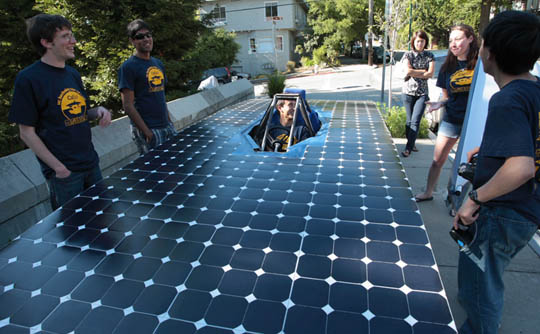
OK. This picture isn't what I'm actually talking about, but it does highlight part of the problem that would need to be solved:

Could you reasonably make a passenger car that charged itself using solar panels?

A few assumptions:
That would result in  ~16MJ of energy per day.
So you could recharge 11% of the battery a day, which would yield a range of ~10.8 miles.

If you assume the average commute is 33 miles each day (16.5 miles each way), that would mean:
  • To allow for a full trip home would take ~12 hrs of recharge time or
  • A panel that could generate ~0.9kW and be ~86 ft^2. That's more than 1.5x the area available on the car roof.
To give a sense of the size of the problem of solar charging exclusively:
  • To fully charge the battery would take ~73 hours or 
  • A panel that could generate 5.2 kW and be ~519 ft^2. That's more than 9x the area available on the car roof.
Most houses that get solar PV only go for 2 - 3 kW.

So self powered cars ALMOST make sense as long as you can recharge them from the grid after you get home. Fully self powered solar cars don't make sense.
It also strongly suggests that solar powered EV recharging stations (e.g. with the panels on a nearby roof or on the parking lot roof) actually make quite a bit sense.

Friday, April 2, 2010

How cigarette smoking could help save the planet... sort of...

Ok... not smoking per-se, but the 12V plug they built into every car to run the cigarette lighter.

Many of the electronic items in the home do not require 110V AC. If it has a big plug adapter or a power brick attached, the item is converting the 110V AC down to some smaller (something around 5 - 12V) DC current. Those conversions are not perfect and energy is lost.

What if you recovered those losses by having a single efficient conversion instead of many less efficient ones (or required that all converters be more efficient)?

Assuming that computer power supplies are representative of overall power supply conversion efficiencies, the average AC/DC converter is about 75% efficient. On the upper end, you can get ~90% efficient converters. So say a 15% difference in conversion efficiency between several average converters and one efficient one.

According to the DOE End Use Consumption of Electricity Survey (2001 - latest data), about 15% of a house hold's electricity usage goes to things that could, plausibly, run on 12V DC power. That was about 173.5 Million MWh of electricity. Improve that by 15% and you save 26 Million MWh of power.
The average output of a coal fired power plant is about 233 MW. So, for simplicity, if you assume 100% duty cycle, that 15% efficiency boost becomes the equivalent of 12.7 coal fired power plants.
While that is maybe not world saving (<1% of the 1445 coal fired plants in operation in 2008), that is ~5.5x the total Solar (thermal + PV) generating capacity in 2008... a bigger impact than solar has gotten us so far.

Where DC wiring, rather than just more efficient converters, might be more important is in Solar PV on homes. In that case, the DC output of the panel is converted to AC before being used in the home. That step has about a 90% efficiency.
However, many appliances then convert the AC right back to DC with all the losses noted above. Even with 90% efficient converters, that's a 19% efficiency loss over using the electricity directly from the panels.
Viewed another way, the AC wiring in your house is raising the price of Solar PV by almost 20%!

photo credit: David Baker (Flickr)

Thursday, February 25, 2010

Can renewable energy be differentiated?

When the solar market was hot I, like probably half the people in the Bay Area, was thinking about a career in solar. I thought about this a bit and concluded that this would be the wrong place for me because I could not figure out how it could be differentiated enough to yield an interesting marketing job.


Can renewables be differentiated?
Renewables, at the end of the day, are just another source of power. Power is a commodity.
Can a commodity be differentiated?
Or is it solely about $ / unit?

If you put it against grid connected power, then it is about $/kWh. It's a race to the bottom.
It's about being the cheapest because all the power is interchangeable.

If you put it against something else, then you have a niche and can be differentiated some other way.
For example: off grid development.
Are you the most rugged? Portable? Reliable? Efficient (kW/m2)? Flexible? Available in all weather conditions? Backup-solution-ready? Affordable (if you're off grid b/c no one can afford to build a grid)? Difficult to steal? Easy to install and maintain?

Or the "save the planet" green niche.
It's really important, but still a niche today.

Are these niches big enough to support a business in the US?
I think many people are counting on it getting really big... though there is a question of how realistic that is because of the scale of the problem...


If you don't want the niches, can you create differentiation where it doesn't exist with renewables and ride that to financial success?
Ok. Maybe this is more interesting than I originally gave credit for.

Monday, February 15, 2010

Putting that number in perspective

Recapping...
Saving 10% of energy used in buildings = ~$676B if you tried to replace it with solar PV.

According to the White House Budget Summary for 2010:
  • The US Military Budget is ~$707B. That's about 20% of the entire US budget [or about 41% of entire world spending on military].
  • Corporate income tax revenues are projected to be ~$179B. Only ~26% of what you'd need.
  • The only other two income line items of equivalent magnitude are:
    • Personal income taxes (~$1051B)
    • Social Security payroll taxes (~$683B) 
Looked at another way: If you spent the ENTIRE GDP of the US (~$14Trillion) at trying to replace the entire energy usage of the US (3297TWh) with solar PV, it would take ~7.9 months of spending (65% of GDP).
To put this number in perspective, the US Military Budget is 4.8% of GDP. That's ~17 days of spending.

Not that it's realistic or even correct, but can you imagine the entire US economic output focused on nothing but solar for almost 2/3 of a year?

Friday, February 12, 2010

How many solar panels would that be?

If I wanted to generate all of that electricity using solar PV panels instead of by saving it through conservation, what would that look like?

If you assume 2.5 kW is the average installation size and you can get 8 hours/day of power at that peak level. To generate 231 TWh of energy would take ~31.6 million buildings.

According to the US Census and Dept of Energy, there are about 124 million residential + commercial buildings in the US. That means you'd need an average installation of solar panels on ~26% of all buildings in the US.
That's 1 in 4.
That's a lot.

If you estimate the average install cost at ~$21.4k (assuming Jan 2010 prices and 50% of total installed cost is the module), then that is ~$676 billion.
That's a lot too.