Showing posts with label car. Show all posts

Saturday, August 14, 2010

Solar chargers for electric cars?

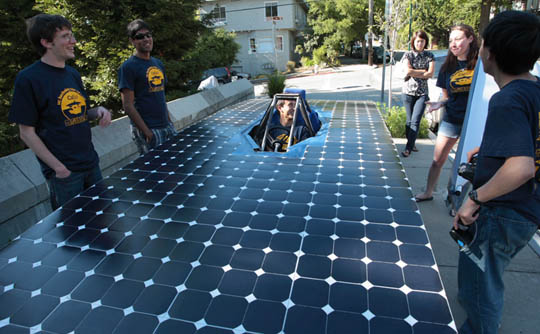
OK. This picture isn't what I'm actually talking about, but it does highlight part of the problem that would need to be solved:

Could you reasonably make a passenger car that charged itself using solar panels?

A few assumptions:
That would result in  ~16MJ of energy per day.
So you could recharge 11% of the battery a day, which would yield a range of ~10.8 miles.

If you assume the average commute is 33 miles each day (16.5 miles each way), that would mean:
  • To allow for a full trip home would take ~12 hrs of recharge time or
  • A panel that could generate ~0.9kW and be ~86 ft^2. That's more than 1.5x the area available on the car roof.
To give a sense of the size of the problem of solar charging exclusively:
  • To fully charge the battery would take ~73 hours or 
  • A panel that could generate 5.2 kW and be ~519 ft^2. That's more than 9x the area available on the car roof.
Most houses that get solar PV only go for 2 - 3 kW.

So self powered cars ALMOST make sense as long as you can recharge them from the grid after you get home. Fully self powered solar cars don't make sense.
It also strongly suggests that solar powered EV recharging stations (e.g. with the panels on a nearby roof or on the parking lot roof) actually make quite a bit sense.

Thursday, August 12, 2010

A better way for electric cars? A Better Place.

What are the two main things you worry about with electric cars?
  1. Price
  2. Range
Gasoline is great because it is a well established, subsidized fuel with very high energy density (1.3x10^8 J//kg). That makes it easy to carry around and get pretty far with. Plus, when you run out, there's always a gas station somewhere nearby. Price and range... not a problem.

Electric cars are limited by their batteries. Li-Ion battery's energy density is nowhere near as high as gasoline (5.2x10^5 - 7.2x10^5 J/kg - gasoline has >180 times more energy per kg of "fuel"). Even accepting that a gasoline engine is 30% efficient vs a 90% efficient electric motor (i.e. total energy that would be converted to work per kg of fuel is 3.9x10^7 J/kg for gasoline vs 6.5x10^5 J/kg for Li-ion), that yields ~60 times more energy per kg of "fuel" from gasoline than from batteries. So to get the same range as a gasoline car (from one tank of fuel), requires either:
  1. A very large battery -or-
    • If a typical car holds 15 gal of gasoline (@ ~2.7kg/gal = 40.5 kg) , a battery that contains the same effective energy would need to weigh ~2430kg ... where a Honda Civic weighs about 1270 kg... not practical to carry or to pay for.
  2. The ability to "refuel" the battery in less time than refueling a car 
    •  Even with the best recharger possible, it takes hours (~4 hrs for a Tesla roadster) vs maybe 5 minutes to refill a gas tank.
    • With a 100 mile range per battery charge, that would require about 4 battery charges per tank of gas (assuming CAFE standard of 27.5 mpg and 15 gal tank = 412 mile range). Sixteen hours (battery) vs 5 minutes (gasoline) (assuming both cars start empty).
 Those are pretty bad starting places to catch up from.

So Shai Agassi has an idea: Treat the electric car like a cell phone.
The customer buys miles and gets a subsidized car. The batteries are the medium for the "minutes." You never own them, you just use them.
Which means you can now swap batteries because you don't care about the specific battery that you have, only that you're getting the mileage you're paying for.
Suddenly the range problem goes away (~1min to change the battery).
Suddenly the price has a means of being subsidized (ala cell phone contracts that keep the price of the phone low for the end user).

Kind of like Blue Rhino propane tanks ... but way cooler.

And he created a company Better Place to do it:
  • Get the cars built
  • Get the battery swap system figured out
  • Get the infrastructure in place
  • Prove to the world that it can work
Check out this video (or the video below) of the system working in Tokyo. It's real.


So, admittedly, it only works where you have the infrastructure, but it certainly gives a new direction for addressing the two big problems of EVs.

Friday, August 6, 2010

Biking to work and energy efficiency

Bike to work and stop global warming.
Bike to work and get healthy.
Ok. Since it's so good for me and my planet and I'm only about 6 miles from work, I finally decided that I should give this a try.

I used a cool iPhone app (Runkeeper) to log how far I went and how fast I went there. As part of the app I got an estimated calorie usage... and that got me thinking about energy efficiency:

So my bicycle commute is more than 18 times more energy efficient than driving.
...And I drive a Prius.
If you use the CAFE Standard fuel efficiency for a passenger car in 2010 (27.5 mpg), then that bicycle commute is more than 28 times more energy efficient than driving.

To be as energy efficient as cycling, the car would need to use 0.01gal of gas for the 6 mile trip, which is 600 mpg! Whereas the current automotive X-Prize is only looking for 100 mpg... 6x short of what is needed.

So we REALLY need to be doing more of what Copenhagen is doing with making cycling mainstream:
"If you make the bicycle the fastest way to get around the city ... you're going to get everyone and their dog to do it."
  • Pervasive use of dedicated bicycle lanes.
  • 37% of all people commuting to work or school use bicycles.
  • 50% of all trips in the city are made by bicycle.
  • Double bike lanes to accommodate bike traffic volume in some places.
  • "Green wave" timed to give cyclists a no-stoplight flow into the center of the city for 6km (3.7mi).
  • Red LED lights on the bicycle lane demarcation that sense coming bicycles and flash to warn cars to avoid right turn conflicts.
  • Dedicated parking spots for cargo bikes (taking away 1 car parking spot for 4 cargo bike spots).


Picture credit: Adam Stein (terapass blog)