I posted earlier about an experiment with virtual daylighting on a small scale using indirect light.
Here is a post about a direct experiment where the designer replicates the sky, clouds and all, using arrays of LEDs.
Probably not an energy efficient use of LEDs but an interesting experiment that requires some thought about the trade-offs between energy efficiency and productivity gains.
Exploring how a little knowledge and a lot of questions lead to something profound... or at least interesting.
Showing posts with label lighting. Show all posts
Tuesday, January 3, 2012
Thursday, November 11, 2010
ESLs - Comparison to other lighting technologies
In a previous post I compared several light sources to understand why a person might choose one over the other.
I bumped into this story on treehugger about Electron Stimulated Luminescence (ESL) bulbs. These lights use an approach like a CRT television to cause a phosphor to light up.
Technical specs for the bulbs are:
If I take "price competitive" to mean 25% less than an equivalent LED bulb, that leads to an expensive bulb... (~$136/klm ESL vs $5/klm CFL).
Plotting that information in the same charts I used earlier gives the following:
The ESL bulb falls into a pretty good space in terms of visual quality. However, its efficacy is quite low compared to the other choices in the space.
Assuming that the FAQ comparison with LED lighting is any indication of how they intend to price the bulbs, then a more serious problem emerges.
The price | performance ratio is quite poor for the ESL. Its lifetime and efficacy values are FAR too low to be priced anything like an LED light. To be competitive, the price would have to be closer to that of a CFL (1/30th the current estimate).
Being Hg free, made from environmental friendly materials, dimmable, providing instant on and lacking heat issues are all very nice but, given it is only about 1/3 as energy efficient as a CFL, a 30x price premium is not warranted ... it would be hard to justify a 2x price premium I suspect.
So unless the pricing comparison with LEDs is highly misleading, ESL is likey to be DOA.
Mass market will buy CFLs because of price | performance.
Specialty applications focused on "green" creds will use LEDs because they are far superior in those aspects.
I bumped into this story on treehugger about Electron Stimulated Luminescence (ESL) bulbs. These lights use an approach like a CRT television to cause a phosphor to light up.
Technical specs for the bulbs are:
- efficacy = 30.7 lm/W
- lifetime = 10,000 hrs
- CRI = 85
- Color Temp = 2700K, 2900K, 4000K
- Fully linear dimming with household dimmers (vs CFLs)
- Mercury-free, environmentally-friendly materials throughout (vs CFLs)
- Mount in any orientation [heat issues] (vs CFLs and probably LEDs)
- Instant on at full brightness (vs CFLs)
- Lasts approximately 3-6 times longer than an ordinary incandescent bulb
If I take "price competitive" to mean 25% less than an equivalent LED bulb, that leads to an expensive bulb... (~$136/klm ESL vs $5/klm CFL).
Plotting that information in the same charts I used earlier gives the following:
The ESL bulb falls into a pretty good space in terms of visual quality. However, its efficacy is quite low compared to the other choices in the space.
Assuming that the FAQ comparison with LED lighting is any indication of how they intend to price the bulbs, then a more serious problem emerges.
The price | performance ratio is quite poor for the ESL. Its lifetime and efficacy values are FAR too low to be priced anything like an LED light. To be competitive, the price would have to be closer to that of a CFL (1/30th the current estimate).
Being Hg free, made from environmental friendly materials, dimmable, providing instant on and lacking heat issues are all very nice but, given it is only about 1/3 as energy efficient as a CFL, a 30x price premium is not warranted ... it would be hard to justify a 2x price premium I suspect.
So unless the pricing comparison with LEDs is highly misleading, ESL is likey to be DOA.
Mass market will buy CFLs because of price | performance.
Specialty applications focused on "green" creds will use LEDs because they are far superior in those aspects.
Friday, June 25, 2010
Lighting Labels coming in 2011
Better information for comparing light bulbs is coming next year.
Read this this earlier post to understand what these terms mean.
- Brightness = Luminous flux
- Brightness / Energy Used = Efficacy
- Light appearance = Color Temperature
Wednesday, June 23, 2010
Comparing Light Sources - LEDs vs Fluorescents vs Metal Halide HID
From the previous post, one could conclude that LEDs, Fluorescents and Metal Halide HIDs were all pretty much the same: High efficacy, OK to good CRI and good color temperatures.
Yet what we see are fluorescent bulbs everywhere.
One way to compare these light sources is by bulb life vs cost per lumen output with efficacy taken into account. That looks like this: "Good" is high and to the left with a larger bubble.
One conclusion that immediately stands out is how expensive LED lights are relative to the alternatives. They may be 2x as efficient and last 5x as long, but they are ~38x - 175x the price. That makes adoption of LEDs very difficult for most applications that don't have some other needs specifically met by LEDs.
Some of those special needs:
So as the cost of LEDs drop (cost comes in line with alternatives), energy costs rise (efficacy difference becomes more important) and green building codes become more prevalent (raising the minimum energy efficiency requirements for new buildings), the ROI of LED lighting will rise vs fluorescents until LED lighting makes economic sense.
It's just not quite there today.
Yet what we see are fluorescent bulbs everywhere.
One way to compare these light sources is by bulb life vs cost per lumen output with efficacy taken into account. That looks like this: "Good" is high and to the left with a larger bubble.
One conclusion that immediately stands out is how expensive LED lights are relative to the alternatives. They may be 2x as efficient and last 5x as long, but they are ~38x - 175x the price. That makes adoption of LEDs very difficult for most applications that don't have some other needs specifically met by LEDs.
Some of those special needs:
- LEED certification
- LED lighting is more efficient so it can be used towards energy efficiency credits (EAc1). If 25% of a commercial building's electricity usage goes towards lighting and you can cut that by 50%, that's a 12.5% reduction in electricity cost.
- LED lighting is more easily controlled (dimmable) to allow for controllability of systems - lighting (EQ6.1).
- Flicker
- For some tasks and working conditions, 60Hz cycling from fluorescents can cause eye strain, especially if it is used with other visual equipment that runs off 60Hz AC. LED lighting has a 120Hz cycling which means it is much more difficult to detect flicker and it is less likely to beat with other equipment running at 60Hz.
- Dimming
- Commercial use fluorescent bulbs (T8, T10 and T12) are not easily dimmable due to the construction of the ballast that keeps them lit. LEDs are dimmable using standard dimming equipment. This is important for applications where light level control is desired.
- Directionality
- LEDs are point sources that can be configured more easily to provide a variety of lighting patterns (focused to diffuse) while fluorescent bulbs are generally quite long making it more difficult to use as task lighting or for other special lighting purposes.
- Toxic waste disposal concerns
- Fluorescent bulbs contain mercury which is a hazardous substance. LEDs do not contain mercury, though they are still eWaste and need special handling for disposal.
- Low temperature operation
- LED lighting performs better at lower temperatures. In fact, life time if greatly reduced if they operate at too high temperatures (hence all the heat sinks on the LED bulbs). This makes LED lighting a natural fit for lighting refrigerated displays.
- Green image
- The current perception of LED lighting is that it is the next big thing in energy efficiency and is, therefore, green. Using this perception to advertise your greenness is good marketing.
So as the cost of LEDs drop (cost comes in line with alternatives), energy costs rise (efficacy difference becomes more important) and green building codes become more prevalent (raising the minimum energy efficiency requirements for new buildings), the ROI of LED lighting will rise vs fluorescents until LED lighting makes economic sense.
It's just not quite there today.
Sunday, June 20, 2010
Comparing Light Sources
One of the low hanging fruit in energy efficiency is replacing incandescent lights with fluorescent ones.
OK.
Then there is much news about how big LED lighting, outside of TV and LCD monitor back-lighting, will be:
So LED lighting is where it's at.
OK.
So which is it and why?
First some terms:
How lighting is measured:
- Photometry: The science of radiated energy as observed by the human eye. Metrics of photometry incorporate wavelength and sensitivity of the human eye at various wavelengths (luminosity function).
- vs Radiometry, which is the science of radiated energy without regard to human perception of the radiated energy.
- Luminous Intensity: measured in Candela (cd). Defined as:
- The luminous intensity, in a given direction, of a source that emits monochromatic radiation of frequency 540 × 1012 hertz (~550 nm) and that has a radiant intensity in that direction of 1⁄683 watt per steradian
- Luminous Flux: measured in Lumens (lm). The light produced by a light source that emits one candela of luminous intensity over a solid angle of one steradian. Light bulbs usually label the output of the bulb in Lumens somewhere on the package.
- Illuminance: measured in Lux (lx) or Foot Candles (fc). The total luminous flux incident on a surface, per unit area.
- For metric units: Lux = lm/m^2
- For English units: Foot Candles = lm/ft^2
- Efficacy: The amount of illuminance generated per watt of energy input.
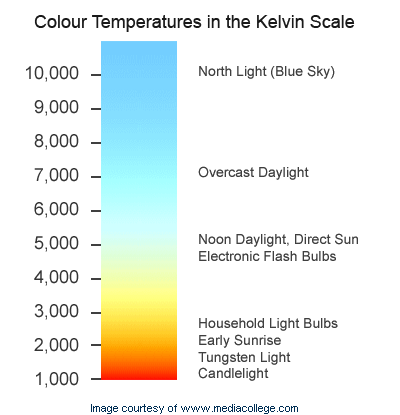
- Color Temperature (CT) / Correlated Color Temperature (CCT): The "whiteness" of light generated from a source. Correlated to the color of light produced by a radiating black body of that temperature (K).
- Color Rendering Index (CRI): The ability of a light source to correctly reflect accurate colors in the environment. CRI = 100 is perfect reproduction. CRIs in the range of 75-100 are considered excellent, while 65-75 are good. The range of 55-65 is fair, and 0-55 is poor.
I plotted the source characteristics for some common light sources below to show how they relate to each other. "Good" translates to high, to the right(ish) and with a large sized bubble.
What does that mean?
- Incandescent and halogen bulbs are what most homes use today so they are the baseline against which all other lighting is most easily compared.
- It has good CRI, medium-low CT and very low efficacy.
- i.e. objects appear to be the "right" color when illuminated and the light itself is "warm (reddish)" but takes significant energy to produce very much of.
- Fluorescent lights are very common, particularly in commercial lighting and are the other light source which you've probably encountered frequently. There is large variation in the characteristics available depending on phosphors used but:
- Newer bulb types have reasonably good CRI, a wide range of CCTs (med - high) and high efficacy.
- i.e. objects appear to be nearly the right color, light can be anywhere from "warm" to "cool (white)" (depending on the bulb) and energy is efficiently converted to light (~5x incandescent).
- Metal Halide High Intensity Discharge (HID) are more common as outdoor lighting (and a variant - Xenon HID in car headlights).
- It has borderline good CRI, medium CT and high efficacy.
- i.e. objects appear to be the "almost right" color when illuminated, the light itself is "cool (white)" and energy is efficiently converted to light (~7x incandescent).
- Low Pressure Sodium lighting is the the yellow street lamp you've probably seen in the parking lot that made it impossible to figure out which car was yours because they all looked grey.
- It's very good at converting energy to light, but it's not light you want to look at... unless you are an astronomer and want to filter out the city of San Jose's light pollution from your observations...
- LED lighting is still fairly rare but is starting to show up in some more efficient building designs, vending machines and refrigerated display cases.
- Newer LED types have reasonably good CRI, a wide range of CCTs (med - high) and high efficacy.
- i.e. objects appear to be nearly the right color, light can be anywhere from "warm" to "cool (white)" (depending on the phosphor used) and energy is efficiently converted to light (~10x incandescent).
Conclusion: modern fluorescents are quite good from a light quality standpoint, modern LEDs are similar as are (some) HID lamps. LEDs are clearly more "efficient" but adoption is still low. From this basic data one would expect that HID penetration would be higher too. Why is it not?
I'll get into more characteristics of these light sources later to better understand why the lighting situation looks like it does today, but hopefully this post went a good way towards explaining why the forerunners are what they are.
At least this proposed light bulb label should now makes sense:
Subscribe to:
Posts (Atom)