Showing posts with label leverage. Show all posts

Friday, March 8, 2013

Wait... There's a Genie in my Economy!


What do the following have in common?
  • International Paper
  • United Airlines
  • Google
  • Facebook
  • Twitter
  • Amazon EC2
  • Kickstarter
  • 3D Printing
  • Genies
Friction.

More specifically, they each help to reduce the friction between all of the things that must be in place to get something that you want.
  • International Paper - What does it take to get the paper in your printer? 
    • Rights to log trees. The labor to log them. The tools to cut down a tree. The knowledge to use those tools. The transports to move the trees. The machines to pulp the tree. The labor and knowledge to use the pulping equipment. The chemicals to process the pulp into paper... you get the idea...
  • United Airlines - What does it take to move yourself to Japan?
    • The money to buy an airplane. The knowledge to fly it. The contacts required and hours spent to negotiate the rights to take off from SFO and land at NRT. The labor and knowledge to service the aircraft... etc...
  • Google - What does it take to find out about everything on the internet?
    • The knowledge to create an algorithm that is helpful at finding what you want amid tons of stuff you don't. The programming skills to implement it. The knowledge to build the IT infrastructure to process and store all of the data required to run the algorithm. The servers and real-estate required to hold the servers... how easy would those be to get on your own?
  • Facebook - What does it take to find all of your long lost high school friends?
    • The hours and hours of phone calls to numbers in your old day runner (they still make these?) hoping that their parents still remember you and still live there. Or trawling through phone directories looking for the right Joe Smith... ugh...
    • OR build your own content site which will attract half of the planet AND get them to list their high school... pretty simple...
The remaining companies or topics flip the equation a bit as they are more general tools for reducing friction towards the end of doing something else.
  • Twitter - How could I publish my thoughts to "everyone" at a reasonable cost?
    • I could never mail a letter, call by phone or place enough radio and TV ads to do this. What would it cost to generate the lead list and qualify the leads to do this in a more focused way?
  • Amazon EC2 - How do I start a s/w business that scales without major capital outlays?
    • How else can I get enough computers to scale my SaaS business to profitability without the friction of convincing someone to front a significant amount of money to purchase and administer a server farm?
  • Kickstarter - How do I find funding to raise capital to do something people want to see done?
    • Am I lucky enough to be born rich? Did I get lucky enough to know powerful, rich people? Am I a good enough social engineer to find these people? Do know the right VCs? Is my product profitable enough to a VC for them to consider? What would it cost to build the audience of millions who are engaged enough to put money on the table - sight unseen?
  • 3D Printing - How do I make a complicated, custom physical part in low volume (qty 1)?
    • The money and space to buy a CNC machine plus the experience and knowledge to operate it? Or the hours spent to find a machine shop that will do a low volume run, now, for a reasonable price?
  • Genies - How do I do anything with anyone, anywhere at any time?
    • You have 3 wishes...
The interesting thing about removing the friction around doing "something else" is that it enables new ways for people to do things for themselves and, ultimately, find others who might want those things. Which they then might trade something for (like money). Which sounds sort of like an economy.
Take that to its logical conclusion where friction is, genie-like, reduced to near zero between all people and the resources / skills they hold and what is the purpose of a corporation as we know it today? We could do anything for ourselves by finding and coordinating the right people.

Maybe this does not happen in my lifetime, but the idea of friction seems like a powerful filter for looking at the value of any product or service that you are trying to create today. If it is not reducing friction then you're heading the wrong way.

-----------------------------------------------------------------------------------------------------

Thanks to Gabe Newell for throwing the lightning bolt which fused the 10,000 threads in my brain into a coherent idea.

Take a look at this talk if you have an hour to spare.
Why is Valve structured as it is?
What is the purpose of a corporation in recent history and today?

Good stuff. 


Thursday, September 23, 2010

More Energy Efficiency and Leverage - It's STILL not about caulking.


I can't make a good decision about how to make my energy usage sustainable unless I know which activities are using the most energy. The chart presented here attempts to give an idea of the scales of energy I've been talking about in previous blog posts.

The total energy usage in the US per year (as noted in this blog post) is ~1x10^20J. For comparison, that is:
Closer to home, the total electricity used per year by the average US household is about 4x10^10J. While media focus has been on making our homes more energy efficient as a good way to tackle sustainability, it turns out that driving a single car each year uses ~5x more energy than our homes consume*.
Increasing fuel efficiency or reducing miles driven by 20% would be the equivalent of reducing your home electricity usage by 100%. That's big leverage. Better than caulk or fluorescent light bulbs.

Flying is also pretty energy intensive. A single flight from SanFrancisco to Tokyo uses about the same energy as driving a car for a year** or ~3.5x the average annual electricity usage of a home. With about 4 flights per day 365 days/yr that is ~5100x the average annual electricity usage of a home per year of flights... and that's just one destination from one airport...

So shooting for 30% reductions in energy usage in the home may not be entirely where the leverage lies.

*assuming 15,000 mi/yr @ CAFE standard 27.5 mpg.
** assuming 5148 miles @ 5.29 mpg of kerosene.

Wednesday, September 15, 2010

Energy Efficiency and Leverage - It's not about caulking and insulation.

Lawrence Livermore National Labs published a very interesting diagram of energy usage in the US for 2009 (above picture).
One thing to take away from it is that most of the inefficiencies ("rejected energy") come from:
  • transportation (37%)
  • losses during electricity generation (48%)
Combined commercial and residential losses amount to about only 7%.
So even if I could make all commercial buildings and houses 30% more efficient through energy efficiency retrofits, new appliances, smart monitoring, lighting and HVAC feedback controls, etc, that would only reduce the rejected energy by 2%.

Leverage comes from addressing transportation and energy generation and transmission.
  • Electric Cars:
    • LLNL assumes 25% efficiency for conversion of petroleum energy to useful transportation energy. If you assume that electrifying all transportation could improve this to 90%, that would reduce rejected energy by 24%. That's 12x the impact of green building on energy usage.
  • Distributed Generation: Solar panels and wind in your backyard.
    • Transmission losses are estimated at about 6.5% for 2007. If those losses were eliminated (optimistically) by putting solar panels and wind farms near the consumers, that would reduce rejected energy by ~1.5%, or slightly less than making all buildings "green" with respect to their energy usage.
    • A much bigger deal is the reduction in fossil fuel usage this would allow. Assuming that wind, hydro, geothermal, nuclear and solar are 100% "efficient"(no rejected energy), that means fossil fuels are only about 24% efficient. If you could replace all the coal with some combination of these other sources (preferably wind or solar to allow for distributed generation), that would reduce rejected energy by ~25%. That's 12x the impact of green building (albeit at potentially high cost).
This is not to say that green building is unimportant but, if this analysis is correct (or even in the ballpark), then it's far less important in the big picture of energy efficiency than I thought.
It is important to concede that the changing all transportation to electric drive and replacing all coal with solar or wind is a HUGE hurdle to overcome. Making buildings greener may not be the longest lever but it's one that is easier to deal with.

Monday, April 12, 2010

What if Tech Were a Fad?

This is an actual conversation I had:
- Buddhist scholar: "Tech is a fad."
- Engineer (me): "I think you may be right. But it's a fad that will last for the rest of my lifetime."

So what if I was wrong?
Not to say I believe that statement was wrong, but what might you get by thinking about things as if my Buddhist friend were right?

Wired Magazine posted an article about Lost Tribes of the Amazon using land that modern people consider unfarmable in order to grow crops. Here is an example of knowledge that was indeed lost about leveraging the natural system in which we live:

" “Human engineering, if we do it cleverly, can work together with natural ecosystem engineering,” said McKey.

The mounds appear to have been constructed from layers of surrounding topsoil, which was shoveled out and layered like cakes. That formed the basis of the mounds, which put crops above the flood line...

Friday, April 9, 2010

Japanese Traditional Building, Sustainability and the Industrial Revolution

I stumbled on an essay written about traditional Japanese building practices by Azby Brown. The author points out some striking parallels to the challenges faced by the world today. Following are some excerpts that I found particularly relevant and reflective of the ideas I blogged about earlier on re-learning lessons about sustainability. These people clearly understood and leveraged the system dynamics of the place in which they lived to make the most of the resources they had.

It is an interesting observation, the same one made by William McDonough & Michael Braungart in Cradle to Cradle, that Azby makes towards the end of his essay: that easy access to large amounts of cheap power brought this need to use leverage to an end. With the loss of that need, so too was (nearly) lost the knowledge of the leverage itself.

"During the Edo period, from the early 17th to the mid 19th centuries, Japan faced environmental problems similar to ours: large population, fuel scarcity, limited arable land, deforestation, a damaged watershed. Through well-thought-out policies that reinforced existing cultural values, and through technical and economic innovation, the nation brought itself back from the brink, and did it in beautiful ways.
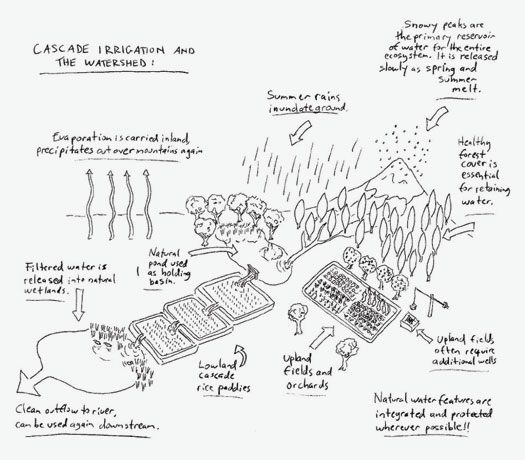
 One of the most important lessons is that the primary design response to material and energy shortages of the era was to seek multiform solutions, designs that solved many problems at once. ... the same attitude led to the development of rice paddy irrigation systems, which were almost entirely gravity-fed, acted as cascading filters for the water supply, and could function as solar-heated warm-water tanks for processing hemp and other plant-based textile fibers. The system allowed the paddies themselves to function as wetland habitat for many species in addition to growing food.

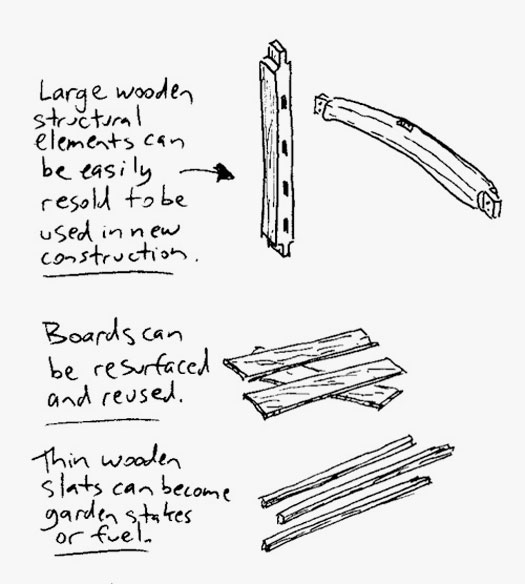
The design of the ubiquitous dismantleable Japanese jointed wooden building frame facilitated reusing the posts and beams elsewhere, helping to reduce the stress on forests for lumber supplies.

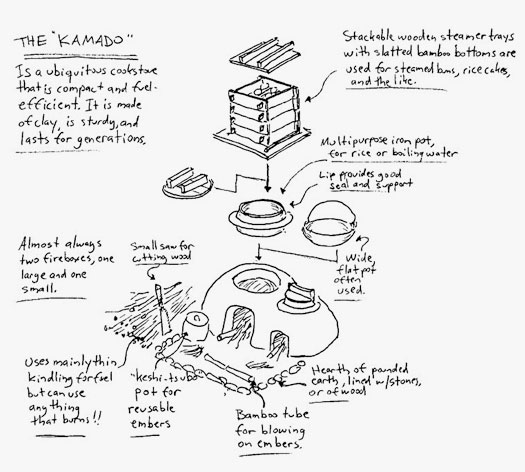
The constantly refined design of earthen cookstoves minimized fuel use and helped keep fuel consumption well within the available supply, further minimizing the stress on forests.

Forest management was recognized early on as essential for preserving the health of waterways that were vital for transportation and as a food source

 Metal, mainly iron, whose production depended upon a high expenditure of energy in the form of large quantities of charcoal, was an extremely valuable commodity.... The near total absence of metal nails in architectural structures, depending instead on mortises, tenons, pegs and wedges, and the fact that nails were carefully salvaged and reused whenever possible, attests as much to the desire to minimize energy consumption in the form of embodied energy as it does anything else.
 Can this be done without consuming fuel (like weaving)? Can it be made from a rapidly renewed material (bamboo for baskets, or reeds for thatch)? Can it take advantage of recycled material (a broken iron pot becomes a blade)? Is it scalable and able to be customized to suit specific regions, households or individuals (like kimono)? What is the desired degree of durability — is it better to make it last for generations (like cabinetry) or remade every year (like straw boots)? Is there a way to use the material at end-of-life (use the straw as fuel, convert worn cotton fabric to pouches)?
...by and large the intricately interconnected sustainable material production system broke down with the advent of the industrial revolution in Japan in the late 19th century. The widespread introduction of fossil fuels, coal primarily, broke the bond between people and the forests that had supported them..."

Saturday, March 20, 2010

A Big Picture of Sustainability

Where are some key leverage points in cleantech, green building and sustainable business?

This is a swag at the system, which captures, I think, some interesting connections and highlights some key leverage points.
Sustainability Systems Diagram

 Before your head explodes, the theory behind it:
  • A building owner's success is defined as a function of the triple bottom line (Planet, People, Profit).
  • There are a lot of factors behind each part of the bottom line and some of those factors affect multiple bottom lines.
  • Most factors are affected by several other factors. A few factors are "decisions." They gain their value because the owner decides to do them, not as the consequence of some other factor. These are marked in RED in the diagram.
In this post, I want to focus on the last point as I think these are key leverage points for sustainability.

Sustainable Sourcing and Sustainable Material
What materials you choose and where you get them from affects all three bottom lines:
  • Planet : unsustainable harvest of materials destroys habitats, kills species (which can further degrade habitats) and depletes resources.
  • Profit : resource depletion ultimately raises the cost of procuring materials. Habitat destruction increases the allocations you should make to account for and insurance costs you will likely bear due to losses associated with it (e.g. increased flooding, loss of location due to sea level rise or desertification, etc.)
  • People : habitat destruction ultimately limits the locations where you can run your business and that has a big impact on how your company runs (see below).
Feedback Control
How you manage your resource usage affects all three bottom lines:
  • Profit : Controlling usage to increase efficiency costs a little more to implement but can ultimately save significantly on direct operating expenses as well as on carbon costs (assuming a carbon tax or cap & trade are enacted). Good control of the indoor environmental quality also has positive impacts on worker productivity, increasing profits.
  • Planet : Increased efficiency of resource usage, especially for water or energy sources (coal, oil or land set aside for biofuel growth) helps offset resource depletion which, in turn, helps preserve habitats and species.
  • People : Good indoor environmental quality also increases retention, which reduces training costs and opportunity costs associated with head count gaps, thereby increasing profit.
Location
Where you locate your operations affects all three bottom lines:
  • People : Location has a large impact on lifestyle. Educational, entertainment, cultural options all depend highly on where you live and that depends, most of the time, on where you work. "Better" options lead to higher retention and ultimately lower costs. If a location is too expensive, dangerous or otherwise undesirable to live near, then commute times increase, negatively affecting work life balance, hurting retention.
  • Profit : More "desirable" locations tend to attract more educated, higher skilled workers. While hiring these people may cost more money, their productivity and quality of work increase profits (See this post for more thoughts on that idea). More "desirable" locations also tend to cost more money to locate in, increasing expenses which decrease profit, therefore requiring a careful consideration of worker quality available vs real estate costs (or requiring an alternative method of working).
  • Planet : Locating to environmentally sensitive or pristine locations can result in habitat destruction which cascades into species loss and resource loss.
This is only scratching the surface of the connections captured in this diagram. I expect to come back and explore this some more.

Wednesday, February 17, 2010

Changing behavior is big leverage: electric bill example.

Expanding on the story from Treehugger.

Buried in the bottom of this TED speech is an example of behavioral economics at work and how you can use an inexpensive approach to leverage large changes in consumption.

The bit of interest is at 10:32 - 11:20


According to this, real world testing has shown results of about 2-3% reduction in energy usage.
Using the numbers from USGBC and DOE (per earlier post):
  • a 3% savings in electricity is ~2.1% reduction in total electricity usage which is ~69TWh/yr.
  • Assuming the same 2.5kW per installation, 8hrs/day of peak generation & $21.4k/installation
  • That's $201B to replace with solar PV.
... and changing the information printed on you bill would cost a few hundred $k to a few $M in software, training, admin, development, rollout, etc...
Say $2M.
So an ROI of  > 100,000?

Friday, February 12, 2010

How many solar panels would that be?

If I wanted to generate all of that electricity using solar PV panels instead of by saving it through conservation, what would that look like?

If you assume 2.5 kW is the average installation size and you can get 8 hours/day of power at that peak level. To generate 231 TWh of energy would take ~31.6 million buildings.

According to the US Census and Dept of Energy, there are about 124 million residential + commercial buildings in the US. That means you'd need an average installation of solar panels on ~26% of all buildings in the US.
That's 1 in 4.
That's a lot.

If you estimate the average install cost at ~$21.4k (assuming Jan 2010 prices and 50% of total installed cost is the module), then that is ~$676 billion.
That's a lot too.