Showing posts with label sustainability. Show all posts

Saturday, February 4, 2012

Cloud Computing, Virtualization, IaaS, PaaS and SaaS - Part 2

In part one of this post, I looked in to the question of why cloud computing is important. In this post, I will look into the question of what cloud computing is.

NIST's definition of cloud computing gives a useful model for deciding what is and is not a cloud deployment:
 "cloud computing is a model for enabling ubiquitous, convenient, on-demand network access to a shared pool of configurable computing resources (e.g., networks, servers, storage, applications and services) that can be rapidly provisioned and released with minimal management effort or service provider interaction."

But to understand what "the cloud" is really made up of, it helps to look at how cloud computing is packaged and sold.

  • Infrastructure as a Service (IaaS)
  • Platform as a Service (PaaS)
  • Software as a Service (SaaS)

Infrastructure as a Service (Iaas)
In this cloud offering, the seller provisions virtualized compute, network and storage upon which the buyer installs his own operating system and software. This is most easily thought of as buying bare computers and storage onto which your own IT dept will put everything required for your specific uses.
A few major vendors who offer these products are: Amazon Web Services, RackSpace and AT&T Synaptic Hosting.

Virtualization software is key to making IaaS feasible. Without virtualization, physical hardware would need to be provisioned for each customer. This would make it prohibitively expensive to quickly provision, re-provision and scale resources to meet customer needs.
The major virtualization s/w vendors include VMWare (ESX), Microsoft (HyperV) and an open source virtualization solution Xen.

More on virtualization in another post.

Platform as a Service (Paas)
In the platform level cloud offering, the seller provisions some combination of operating system, middleware and runtime packages which enable the buyer to develop and run applications of their choosing. This can be thought of as buying access to services which enable programs to easily access the resources they need to run.
Vendors provide a variety of offerings in this space. A few major offerings are below:

  • Google App Engine provides a number of runtime environments for web application developers.
  • Amazon Simple Storage Service (S3) provides file based storage to any application which needs it while Amazon Elastic Block Store (EBS) provides block level storage for applications the need direct storage access (like DBs).
  • Microsoft Azure provides access to a few runtime envrionments,  SQL DB services for applications which need DB services and the virtual network fabric required to link together multiple server's services.
Software as a Service (Saas)
In this level of cloud offering, the seller provides the buyer with access to end applications while hiding the infrastructure, middleware and runtime components. Pretty much every time you hear about a "web application" being offered by a company, you are seeing a SaaS product.
There are probably thousands of SaaS offerings available so covering any significant fraction of the space here is futile. But here are a few examples of SaaS offerings:
  • Web email - from google, Yahoo, etc
  • Office 365 and Google Apps - On line productivity apps for creating, accessing and collaborating with others on a variety of document types (word processing, presentations, spreadsheets, picture editing, etc).
  • Sustainable Supply Chain (SSC) - Supply chain survey management for corporate social responsibility reporting from CSRware.
  • Facebook and Google + - public social networking tools for keeping tabs on your friends around the world.
  • SocialcastClearvale Jive and Spigit -  Enterprise social networking tools for keeping abreast of news and status, smoothing workflow, fostering collaboration and spurring idea generation in a corporate context.
One additional consideration is which user base a cloud deployment is intended to serve. This leads to the ideas of: Private, Public and Hybrid Clouds

  • Private cloud = services and (often hardware) are strictly for a single company's use. Frequently this implies that the company consuming the services will deploy the cloud services on hardware behind their corporate firewall.
  • Public cloud = services are available for all users anywhere. Though users may need to pay for services... This is the context in which most people experience the cloud because of the heavy reliance start-ups offering SaaS products have on public cloud services.
  • Hybrid cloud = multiple cloud systems connected in such a way as to allow programs and data to be easily moved between private to public clouds.

Tuesday, January 31, 2012

Cloud Computing, Virtualization, IaaS, PaaS and SaaS - Part 1

What is cloud computing and why is it important?

On the question of importance, cloud computing addresses several business problems.

Perhaps the most mundane problem that cloud computing addresses is one of cost for getting applications up and keeping them running.

  • Availability 
    • Because of the underlying technology used in cloud computing (Virtualization - more on this next post.) it becomes relatively easy to implement failover and high availability for servers. This makes the customer experience better (fewer interruptions) and allows more routes to addressing business critical applications (lowers barrier to entry on some enterprise applications).
  • Application deployment & maintenance 
    • Depending on the level of the cloud you engage at (Infrastructure, Platform or Software - more on this next post), the level of IT expertise required to use the applications / services you want can be greatly reduced. Software patching, upgrades, hardware provisioning and maintenance is left to the cloud providers who have this expertise on staff.
These "mundane" aspects of cloud computing enable significantly less mundane capabilities. The most immediate of which are the new business models that become feasible.
  • Software start ups galore
    • Because compute power can be purchased on-demand and in relatively small units, capital costs for starting a software company are significantly reduced. This enables more players to try more things in search of the next big thing.
  • F2P (Free to Play), Freemiums and ad-driven businesses
    • Because the marginal cost of adding users to a centralized s/w application can be nearly zero when deployed in a dynamically scalable infrastructure such as the cloud provides, companies can explore business models that "give away" software, or more precisely: give away access to software, while closely tracking and tailoring the user experience more easily. This leads to businesses that thrive on micro transactions within the software or on ad revenue instead of from sales of the software itself.
  • On-line special events
    • Relatively low cost and rapid provisioning of compute, network and storage resources allows for companies to generate increased community engagement or media attention by using this burst capacity to host periodic special events. For a small fraction of the cost of buying and setting up the h/w and software required to gain this capacity, the same buzz generating potential can be realized.
  • Mobile
    • By using the relatively limited compute power of networked mobile devices to drive the user interface and pushing the computationally intensive tasks to servers in the cloud, the capabilities of mobile devices become nearly unlimited. This creates a new class of applications (e.g. voice recognition, navigation, etc) for entrepreneurs to explore and market, driving sales of mobile computing hardware (e.g. smart phones and tablets) or of the applications (as apps or as services) themselves.
  • Distributed work force, virtual desktops and collaboration
    • Because public cloud resources can be accessed from any internet connected device and data storage is easily centralized, the cloud makes it more feasible than ever to provision specialized applications to anyone, anywhere, to keep company data centralized and provide tools by which physically separated groups can easily interact and exchange information in real time in order to improve productivity.
As Corporate Social Responsibility (CSR) and sustainability concerns increase, the "green" aspects of cloud computing also become more important.

  • Economies of scale in "green" data centers may mean that renting capacity via "the cloud" is greener than you can afford on your own.  
    • Making an efficient data center requires high up front capital and expertise costs. Considerations like the ones below are more affordable by large businesses or by dedicated cloud hosting companies where the risk associated with the capital costs are more acceptable for the long term return.
      • efficient server h/w
      • low energy and passive cooling strategies
      • occupancy based lighting, energy efficient lighting fixtures and daylighting strategies
      • green power purchase agreements
      • on-site generation via renewables (e.g. co-gen, bio-fuel based fuel cells, PV, Solar thermal, etc.)

Next time some details about the the "what" part of the question.

Friday, December 31, 2010

Saving the Savages = Breaking the System

I just finished reading The Wayfinders - Why Ancient Wisdom Matters in the Modern World by Wade Davis. Besides being one of the best arguments I've read on why sustainability matters and where we might "relearn" how to achieve it, there was a section on the consequences, however well intended, of misunderstanding the context of a culture and of applying the wrong solution to a problem because of it.

The story is of the people of the Kasuit desert in northern Kenya. For hundreds of years, they lived in this desert. They developed a culture that embraced the difficulties of living in the desert and, therefore, did just fine. Until severe drought, combined with nearby wars brought this region to the attention of the West. At which point, the United Nations took actions to "save" them from themselves.
Following is my summary of Wade's story.

The culture the originally developed worked like this:

To ensure that enough livestock survived severe drought, large herds of livestock were required.
To maintain large herds required large families, stewardship of the land and a nomadic lifestyle (so that the carrying capacity of any one area was not exceeded).
The requirement to have large families resulted in polygamy being common. But to maintain social harmony among the young men in a group where there were not enough women for every man, the culture developed rites around sending young men away to tend the herds. These rites bound together the men involved in them, creating life-long social bonds which reinforced the "commonness" of their use of the land (avoiding the "tragedy of the commons"). These rites also instilled a large amount of prestige in the men, allowing them to accept the situation which supported the large families.

Then the UN intervened and added a few things:
First they added the idea of private ownership of the land and, thereby, permanent settlement. This required the reduction of herd size which quickly led to dependence of outside aid to keep the people alive.
Outside aid included western education. The education broke the traditional rites of passage (by instilling the idea that such a life was "beneath" an educated man), which broke the personal ties which were necessary, among the other factors, to allow life in the harsh environment.

The entire culture collapsed and, along with it, the ability to sustain life in that place.
All with the best intentions...
...but without sufficient respect for the wisdom of the people who had learned to live within the limits of the place they inhabited.

Tuesday, November 9, 2010

Saving the World is Like a WoW Raid?


TED recently posted another interesting talk about games and social change by Tom Chatfield.


One big take away from his talk is seven lessons from games that you can take and use outside of games to engage people with game-like rapture.
  1. Experience bars measuring progress - show progress towards a single, large, long term goal.
  2. Multiple long and short term aims - lots and lots of different tasks at a level that is still engaging. Break down a huge problem into interesting slices.
  3. Reward effort - credit for trying. No punishment for failure.
  4. Feedback - link consequence to action. Even when they are distant in time and space.
  5. Element of uncertainty - uncertain rewards at the right level of occurrence (intermittent reinforcement).
  6. Windows of enhanced attention - provide the lessons at the right time when attention is focused.
  7. Other people - doing things with your peers.

The mention of EverQuest did get me to thinking about games for sustainability in a slightly different way. I had been trying to answer how you bride the gap from games to changed behavior.
  • In games about sustainability, there is some attempt to educate, but no real requirement to actually change. Here is an example ("Fate of the World") that lets the player experiment with different policies to understand how those policies affect outcomes that are not readily apparent in a short time frame.
  • In crowdsourced efforts, like zooniverse's "old weather" project and the Great Backyard Bird Count,  people expend effort at processing data that can be used to understand our environment. That is arguably a change in behavior, but one that is of an information processing nature rather than a lifestyle change.
  • In augmented reality, an objective is overlaid on some real environment as a way to change your interaction with that environment. But it leaves the problem of making sustainability related behavior changes exciting enough to play in and of itself on a long term basis.
The answer (of the hour): Raids.
A focused game mechanic that closely coordinates people to act towards a common goal that can require a large amount of preparation outside of the specific event in order to achieve.
  • The game sets a target (e.g. kill bad guy X)
  • People gather to achieve it (e.g. clan N and clan Y decides to take on this raid for the greater glory)
  • The game could set up a mechanic whereby the first team to reduce electricity usage over baseline by 100kWhr opens the dungeon required to start the raid. Or the more energy saved by the group, the more powerful a summoned assistant the team gets (with tiers and drastic changes to powers and appearance as the tiers are achieved). As part of this mechanic, the game would:
    • Show each player's contribution towards the goal
    • Suggest approaches for achieving the goal
    • Provide some in-game feedback about the effect of this goal 
      • e.g. the saved energy builds up in a visual form somewhere in-game
      • e.g. provide tiered but randomized rewards as players' contributions reach certain levels.
    • Provide real world context of what the energy savings means (e.g. $x of savings)
    • Keep a public record of what was achieved for all groups attempting the raid to see.
  •  Rinse and repeat
Instead of trying to make a game entirely about sustainability, build it into a game that people want to play (like WoW).

One huge opportunity that comes from this is establishing the systems by which you get accurate feedback from the real world on the actions that you really want to drive. Smart meters are one example (leaving open the question of how you establish a "baseline"). But, as noted in this post, car mileage is a much larger contribution to overall energy usage. How would you monitor miles reduced? Similar questions for green buying decisions, water use, etc... some probably easier to solve (and easier to tie to a product promotional campaign) than others.

Thursday, September 23, 2010

More Energy Efficiency and Leverage - It's STILL not about caulking.


I can't make a good decision about how to make my energy usage sustainable unless I know which activities are using the most energy. The chart presented here attempts to give an idea of the scales of energy I've been talking about in previous blog posts.

The total energy usage in the US per year (as noted in this blog post) is ~1x10^20J. For comparison, that is:
Closer to home, the total electricity used per year by the average US household is about 4x10^10J. While media focus has been on making our homes more energy efficient as a good way to tackle sustainability, it turns out that driving a single car each year uses ~5x more energy than our homes consume*.
Increasing fuel efficiency or reducing miles driven by 20% would be the equivalent of reducing your home electricity usage by 100%. That's big leverage. Better than caulk or fluorescent light bulbs.

Flying is also pretty energy intensive. A single flight from SanFrancisco to Tokyo uses about the same energy as driving a car for a year** or ~3.5x the average annual electricity usage of a home. With about 4 flights per day 365 days/yr that is ~5100x the average annual electricity usage of a home per year of flights... and that's just one destination from one airport...

So shooting for 30% reductions in energy usage in the home may not be entirely where the leverage lies.

*assuming 15,000 mi/yr @ CAFE standard 27.5 mpg.
** assuming 5148 miles @ 5.29 mpg of kerosene.

Friday, September 3, 2010

More about games and sustainability

In a previous post, I was thinking about how to connect the game world to the real world so that the game was not ABOUT sustainability, but actually required sustainable behaviors in order to play. In that post, I mentioned using smart meters as "input devices" and augmented reality as two possible approaches.

Here are a couple more thoughts:
Tweet-a-Watt
 Use the Kill-a-Watt product, modified to tweet your electricity usage, in order to easily report energy usage over time. By tracking usage changes, giving points for number of connected electricity monitors, creating special achievements that require certain energy usage behaviors and teaming up with others to pool points to perform in-game actions, you can link real energy usage to the game's outcome. By making the interface a tweet instead of a manual entry the game can focus on action rather than data entry.

Reverse my thought - pay for sustainability through proceeds of the game's sales or in-game economy
Maybe my thinking about requiring sustainable behaviors to play isn't the right way. Maybe a good alternative is to fund other peoples' sustainability activities by playing games. Puff Puff : Gulf Spill is an iPhone game that donates 10% (or 30% depending on whether the article or the video is correct) to habitat restoration. Donating proceeds from sales to a charitable cause is not a new thing, but attaching it to a game is new.
Attach it to a game with an in-game economy (e.g. World of Warcraft, Second Life, EvE Online, etc.) and give the option to the player to donate some of their in-game money to real world causes (instead of cashing it out as real-world money or selling it to someone else for real world money as is done on eBay) and it might be useful.

Friday, August 20, 2010

(more) TED on games as a way to make change

I posted earlier (here and here) about sustainability and using games to try to change peoples' behaviors toward the more sustainable.

Following is a TED video about that same topic (driving behavior changes with games) from someone whose work it is to drive business by getting people to play games that require interaction with the real world: in this case the companies that want you to visit them and buy their products.

Key take aways for me:
  • Last decade was the decade of social. This is the decade of games.
  • With 7 dynamics, you can get people to do anything.
  • Four dynamics presented in the video (the other 3 are "secret" so that the speaker still has a competitive advantage at the end of the talk :P).
    • Appointment dynamic = Do something at a certain time and place.
    • Influence and status = Offer things that convey social status
    • Progression dynamic = Offer a definition of "100% complete" and track progress against it. Level-up.  Unlock rewards over time.
    • Communal discovery = Everyone works together to achieve a common goal.

Thursday, August 12, 2010

A better way for electric cars? A Better Place.

What are the two main things you worry about with electric cars?
  1. Price
  2. Range
Gasoline is great because it is a well established, subsidized fuel with very high energy density (1.3x10^8 J//kg). That makes it easy to carry around and get pretty far with. Plus, when you run out, there's always a gas station somewhere nearby. Price and range... not a problem.

Electric cars are limited by their batteries. Li-Ion battery's energy density is nowhere near as high as gasoline (5.2x10^5 - 7.2x10^5 J/kg - gasoline has >180 times more energy per kg of "fuel"). Even accepting that a gasoline engine is 30% efficient vs a 90% efficient electric motor (i.e. total energy that would be converted to work per kg of fuel is 3.9x10^7 J/kg for gasoline vs 6.5x10^5 J/kg for Li-ion), that yields ~60 times more energy per kg of "fuel" from gasoline than from batteries. So to get the same range as a gasoline car (from one tank of fuel), requires either:
  1. A very large battery -or-
    • If a typical car holds 15 gal of gasoline (@ ~2.7kg/gal = 40.5 kg) , a battery that contains the same effective energy would need to weigh ~2430kg ... where a Honda Civic weighs about 1270 kg... not practical to carry or to pay for.
  2. The ability to "refuel" the battery in less time than refueling a car 
    •  Even with the best recharger possible, it takes hours (~4 hrs for a Tesla roadster) vs maybe 5 minutes to refill a gas tank.
    • With a 100 mile range per battery charge, that would require about 4 battery charges per tank of gas (assuming CAFE standard of 27.5 mpg and 15 gal tank = 412 mile range). Sixteen hours (battery) vs 5 minutes (gasoline) (assuming both cars start empty).
 Those are pretty bad starting places to catch up from.

So Shai Agassi has an idea: Treat the electric car like a cell phone.
The customer buys miles and gets a subsidized car. The batteries are the medium for the "minutes." You never own them, you just use them.
Which means you can now swap batteries because you don't care about the specific battery that you have, only that you're getting the mileage you're paying for.
Suddenly the range problem goes away (~1min to change the battery).
Suddenly the price has a means of being subsidized (ala cell phone contracts that keep the price of the phone low for the end user).

Kind of like Blue Rhino propane tanks ... but way cooler.

And he created a company Better Place to do it:
  • Get the cars built
  • Get the battery swap system figured out
  • Get the infrastructure in place
  • Prove to the world that it can work
Check out this video (or the video below) of the system working in Tokyo. It's real.


So, admittedly, it only works where you have the infrastructure, but it certainly gives a new direction for addressing the two big problems of EVs.

Thursday, July 22, 2010

A Video game ABOUT environmental responsibility

Speaking of games as a way to encourage people to make sustainability a part of their routines. I bumped into this article about Oceanopolis -
"a fun, interactive and educational game that engages players worldwide in stopping waste and recapturing resources using recycling & up-cycling principles."

This is a Facebook based game, created by the recycling company Greenopolis, that lets you perform a variety of waste management activities to keep your island clean and to earn points to buy in-game (or some real world) stuff. Basically it's a game ABOUT recycling (I'll get back to that in a minute) that is intended to make learning about the benefits of recycling fun and maybe a little cool.

So how does this stack up against some of the factors that I think make for a good game? i.e. the ones that keep you coming back for more...
[Full disclosure: I have not played the game. This analysis is based on the description of the games features, some feedback from players on the facebook page and experience with similar games]
  • Sense of progression
    • Achievements - The achievements seem to be centered around buying in-game stuff to build up your island. There is a promise of adding quests and so-forth in the future, but it is not clear if this gives you badges or other permanent signs of achievement or just the generic "point."
    • Discovery / story - New garbage? New up-cycled things you can make with your garbage? New animals to rescue?
  • progression measured vs others and yourself (normalizing scoreboard)
    • Points and the scoreboard - There appears to be a scoreboard in game that summarizes how much stuff you have collected and points earned. Not clear how public this is or that is is compared to others' boards.
    • Buying stuff - Progression becomes mostly about adding things to your island and your Avatar that others can see when they visit.
  • bragging rights - tell your friends
    • Facebook integration - presumably this game will spam your friends' walls with updates of what you have collected, built and bought.
    • In-game chat - not clear that there is a way to converse with other Avatars but you can visit other's islands and see what stuff they have on the island as well as on their Avatar.
  • Replay value
    • Get real world stuff - Points can be "...turned into cash donations, or exchanged for real discounts at thousands of restaurants, theaters and real-world establishments." So to the extent that getting these things is really interesting or helpful it might keep you coming back.
    • More islands - you get the opportunity to manage more islands... but it's hard to imagine that the experience on two islands will be much different than one island. It is a chance to keep playing, but it's not clear that it really ends or has a logical conclusion that you'd want to go back and see over and over.
So I'm not sure how "sticky" this game will be as it seems fairly one dimensional about a topic that most people don't find that interesting...

 Game ABOUT sustainability or a game that helps you be sustainable?
A more important idea that this game helps crystallize for me is the difference between a game ABOUT a thing and game that involves you in DOING a thing. To borrow a little terminology from Switch - How to change when change is hard [Chip and Dan Heath]:
  • A game "about" implies that the goal is to teach people and that will change behavior (motivating the rider).
  • A game of "doing" implies that the goal is to shape the path and include changed behavior as part of the criteria of winning the game.
Oceanopolis clearly falls into the "about" catergory despite its one real world link which is to get extra points for recycling at a Greenopolis recycling station.

MIT has been doing research on Augmented Reality (AR) games. These games put the player in the real world, doing real and virtual things in order to play. That is perhaps a little further than most want to go for a game but it does suggest the opposite extreme from games that are entirely about cerebral learning of what to do.

So... I'm still looking for that game that strikes the right balance of in-game progression and feedback using real world signals and behaviors (think Smart Meters!).

Monday, July 19, 2010

Edible drinking cups

Better than a cup that is recyclable or reusable, how about one that is compostable and edible?

These cups are made from agar, an extract from reg algae, frequently used in Asian desserts and biology experiments.

According to this material data about Agar:
  • It melts at 176F so holding it in your hand shouldn't be a problem. 
  • It is insoluble in cold water 
  • Is "completely resistent to the enzymes applied in the food technology area" ... which I take to mean it won't dissolve or react with things you'd want to eat or drink.
So as long as you're not looking to drink hot coffee or tea from it and aren't going to let it sit outside for too long (agar is a popular substrate for growing bacterial colonies), agar is a widely available, non-endangered plant product, so it does seem to solve that part of the "green" equation.

However, this material clearly has some problems with large scale use in an office:
  • Agar does not fold or compress without losing it's structural integrity so it would be difficult to transport or store in large numbers.
  • Agar is a nutrient so it probably needs to be refrigerated, further adding to the transportation and storage costs... unless you brew and mold your own cup on demand... which would be novel if not very efficient.
  • Agar is one of the more expensive gelatines, so compared to a foldable paper cup, it would be difficult to justify the cost per unit to give away by the hundreds and thousands per months.
oh well... it makes an interesting story.

Thursday, July 15, 2010

The essence of a drinking cup

How would you rebuild a disposable drinking cup if you had sustainability in mind?

  • minimum material per cup
  • use of renewable resources
  • use of recyclable materials
  • low cost
  • small storage and transportation foot print
  • high packing density (less restocking labor costs)
It might look a lot like this:

Opened to hold water. You would hold this and drink from it.

This is the dispenser next to the water cooler. That is a HUGE number of cups (100s) in a tiny space. 
Compare to the ~15 styrofoam cups in this picture stacked to roughly the same height as the paper cup dispenser box.


This won't work for hot drinks and it's difficult to use a single cup for more than a few drinks, but for it's intended purpose: getting a quick drink of water, it's quite effective.

It would be better to not use disposable cups at all but...


stacked Styrofoam cups photo credit: Dan Meyer @ http://blog.mrmeyer.com/?p=69

Thursday, July 1, 2010

A Framework for Sustainable Business

Sustainability
"The ability to provide for the needs of the world's current population without damaging the ability of future generations to provide for themselves. When a process is sustainable, it can be carried out over and over without negative environmental effects or impossibly high costs to anyone involved."
This definition is nice but how to make it actionable?
A checklist would be nice, but that is probably too simplistic. Rather, there seems to be a few key ideas that lead from this definition that give a framework for answering the question: "Is this sustainable?" in whatever context it might arise. The first question is: sustainable for whom? Which leads to...

Triple Bottom Line (TBL)
""People" (human capital) pertains to fair and beneficial business practices toward labour and the community and region in which a corporation conducts its business. A TBL company conceives a reciprocal social structure in which the well-being of corporate, labour and other stakeholder interests are interdependent."
""Planet" (natural capital) refers to sustainable environmental practices. A TBL company endeavors to benefit the natural order as much as possible or at the least do no harm and curtail environmental impact. "
""Profit" is the economic value created by the organisation after deducting the cost of all inputs, including the cost of the capital tied up."
To understand if something has unacceptable costs to anyone involved, you must first identify all of the stakeholders. The simplest embodiment of this idea is in the triple bottom line: Expanding accountability to the stakeholders rather than just the shareholders. Who are the stakeholders?
  • Your people
  • Your planet
  • Your profit (i.e. the economy in which you live and on which you depend).
Once you begin trying to account for all the stakeholders' costs and benefits you are led naturally to...

Full Cost Accounting (FCA)
  1. Accounting for costs rather than outlays
  2. Accounting for hidden costs and externalities
  3. Accounting for overhead and indirect costs
  4. Accounting for past and future outlays
  5. Accounting for costs according to lifecycle of the product

FCA requires explicit acknowledgement of costs that are typically ignored in traditional cost / benefit analyses. It requires systems thinking to understand the scope and source of these costs. The points of FCA that seem, to me, to be particularly relevant to sustainability are:
  • What does it really cost to obtain, use and replace a resource? Natural resource usage is a good example: prices reflect extraction costs rather than replacement costs (it's not sustainable if I run out with no replacement). So using resource price as the cost of resources is insufficient to account for the impact of using that resource. Oil is cheap to extract but difficult to replace.
  • Externalities are acknowledged as costs of business rather than someone else's problem. Passing the cost to someone else does not make the cost go away - it's just theft from that person. A good example is the effect of overworking employees. What is the cost of a crumbling family or of the loss of a parent from workplace induced illness or stress related disease? In traditional accounting, such concerns are not the business' concern so efforts to improve employee well-being are are difficult to justify.
  • Future outlays to deal with preventing externalities are also planned for. This encourages reuse and encourages building recycling and collection into the product design and business model. It is good business to have people buy a new cell phone every year, until you have to pay for the safe disposal of every one of those phones or the impact on health and environment loss from improperly disposed phones. Wouldn't it be more economically effective to plan on collecting and reusing the materials?

If you include in the costing the environment as the source of all resources and that a better environment results in more plentiful, higher quality, more productive resources (material and labor), then you reach...

Cradle to Cradle Design
"Cradle to Cradle design perceives the safe and productive processes of nature’s ‘biological metabolism’ as a model for developing a ‘technical metabolism’ flow of industrial materials. Product components can be designed for continuous recovery and reutilization as biological and technical nutrients within these metabolisms."

This is about making the world better with each unit produced rather than just making things "less bad."
While Cradle to Cradle emphasizes product design, to me the idea logically extends to sustainable business processes as well: How do I design a business process that makes my people and customers more fulfilled rather than just "less abused" in pursuit of the company's goals?

  • Trust marketing: respect your customers and their interests to build more business.
  • Foster and direct intrinsic motivation (Drive... see TED video below) to get the most from employees.


Put another way: sustainability seems to be about approaching business with Aikido in mind (blend and direct) rather than with Taekwondo in mind (block, strike and smash).

Monday, June 28, 2010

Sustainable vs Green

"Green" and "Sustainable" seem to be used as if they mean the same thing in mainstream media. However they are not the same:

Green but not sustainable:
Michael Pollan has a good example of this in his book The Omnivore's Dilemma: industrial organic food. The food is raised without artificial fertilizers or pesticides. However, it is raised in a giant monoculture. This means that a single disease could wipe out the entire crop. It also means that the land is not replenished by the crop growth so more and more fertilizers are needed to keep up yield.

Another example is in the common complaint about LEED not being green enough. I think, this could be a complaint about LEED not being as strong about sustainability as some might like. A recycled, refurbished, bright and airy building with solar panels constructed in the middle of nowhere is not sustainable to operate or for occupants to get to... yet it can still be LEED certified - a "green" building.

Sustainable but not green:
A small community raises pigs and chickens in a factory farm in addition to having a number of farms to supply food to the animals and people. The waste is rotated between a number of storage ponds where the land is severely polluted but the waste is broken down at a rate such that additional land is not required to contain it. The water supply is contaminated but sufficient rain falls that cachement supplies the required amount year-round. By having multiple animal types, a cull due to disease outbreak in one population does not result in a total loss of income or food supply.
This is, I will admit, a bit contrived but is within the realm of possibility for a small enough community without economic growth as a primary goal. It would be impossible to call this situation green but it, arguably, could be sustained.

The relationship between sustainability and green does exist. Namely that it is very hard for a planet of 6.8 billion people to be sustainable without being green because the environmental impact of our current technology is too high. To ensure that we can continue to live here, for human life to be "sustainable", our impact needs to be moderated. The best way we know to do that is by being "green."

It also highlights that "sustainability" is about the entire system. There cannot be "waste" and inputs cannot come exclusively from limited supplies when the population is too large. Or, as William McDonough puts it, "Waste equals food."

Maybe it is fair to say that the missing distinction is that sustainability requires systems thinking while green is about point solutions?

Tuesday, June 15, 2010

Interesting Mixed Metaphor - BP Oil Spill and Energy Efficiency

This story from Treehugger highlights an interesting quantification of the BP Oil Spill in terms of energy being wasted.
  • The estimated cost to clean up the oil spill ($40 B) is many times greater than the cost to retrofit 75,000 houses ($1 B) and save the energy equivalent of the gulf oil spill every year.
  • 75,000 houses = mid-sized U.S. city or large suburb of a major city, like Chattanooga, Tenn. or Providence, R.I.
  • A typical home energy retrofit costs around $10,000 per house -- before any utility or governments energy rebates are applied.  
Of course, wasted energy is only a small part of the problem. There is the matter of millions of barrels (>114 million gallons = ~2.7 million barrels in worst case estimate or ~30M gal for a more conservative estimate) of crude oil in the water:
  • Oil washing up in coastal habitats killing animals, destroying ecosystems and heading towards Florida and the Atlantic Ocean.
  • Tons (>1.2 Million gal) of toxic chemicals being sprayed on it (dispersants) with unknown long term impact
  • The effect of the dispersed oil droplets sinking in the water column impacting sub-surface life.
  • Tons of methane, >20x more potent than CO2 as a green house gas, that have been released (around 2900 cu ft of methane per barrel of oil = 7.8 billion cu ft = ~112,000 metric tons = ~ equivalent to green house gas effect of emissions from 20,400 cars)
  • Increased hyopxic "dead zone" in the gulf (between 8% and 30% larger than normal) possibly from all the methane being pumped into the water along with the oil, further impacting the ecosystem.
  • The short and long term cost of health effects from the oil, chemical and gas exposure on clean up volunteers.
  • The resulting economic and job loss throughout the market chain as people cannot catch fish, sell fish, buy fish, so fishermen can't buy things thereby hurting local businesses which rely on the fishermen's income. (1% of Lousiana's economic output according to NPR)
  • More economic loss from the moratorium on deep water drilling (16% of the economic activity of Louisiana according to NPR).
  • The loss in stock value of BP impacting the retirement income and viability of retirement portfolios for large numbers of people, bringing further economic hardship on people already in the middle of one of the worst recessions in recent history.
So interesting comparison: yes... but sort of missing the big picture.

Thursday, April 29, 2010

Necessity is a *Mother* ... oh... of invention

This is a short video of how one architect has used very limited space (344 sq. ft) to maximum effect (24 purposes built into that single space) in a city (Hong Kong) where space is at a premium.


I'm not saying this is how we should all strive to live or even how we'll end up living despite our ambitions, however, it does get one to thinking about what we'd do differently if we were faced with scarcity of this sort on more of our design problems.

  • Not enough space to have 3000 sq ft. per home.
  • Not enough fuel to drive 30 miles to work and back. To drive 10 miles for groceries. To ship groceries 1000s of miles to a supermarket.
  • Not enough water to "waste" it on grass or even on washing clothes.
  • Not enough chemical or electrical power to level mountains or keep our homes and workspace air conditioned or heated. Or lit for more than a few hours a day artificially.

I'm not a Luddite, but it seems like thinking as if we had these restrictions might actually result in some greener, more sustainable approaches.

Sunday, April 25, 2010

Two Paths of Full Cost Accounting

If market based capitalism is to "succeed" in-so-far as it makes the world a more livable place for ourselves and other species (i.e. it is sustainable), then something like full cost accounting seems to be necessary. Capitalism is powerful at driving the "right" behavior given the right accounting / incentives.

There seem to be two ways of coming to this conclusion:

1) Pure pragmatism
As outlined in this Wired article "Betting on Climate Change" forward looking companies will make plans for dealing with climate change and the results of other externalized costs because, eventually, those things come back to become real costs (outlays). It doesn't matter why climate change occurred, responsible contingency planning requires dealing with it. If that means incurring costs now to avoid much larger costs later, so be it. That's good ROI.

2) Inspiration & appeal to our "better" nature
As put forward by Robert Kennedy at a speech in 1968 about Gross National Product:
"Too much and too long, we seem to have surrendered community excellence and community values in the mere accumulation of material things. Our gross national product ... if we should judge America by that - counts air pollution and cigarette advertising, and ambulances to clear our highways of carnage. It counts special locks for our doors and the jails for those who break them. It counts the destruction of our redwoods and the loss of our natural wonder in chaotic sprawl. It counts napalm and the cost of a nuclear warhead, and armored cars for police who fight riots in our streets. It counts Whitman's rifle and Speck's knife, and the television programs which glorify violence in order to sell toys to our children.

"Yet the gross national product does not allow for the health of our children, the quality of their education, or the joy of their play. It does not include the beauty of our poetry or the strength of our marriages; the intelligence of our public debate or the integrity of our public officials. It measures neither our wit nor our courage; neither our wisdom nor our learning; neither our compassion nor our devotion to our country; it measures everything, in short, except that which makes life worthwhile. And it tells us everything about America except why we are proud that we are Americans.
"


It certainly makes me feel a bit prouder to be a member of the society that came up with the later reason for doing the "right" thing than it does to only be able to claim the former.

Thursday, April 15, 2010

A Couple of Examples

A couple of masterful examples of people really digging into the details of energy usage and what that MEANS in the context of things we can understand and visualize.

This, from the O'Reilly Emerging Technology Conference, San Diego, CA, March 4, 2008, by Saul Griffith, is long but great:


This, by Catherine Mohr, is much shorter but very educational:

I like the plan but, uh, spare me the details please.

Green design and green building sound great.
Cleantech sounds great.
Sustainability sounds great.

But those terms hide a considerable amount of detail that, I think, makes the average American squirm. I wrote a bit about this at the end of this blog entry. Seth Godin also posted about this same idea here with the key message:
"This is a great opportunity for marketers and others that want to engage with the public. If you can figure out how to communicate, "it's not your fault," then people will be grateful, and they'll return. It might not be right, it might not be mature and it might not be the behavior society wants to advance, but it works.
Even better, figure out how to teach your customers to enjoy taking responsibility. It's the long term solution that builds a healthy relationship between customer and vendor... you coach them on good choices and they embrace what happens after they make them. "
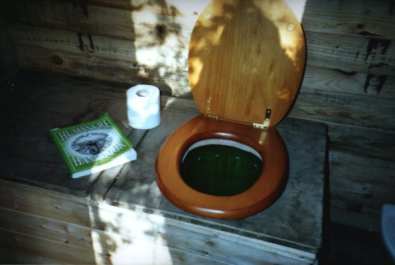
 If I start talking about water conservation through composting toilets or about peak phosphorus and the implications that has for human waste recycling, like having urine separating toilets in your home or office, I think it's safe to say I'll turn off most people. I certainly wouldn't try to lead my marketing campaign with a picture of any of those things.

If I start talking about the details of sustainable agriculture and the cycle of waste to food, no matter how delicious or natural the results, I think I'll end up with the same problem: Most people will think it's gross and will be turned off.

So how do you reach a broad audience with cleantech aimed at addressing these kinds of sustainability problems?
Maybe it can made it into a game?


Or maybe it takes a few generations of bringing it up in classes and mainstream media for people in general to accept it.
Or maybe it just requires that everyone become European, where this kind of thing doesn't seem to be quite so disturbing to talk about.

 A marketing problem worth thinking about.

Certainly helps clarify why we hear so much about solar, wind and LED lighting anyway...

Monday, April 12, 2010

What if Tech Were a Fad?

This is an actual conversation I had:
- Buddhist scholar: "Tech is a fad."
- Engineer (me): "I think you may be right. But it's a fad that will last for the rest of my lifetime."

So what if I was wrong?
Not to say I believe that statement was wrong, but what might you get by thinking about things as if my Buddhist friend were right?

Wired Magazine posted an article about Lost Tribes of the Amazon using land that modern people consider unfarmable in order to grow crops. Here is an example of knowledge that was indeed lost about leveraging the natural system in which we live:

" “Human engineering, if we do it cleverly, can work together with natural ecosystem engineering,” said McKey.

The mounds appear to have been constructed from layers of surrounding topsoil, which was shoveled out and layered like cakes. That formed the basis of the mounds, which put crops above the flood line...

Friday, April 9, 2010

Japanese Traditional Building, Sustainability and the Industrial Revolution

I stumbled on an essay written about traditional Japanese building practices by Azby Brown. The author points out some striking parallels to the challenges faced by the world today. Following are some excerpts that I found particularly relevant and reflective of the ideas I blogged about earlier on re-learning lessons about sustainability. These people clearly understood and leveraged the system dynamics of the place in which they lived to make the most of the resources they had.

It is an interesting observation, the same one made by William McDonough & Michael Braungart in Cradle to Cradle, that Azby makes towards the end of his essay: that easy access to large amounts of cheap power brought this need to use leverage to an end. With the loss of that need, so too was (nearly) lost the knowledge of the leverage itself.

"During the Edo period, from the early 17th to the mid 19th centuries, Japan faced environmental problems similar to ours: large population, fuel scarcity, limited arable land, deforestation, a damaged watershed. Through well-thought-out policies that reinforced existing cultural values, and through technical and economic innovation, the nation brought itself back from the brink, and did it in beautiful ways.
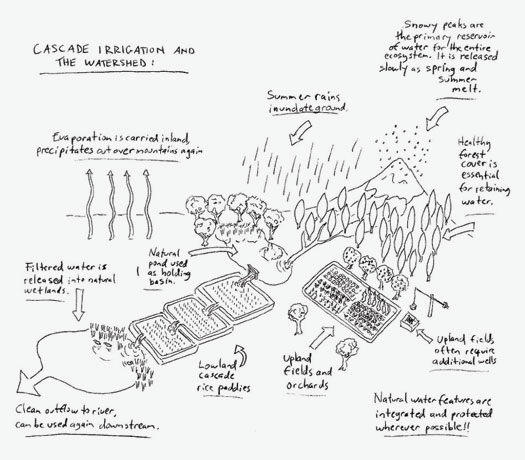
 One of the most important lessons is that the primary design response to material and energy shortages of the era was to seek multiform solutions, designs that solved many problems at once. ... the same attitude led to the development of rice paddy irrigation systems, which were almost entirely gravity-fed, acted as cascading filters for the water supply, and could function as solar-heated warm-water tanks for processing hemp and other plant-based textile fibers. The system allowed the paddies themselves to function as wetland habitat for many species in addition to growing food.

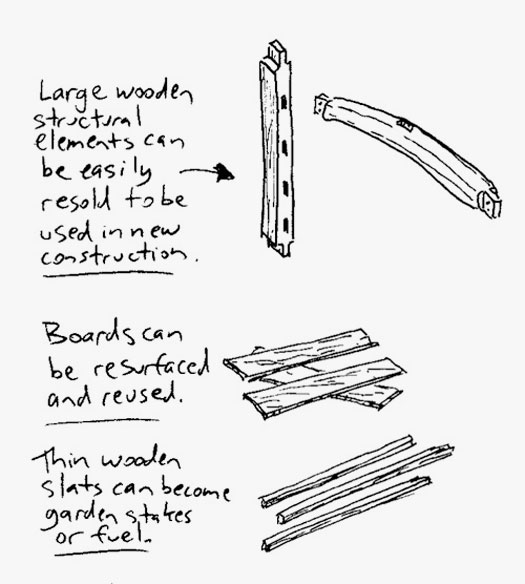
The design of the ubiquitous dismantleable Japanese jointed wooden building frame facilitated reusing the posts and beams elsewhere, helping to reduce the stress on forests for lumber supplies.

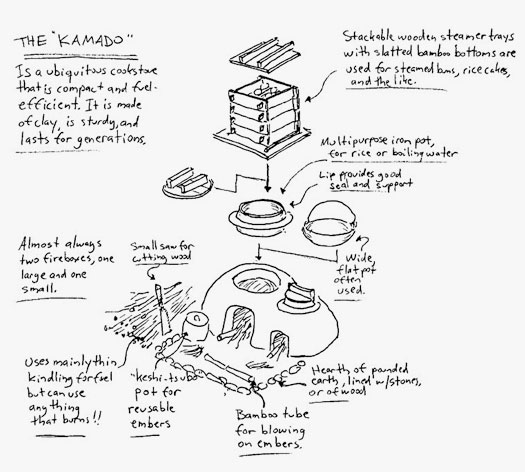
The constantly refined design of earthen cookstoves minimized fuel use and helped keep fuel consumption well within the available supply, further minimizing the stress on forests.

Forest management was recognized early on as essential for preserving the health of waterways that were vital for transportation and as a food source

 Metal, mainly iron, whose production depended upon a high expenditure of energy in the form of large quantities of charcoal, was an extremely valuable commodity.... The near total absence of metal nails in architectural structures, depending instead on mortises, tenons, pegs and wedges, and the fact that nails were carefully salvaged and reused whenever possible, attests as much to the desire to minimize energy consumption in the form of embodied energy as it does anything else.
 Can this be done without consuming fuel (like weaving)? Can it be made from a rapidly renewed material (bamboo for baskets, or reeds for thatch)? Can it take advantage of recycled material (a broken iron pot becomes a blade)? Is it scalable and able to be customized to suit specific regions, households or individuals (like kimono)? What is the desired degree of durability — is it better to make it last for generations (like cabinetry) or remade every year (like straw boots)? Is there a way to use the material at end-of-life (use the straw as fuel, convert worn cotton fabric to pouches)?
...by and large the intricately interconnected sustainable material production system broke down with the advent of the industrial revolution in Japan in the late 19th century. The widespread introduction of fossil fuels, coal primarily, broke the bond between people and the forests that had supported them..."