Showing posts with label management. Show all posts

Sunday, March 30, 2014

What are you really doing when you're doing what you're doing?

I was re-reading Falling Upward by Richard Rohr and got to this quote:
We all try to do what seems like the task that life first hands us: establishing an identity, a home, relationships, friends, community, security, and building a proper platform for our only life. But it takes us much longer to discover “the task within the task,” as I like to call it: what we are really doing when we are doing what we are doing. Two people can have the same job description, and one is holding a subtle or not-so-subtle life energy (eros) in doing his or her job, while another is holding a subtle or not-so-subtle negative energy (thanatos) while doing the exact same job. ...
... In any situation, your taking or giving of energy is what you are actually doing. Everybody can feel, suffer, or enjoy the difference, but few can exactly say what it is that is happening. Why do I feel drawn or repelled? What we all desire and need from one another, of course, is that life energy called eros! It always draws, creates, and connects things. 
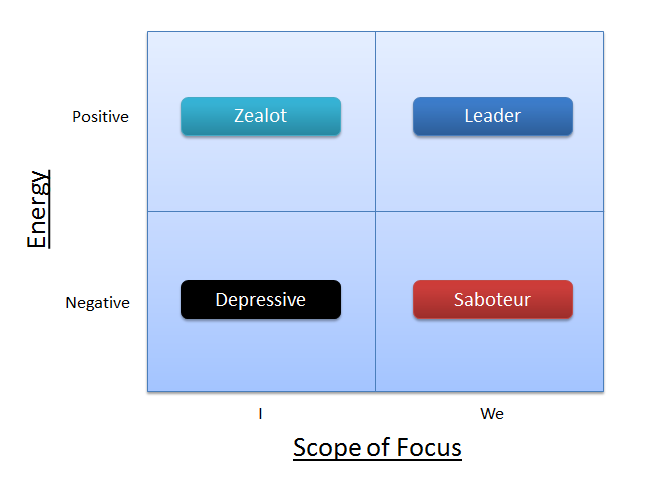
It got me to thinking about my current focus on leading teams at work and the, ah hem, "difficulties" I have had with both myself and others in this space. Thinking for a marketing guy inevitably ends up with a quad chart being produced... so here it is...

Have you met these people?
  • The depressive energy vampire who manages to get nothing done because of all the "impossible" problems? Though he never takes the team down, he isn't particularly inspiring to be around.
  • The depressives' opposite, the zealot, who is unshakable and, for better or for worse, is unstoppable? Though he may scout out and create amazing bright spots he can't bring the team along with him.
  • The saboteur who manages to poison the well with action blocking negativity? This guy is the most dangerous because he does not stop with himself. He's especially dangerous if he is in a position of significant organizational power.
  • The leader who infuses the right people with the right bits of encouragement when and where they are needed to let the team find its own way to success?

Saturday, July 7, 2012

The Essence of Vision

One of the best summaries I have seen of what implementing one's vision means.

  • Experience many things in order to distill your vision
  • Make it your mission
  • Reduce it to a question
  • Apply the question relentlessly to your actions.


Quote extracted from the talk at this link.

Bret Victor - Inventing on Principle from CUSEC on Vimeo.

Wednesday, April 7, 2010

A Model of Sustainable Management : People

There are a few books and authors whose messages have resonated with me lately. I haven't stopped to consider what they have in common with each other or with my own interests until recently.
The books / authors are:
I've put together a picture of the key messages I took from each and how I see them as relating to each other.

Prof Griffith has a very useful model (TOP Management) for thinking about how business problems are solved most effectively by considering them in the context of Technological capabilities, Organizational structures and limitations and People's capabilities and motivations. I have used this as the overlay for my model.

Dan Pink has convincingly described how intrinsic motivation is key to increased productivity in the new work world. Central to fostering intrinsic motivation (Type I work) are mastery seeking behaviors, personally meaningful purpose and autonomy of task, time and team.

Seth Godin takes a slightly different approach to looking at motivation and the new world of work through the concept of the "linchpin." This is a person who, through mastery of subject (his "superpower"), through his ability to define his own roadmap regardless of outside pressures to "just do his job" and through his ability to motivate and lead teams towards those ends, becomes essential to the organization.

Peter Senge provides a framework derived from System Dynamics that emphasizes many of the same mastery and purpose aspects as previously mentioned though through a different lens: Personal Mastery (forever accepting that there is more to know), Mental Models (understanding that you have models in your head and that they may be incomplete or wrong) and Shared Vision (ensuring that everyone is basically working towards the same goals). He also emphasizes Dialog (real trading of ideas rather than just defending your own) and Team Learning (practicing for and reflecting on scenarios, not just reacting to them) as important organizational practices.
These disciplines sit on top of the discipline of systems thinking (the 5th discipline). Which Senge elaborates on to define as the analysis of how the parts relate to each other and thereby create the whole; often with unintended, but predictable, side-effects. This provides a nice link back to Prof Griffith's TOP management model which is, essentially, a systems model.