Showing posts with label green building. Show all posts

Thursday, September 23, 2010

More Energy Efficiency and Leverage - It's STILL not about caulking.


I can't make a good decision about how to make my energy usage sustainable unless I know which activities are using the most energy. The chart presented here attempts to give an idea of the scales of energy I've been talking about in previous blog posts.

The total energy usage in the US per year (as noted in this blog post) is ~1x10^20J. For comparison, that is:
Closer to home, the total electricity used per year by the average US household is about 4x10^10J. While media focus has been on making our homes more energy efficient as a good way to tackle sustainability, it turns out that driving a single car each year uses ~5x more energy than our homes consume*.
Increasing fuel efficiency or reducing miles driven by 20% would be the equivalent of reducing your home electricity usage by 100%. That's big leverage. Better than caulk or fluorescent light bulbs.

Flying is also pretty energy intensive. A single flight from SanFrancisco to Tokyo uses about the same energy as driving a car for a year** or ~3.5x the average annual electricity usage of a home. With about 4 flights per day 365 days/yr that is ~5100x the average annual electricity usage of a home per year of flights... and that's just one destination from one airport...

So shooting for 30% reductions in energy usage in the home may not be entirely where the leverage lies.

*assuming 15,000 mi/yr @ CAFE standard 27.5 mpg.
** assuming 5148 miles @ 5.29 mpg of kerosene.

Wednesday, September 15, 2010

Energy Efficiency and Leverage - It's not about caulking and insulation.

Lawrence Livermore National Labs published a very interesting diagram of energy usage in the US for 2009 (above picture).
One thing to take away from it is that most of the inefficiencies ("rejected energy") come from:
  • transportation (37%)
  • losses during electricity generation (48%)
Combined commercial and residential losses amount to about only 7%.
So even if I could make all commercial buildings and houses 30% more efficient through energy efficiency retrofits, new appliances, smart monitoring, lighting and HVAC feedback controls, etc, that would only reduce the rejected energy by 2%.

Leverage comes from addressing transportation and energy generation and transmission.
  • Electric Cars:
    • LLNL assumes 25% efficiency for conversion of petroleum energy to useful transportation energy. If you assume that electrifying all transportation could improve this to 90%, that would reduce rejected energy by 24%. That's 12x the impact of green building on energy usage.
  • Distributed Generation: Solar panels and wind in your backyard.
    • Transmission losses are estimated at about 6.5% for 2007. If those losses were eliminated (optimistically) by putting solar panels and wind farms near the consumers, that would reduce rejected energy by ~1.5%, or slightly less than making all buildings "green" with respect to their energy usage.
    • A much bigger deal is the reduction in fossil fuel usage this would allow. Assuming that wind, hydro, geothermal, nuclear and solar are 100% "efficient"(no rejected energy), that means fossil fuels are only about 24% efficient. If you could replace all the coal with some combination of these other sources (preferably wind or solar to allow for distributed generation), that would reduce rejected energy by ~25%. That's 12x the impact of green building (albeit at potentially high cost).
This is not to say that green building is unimportant but, if this analysis is correct (or even in the ballpark), then it's far less important in the big picture of energy efficiency than I thought.
It is important to concede that the changing all transportation to electric drive and replacing all coal with solar or wind is a HUGE hurdle to overcome. Making buildings greener may not be the longest lever but it's one that is easier to deal with.

Wednesday, July 7, 2010

EDF Climate Corps Handbook

The Environmental Defense Fund (EDF) has published a free guide to making your office building more efficient system by system. It has:
  • An overview of how to approach the problem (7 steps)
    • Estimate baseline energy use intensity.
    • Commission an energy audit.
    • Consider interactions between systems.
    • Perform financial analysis of possible efficiency investments.
    • Prioritize options for investment.
    • Evaluate financing options.
    • Post-implementation follow up.
  • Tips for identifying and overcoming common barriers to implementing energy efficiency
    • Structural
      • Split incentives - one who bears cost of improvements does not accrue benefits
      • short lease terms - payback period is longer than least term
    • Organizational
      • Scarce resources
      • “Language barriers” between finance and facilities
      • Coordination challenges across finance, human resources and facilities
      • Limited accountability for green initiatives
    • Financial
      • Payback period expectations are unrealistically short
      • Large up-front costs to implement some improvements
      • lack of awareness of  tax incentives or utility subsidies
  • Simple, practical suggestions for which systems to look at first (lowest cost for highest impact)
    • Which systems exist and which you should go after first
      • Lighting
      • HVAC
      • Office equipment
      • Water heaters
      • Building Automation Systems  / Energy Management Systems
      • Data centers
      • Fleet vehicles
    • Which areas to focus on and which to skip within each system
      • Behavioral and policy changes
      • Retrofits
      • Equipment replacement
    • Tips on prioritizing which improvements to make
    • Key questions to ask and information to gather around each system
  • Case studies to help justify implementing changes in any particular area.
e.g. Financial case study: Until 2001, the 1.4-million-square-foot Hewlett Packard (HP) campus in Roseville, California, was operating an EMS with limited automation, which required labor-intensive manual adjustment of controls in order to curtail energy loads during peak demand events. Using funds available from the California Energy Commission and the local municipal utility (Roseville Electric), HP upgraded its EMS and added additional sensor and control points for ventilation and lighting systems. The changes gave HP the capability to shed 1.5 MW of its 10.9 MW peak demand without disrupting occupants. HP now uses the EMS load-shedding capabilities on a day-to-day basis, saving $1.5 million annually in energy costs as a result. The EMS upgrade cost $275,000, but incentives covered $212,000 of the project cost, giving HP a payback of less than one month on the project.6
  • Ideas for presenting financial and non-financial arguments to the appropriate stakeholders in the organization.
  • High level primers and key-word dictionaries on main building systems and links to more information about them to help focus one's learning.
The EDF also has a program where companies can host a Climate Corps member (MBA student) and have that student come on site for ~10 weeks to implement an energy efficiency program based on the guidelines in this handbook.

A very interesting package for kick-starting energy efficiency at your company.

Monday, June 28, 2010

Sustainable vs Green

"Green" and "Sustainable" seem to be used as if they mean the same thing in mainstream media. However they are not the same:

Green but not sustainable:
Michael Pollan has a good example of this in his book The Omnivore's Dilemma: industrial organic food. The food is raised without artificial fertilizers or pesticides. However, it is raised in a giant monoculture. This means that a single disease could wipe out the entire crop. It also means that the land is not replenished by the crop growth so more and more fertilizers are needed to keep up yield.

Another example is in the common complaint about LEED not being green enough. I think, this could be a complaint about LEED not being as strong about sustainability as some might like. A recycled, refurbished, bright and airy building with solar panels constructed in the middle of nowhere is not sustainable to operate or for occupants to get to... yet it can still be LEED certified - a "green" building.

Sustainable but not green:
A small community raises pigs and chickens in a factory farm in addition to having a number of farms to supply food to the animals and people. The waste is rotated between a number of storage ponds where the land is severely polluted but the waste is broken down at a rate such that additional land is not required to contain it. The water supply is contaminated but sufficient rain falls that cachement supplies the required amount year-round. By having multiple animal types, a cull due to disease outbreak in one population does not result in a total loss of income or food supply.
This is, I will admit, a bit contrived but is within the realm of possibility for a small enough community without economic growth as a primary goal. It would be impossible to call this situation green but it, arguably, could be sustained.

The relationship between sustainability and green does exist. Namely that it is very hard for a planet of 6.8 billion people to be sustainable without being green because the environmental impact of our current technology is too high. To ensure that we can continue to live here, for human life to be "sustainable", our impact needs to be moderated. The best way we know to do that is by being "green."

It also highlights that "sustainability" is about the entire system. There cannot be "waste" and inputs cannot come exclusively from limited supplies when the population is too large. Or, as William McDonough puts it, "Waste equals food."

Maybe it is fair to say that the missing distinction is that sustainability requires systems thinking while green is about point solutions?

Friday, June 25, 2010

Lighting Labels coming in 2011

Better information for comparing light bulbs is coming next year.

Read this this earlier post to understand what these terms mean.


  • Brightness = Luminous flux
  • Brightness / Energy Used = Efficacy
  • Light appearance = Color Temperature

Wednesday, June 23, 2010

Comparing Light Sources - LEDs vs Fluorescents vs Metal Halide HID

From the previous post, one could conclude that LEDs, Fluorescents and Metal Halide HIDs were all pretty much the same: High efficacy, OK to good CRI and good color temperatures.

Yet what we see are fluorescent bulbs everywhere.

One way to compare these light sources is by bulb life vs cost per lumen output with efficacy taken into account. That looks like this: "Good" is high and to the left with a larger bubble.

One conclusion that immediately stands out is how expensive LED lights are relative to the alternatives. They may be 2x as efficient and last 5x as long, but they are ~38x - 175x the price. That makes adoption of LEDs very difficult for most applications that don't have some other needs specifically met by LEDs.

Some of those special needs:
  • LEED certification 
    • LED lighting is more efficient so it can be used towards energy efficiency credits (EAc1). If 25% of a commercial building's electricity usage goes towards lighting and you can cut that by 50%, that's a 12.5% reduction in electricity cost.
    • LED lighting is more easily controlled (dimmable) to allow for controllability of systems - lighting (EQ6.1).
  • Flicker
    •  For some tasks and working conditions, 60Hz cycling from fluorescents can cause eye strain, especially if it is used with other visual equipment that runs off 60Hz AC. LED lighting has a 120Hz cycling which means it is much more difficult to detect flicker and it is less likely to beat with other equipment running at 60Hz.
  • Dimming
    •  Commercial use fluorescent bulbs (T8, T10 and T12) are not easily dimmable due to the construction of the ballast that keeps them lit. LEDs are dimmable using standard dimming equipment. This is important for applications where light level control is desired.
  • Directionality
    •  LEDs are point sources that can be configured more easily to provide a variety of lighting patterns (focused to diffuse) while fluorescent bulbs are generally quite long making it more difficult to use as task lighting or for other special lighting purposes.
  • Toxic waste disposal concerns
    • Fluorescent bulbs contain mercury which is a hazardous substance. LEDs do not contain mercury, though they are still eWaste and need special handling for disposal.
  • Low temperature operation
    • LED lighting performs better at lower temperatures. In fact, life time if greatly reduced if they operate at too high temperatures (hence all the heat sinks on the LED bulbs). This makes LED lighting a natural fit for lighting refrigerated displays.
  • Green image
    • The current perception of LED lighting is that it is the next big thing in energy efficiency and is, therefore, green. Using this perception to advertise your greenness is good marketing.
While Metal Halide HID compares well on the cost/lm vs lifetime graph, it does have a major strike against it, besides the borderline CRI: restrike time. This is the time it takes for the bulb's arc tube to cool sufficiently to restart the plasma. This can be several (1 - 15) minutes. A long restrike time makes such bulbs very difficult to use in locations where individual light control is required (e.g. office spaces or residential). Using fast starting HIDs greatly shortens the life of the bulb.

So as the cost of LEDs drop (cost comes in line with alternatives), energy costs rise (efficacy difference becomes more important) and green building codes become more prevalent (raising the minimum energy efficiency requirements for new buildings), the ROI of LED lighting will rise vs fluorescents until LED lighting makes economic sense. 

It's just not quite there today.

Sunday, June 20, 2010

Comparing Light Sources

One of the low hanging fruit in energy efficiency is replacing incandescent lights with fluorescent ones.
OK.
Then there is much news about how big LED lighting, outside of TV and LCD monitor back-lighting, will be:
So LED lighting is where it's at.
OK.
So which is it and why?

First some terms:
How lighting is measured:
  • Photometry: The science of radiated energy as observed by the human eye. Metrics of photometry incorporate wavelength and sensitivity of the human eye at various wavelengths (luminosity function).
    • vs Radiometry, which is the science of radiated energy without regard to human perception of the radiated energy.
  • Luminous Intensity: measured in Candela (cd). Defined as:
    • The luminous intensity, in a given direction, of a source that emits monochromatic radiation of frequency 540 × 1012 hertz (~550 nm) and that has a radiant intensity in that direction of 1683 watt per steradian
  • Luminous Flux: measured in Lumens (lm). The light produced by a light source that emits one candela of luminous intensity over a solid angle of one steradian. Light bulbs usually label the output of the bulb in Lumens somewhere on the package.
  • Illuminance: measured in Lux (lx) or Foot Candles (fc). The total luminous flux incident on a surface, per unit area.
    • For metric units: Lux = lm/m^2
    • For English units: Foot Candles = lm/ft^2
How light sources are characterized:
  • Efficacy: The amount of illuminance generated per watt of energy input.
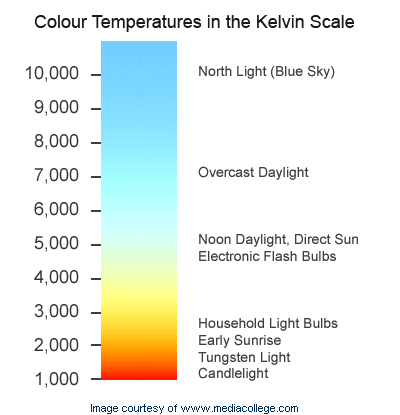
  • Color Temperature (CT) / Correlated Color Temperature (CCT): The "whiteness" of light generated from a source. Correlated to the color of light produced by a radiating black body of that temperature (K).
  • Color Rendering Index (CRI): The ability of a light source to correctly reflect accurate colors in the environment. CRI = 100 is perfect reproduction. CRIs in the range of 75-100 are considered excellent, while 65-75 are good. The range of 55-65 is fair, and 0-55 is poor.
I plotted the source characteristics for some common light sources below to show how they relate to each other. "Good" translates to high, to the right(ish) and with a large sized bubble.


What does that mean?
  • Incandescent and halogen bulbs are what most homes use today so they are the baseline against which all other lighting is most easily compared. 
    • It has good CRI, medium-low CT and very low efficacy. 
    • i.e. objects appear to be the "right" color when illuminated and the light itself is "warm (reddish)" but takes significant energy to produce very much of.
  • Fluorescent lights are very common, particularly in commercial lighting and are the other light source which you've probably encountered frequently. There is large variation in the characteristics available depending on phosphors used but:
    • Newer bulb types have reasonably good CRI, a wide range of CCTs (med - high) and high efficacy.
    • i.e. objects appear to be nearly the right color, light can be anywhere from "warm" to "cool (white)" (depending on the bulb) and energy is efficiently converted to light (~5x incandescent).
  • Metal Halide High Intensity Discharge (HID) are more common as outdoor lighting (and a variant - Xenon HID in car headlights).
    • It has borderline good CRI, medium CT and high efficacy. 
    • i.e. objects appear to be the "almost right" color when illuminated, the light itself is "cool (white)" and energy is efficiently converted to light (~7x incandescent).
  • Low Pressure Sodium lighting is the the yellow street lamp you've probably seen in the parking lot that made it impossible to figure out which car was yours because they all looked grey.
    • It's very good at converting energy to light, but it's not light you want to look at... unless you are an astronomer and want to filter out the city of San Jose's light pollution from your observations...
  • LED lighting is still fairly rare but is starting to show up in some more efficient building designs,  vending machines and refrigerated display cases.
    • Newer LED types have reasonably good CRI, a wide range of CCTs (med - high) and high efficacy.
    • i.e. objects appear to be nearly the right color, light can be anywhere from "warm" to "cool (white)" (depending on the phosphor used) and energy is efficiently converted to light (~10x incandescent).
Conclusion: modern fluorescents are quite good from a light quality standpoint, modern LEDs are similar as are (some) HID lamps. LEDs are clearly more "efficient" but adoption is still low. From this basic data one would expect that HID penetration would be higher too. Why is it not?

I'll get into more characteristics of these light sources later to better understand why the lighting situation looks like it does today, but hopefully this post went a good way towards explaining why the forerunners are what they are.
At least this proposed light bulb label should now makes sense:

Tuesday, June 15, 2010

Interesting Mixed Metaphor - BP Oil Spill and Energy Efficiency

This story from Treehugger highlights an interesting quantification of the BP Oil Spill in terms of energy being wasted.
  • The estimated cost to clean up the oil spill ($40 B) is many times greater than the cost to retrofit 75,000 houses ($1 B) and save the energy equivalent of the gulf oil spill every year.
  • 75,000 houses = mid-sized U.S. city or large suburb of a major city, like Chattanooga, Tenn. or Providence, R.I.
  • A typical home energy retrofit costs around $10,000 per house -- before any utility or governments energy rebates are applied.  
Of course, wasted energy is only a small part of the problem. There is the matter of millions of barrels (>114 million gallons = ~2.7 million barrels in worst case estimate or ~30M gal for a more conservative estimate) of crude oil in the water:
  • Oil washing up in coastal habitats killing animals, destroying ecosystems and heading towards Florida and the Atlantic Ocean.
  • Tons (>1.2 Million gal) of toxic chemicals being sprayed on it (dispersants) with unknown long term impact
  • The effect of the dispersed oil droplets sinking in the water column impacting sub-surface life.
  • Tons of methane, >20x more potent than CO2 as a green house gas, that have been released (around 2900 cu ft of methane per barrel of oil = 7.8 billion cu ft = ~112,000 metric tons = ~ equivalent to green house gas effect of emissions from 20,400 cars)
  • Increased hyopxic "dead zone" in the gulf (between 8% and 30% larger than normal) possibly from all the methane being pumped into the water along with the oil, further impacting the ecosystem.
  • The short and long term cost of health effects from the oil, chemical and gas exposure on clean up volunteers.
  • The resulting economic and job loss throughout the market chain as people cannot catch fish, sell fish, buy fish, so fishermen can't buy things thereby hurting local businesses which rely on the fishermen's income. (1% of Lousiana's economic output according to NPR)
  • More economic loss from the moratorium on deep water drilling (16% of the economic activity of Louisiana according to NPR).
  • The loss in stock value of BP impacting the retirement income and viability of retirement portfolios for large numbers of people, bringing further economic hardship on people already in the middle of one of the worst recessions in recent history.
So interesting comparison: yes... but sort of missing the big picture.

Monday, May 17, 2010

An Experiment with Virtual Daylighting

I'm not crazy after all!

I posted earlier about the idea of virtual daylighting and it looks like someone has gone and actually done something about it.
From Inhabitat:

  
"one innovative designer is experimenting with LED lights to create fake sunlight reflections on interior walls. Using over 3,000 LED lights, which give off the natural color of sunlight, Daniel Rybakken is designing lighting fixtures in the shapes of parallelograms, which give the impression of sunlight coming in through a window and reflecting off a surface.


Before, the entrance was a dark, dank, scary sort of place, and afterwards, with the white walls and reflecting light on the stairwell, you’d think they had added windows and a skylight. This light shift makes a huge difference on the psyche and even though all you see is a distorted rectangle light reflection, it looks exactly the way actual sunlight would reflect in through a window on a wall. "

Friday, May 14, 2010

Micro generation meets micro consumption - Energy Scavenging Wireless Networks

 In a previous post I wrote a bit about wireless mesh networks as a means to cost effectively retrofit sensors into a building to allow feedback control and continuous monitoring of environmental conditions to reduce energy usage.

One problem with wireless: batteries.
While they may last for years, they do need to be replaced eventually. If you have truly adopted a full building installation of sensors, that would be hundreds of nodes and batteries tucked into all kinds of hard to access locations where the HVAC, power distribution, and other systems are located or routed.
Replacing all those batteries in all those places: not trivial.

Energy scavenging to the rescue!
Using versions of the technology that power your kinetic watch (mechanical micro-generators) or that can be stuffed into a shoe (piezoelectric), enough power can be generated from ambient vibrations to power the sensors. It's not a lot of energy, but it's probably enough for low power network devices:
So, even with a smaller or less efficient generator than I found in a few minutes of searching, with a small battery or capacitor to store the micro-generator's energy you're in business without battery changes.

image credit: inhabitat

Thursday, April 29, 2010

Necessity is a *Mother* ... oh... of invention

This is a short video of how one architect has used very limited space (344 sq. ft) to maximum effect (24 purposes built into that single space) in a city (Hong Kong) where space is at a premium.


I'm not saying this is how we should all strive to live or even how we'll end up living despite our ambitions, however, it does get one to thinking about what we'd do differently if we were faced with scarcity of this sort on more of our design problems.

  • Not enough space to have 3000 sq ft. per home.
  • Not enough fuel to drive 30 miles to work and back. To drive 10 miles for groceries. To ship groceries 1000s of miles to a supermarket.
  • Not enough water to "waste" it on grass or even on washing clothes.
  • Not enough chemical or electrical power to level mountains or keep our homes and workspace air conditioned or heated. Or lit for more than a few hours a day artificially.

I'm not a Luddite, but it seems like thinking as if we had these restrictions might actually result in some greener, more sustainable approaches.

Monday, March 29, 2010

The Next Best Alternative & "LEED Washing"

This article from Treehugger "The Four Sins of LEEDwashing" highlights some of the silliness that can occur from the current LEED credit system.

If you break NC v3 down by credits per category, you get this:
After you fulfill some prerequisites:
  • having a construction site pollution prevention plan
  • meeting a 20% reduction in water usage
  • performing basic commissioning
  • meeting minimum energy performance standards
  • not using CFC based refrigerants
  • having recycling plan and facilities
  • having a minimum indoor air quality plan
  • controlling tabacco smoke exposure
all you need is 40 points to be LEED certified.
This can lead to some strange configurations that would not be sustainable at all. For example:
  • A new building in the middle of the desert, far away from any housing, other development or public transit, with a grass lawn that made no special effort to control energy use could be certified  if it took extra care to:
    • Control construction waste, reuse materials, use recycled, sustainable, FSC certified wood and materials. [8 points in Materials and Resources]
    • Put a huge number of solar panels on or near the building, buy green power contracts, control refrigerant types, commission the building more thoroughly and then put an M&V plan in place to ensure that those systems continue to work as designed for a year. [16 points in Energy and Atmosphere]
    • Make a really nice interior environment for its residents by supplying extra air, light and views. By controlling indoor pollutants, by letting inhabitants control their own lighting and environment and by designing and verifying that the environmental design and those environmental controls work as designed about a year later. [15 points in Indoor Environmental Quality]
    • Ensure that residents and visitors are "educated" on just how "green" this building is... or, if that is too ironic, use organic cleaning supplies... or that is too much to ask, find a LEED AP to be a principal on the project. [1 point in Innovation and Design]
That's not very green, but is it better than the alternative: Doing none of the above?

That's a tricky balancing act.
If the bar is too low then it risks becoming greenwashing and undermining real efforts.
If the bar is too high then it risks inaction and rejection as being "too much."


So USGBC probably has struck a good middle road by starting somewhere that is arguably credible and gradually ratcheting the requirements as public and industry sentiment and awareness improve.
Not perfect but better than the next best alternative.

Wednesday, March 24, 2010

Mo' money, Mo' Money. Mo' Money.

A difficulty of the triple bottom line is the entrenched position that only profit matters. So justifying sustainability expenditures must occur in the context of return on investment (ROI). Redrawing the sustainability system diagram in terms of the profit aspect shows that not much actually changes:


Most of the considerations and feedback loops are still included because they all affect profitability in one way or another. However, since the focus is now on ROI, the message changes slightly to focus on comparing what each aspect costs vs what it brings. At a high level:

Contingency expenses vs Materials Cost
  • Does it add more in materials or procurement costs than it saves in insurance, continuity plans, taxes / cap & trade costs, relocation costs and opportunity costs (business disruptions)? 
  • Admittedly, the impact of one company on the overall environment is probably small which is why pricing the externalities helps (e.g. carbon pricing) as it focuses everyone on those externalized costs in a consistent, material way.
Utilities Costs vs Building Cost
Productivity Gains & Decreased Training Costs vs Building Costs
  • Does it cost more to add indoor environmental quality improvements (e.g. daylighting, thermal controls, exterior views, higher ventilation rates) than you gain through improved worker productivity and retention?
  • It helps to consider that payroll costs are generally a much larger fraction of business costs than facilities + real estate costs. So if you can spend 7% in building cost to improve productivity of payroll by 2%, you will still come out very much ahead. Something like:
    • For 1000 employees @ 250 sq. ft /ea in office space built in San Francisco is ~ $50M. Amortize over 30 years = $1.6M/yr. A 7% increase is ~$117k/yr.
    • For the same 1000 employees @ $150k/yr in payroll costs = $150M/yr. If you can improve productivity by 2%, that is ~$3M/yr.
    • ROI ~ 24.
So Mo'Money, Mo'Money, Mo'Money and sustainability really do get along.

Saturday, March 20, 2010

A Big Picture of Sustainability

Where are some key leverage points in cleantech, green building and sustainable business?

This is a swag at the system, which captures, I think, some interesting connections and highlights some key leverage points.
Sustainability Systems Diagram

 Before your head explodes, the theory behind it:
  • A building owner's success is defined as a function of the triple bottom line (Planet, People, Profit).
  • There are a lot of factors behind each part of the bottom line and some of those factors affect multiple bottom lines.
  • Most factors are affected by several other factors. A few factors are "decisions." They gain their value because the owner decides to do them, not as the consequence of some other factor. These are marked in RED in the diagram.
In this post, I want to focus on the last point as I think these are key leverage points for sustainability.

Sustainable Sourcing and Sustainable Material
What materials you choose and where you get them from affects all three bottom lines:
  • Planet : unsustainable harvest of materials destroys habitats, kills species (which can further degrade habitats) and depletes resources.
  • Profit : resource depletion ultimately raises the cost of procuring materials. Habitat destruction increases the allocations you should make to account for and insurance costs you will likely bear due to losses associated with it (e.g. increased flooding, loss of location due to sea level rise or desertification, etc.)
  • People : habitat destruction ultimately limits the locations where you can run your business and that has a big impact on how your company runs (see below).
Feedback Control
How you manage your resource usage affects all three bottom lines:
  • Profit : Controlling usage to increase efficiency costs a little more to implement but can ultimately save significantly on direct operating expenses as well as on carbon costs (assuming a carbon tax or cap & trade are enacted). Good control of the indoor environmental quality also has positive impacts on worker productivity, increasing profits.
  • Planet : Increased efficiency of resource usage, especially for water or energy sources (coal, oil or land set aside for biofuel growth) helps offset resource depletion which, in turn, helps preserve habitats and species.
  • People : Good indoor environmental quality also increases retention, which reduces training costs and opportunity costs associated with head count gaps, thereby increasing profit.
Location
Where you locate your operations affects all three bottom lines:
  • People : Location has a large impact on lifestyle. Educational, entertainment, cultural options all depend highly on where you live and that depends, most of the time, on where you work. "Better" options lead to higher retention and ultimately lower costs. If a location is too expensive, dangerous or otherwise undesirable to live near, then commute times increase, negatively affecting work life balance, hurting retention.
  • Profit : More "desirable" locations tend to attract more educated, higher skilled workers. While hiring these people may cost more money, their productivity and quality of work increase profits (See this post for more thoughts on that idea). More "desirable" locations also tend to cost more money to locate in, increasing expenses which decrease profit, therefore requiring a careful consideration of worker quality available vs real estate costs (or requiring an alternative method of working).
  • Planet : Locating to environmentally sensitive or pristine locations can result in habitat destruction which cascades into species loss and resource loss.
This is only scratching the surface of the connections captured in this diagram. I expect to come back and explore this some more.

Thursday, March 18, 2010

LEEDing to Better Building Control and Efficiency via Wireless Mesh Networks

LEED v3 has expanded the emphasis on measurement and verification (M&V) in order to offset concerns that green buildings don't maintain designed performance over time.

The rating system where this is most evident is in the LEED 2009 Existing Buildings: Operations & Maintenance (EB:O&M) If you dig through the credits with an eye towards the ones that:
  • Require or could benefit from some sort of real time or on-going monitoring
  • Could use a portable monitoring system comprised of sensors and small data network.
  • Address the toxicity and recycle-ability of the sensor & networking systems
You find that something on the order of half of the credits (around 46 of 92 when I last checked) could be affected by having a good sensor system available.

Sensors, of course, need a communication network to feed their data back to a building automation system, (BAS) or building management system (BMS). If you are forward thinking and lucky enough to be engaged in new construction, then you can build many of these networks into the plan. Then when you meet the USGBC requirement for ongoing performance monitoring by following the EB:O&M certification route, you will be ready. For new construction, this is probably a good way to go.

However, if you're in the position of having an already complete building and you want to obtain EB:O&M, getting such a network in place could cost a considerable sum due to the wire routing involved. In such cases, using a low power wireless network would be preferable. Given the large area to be covered by a wireless sensor network and the large number of discrete sensors needed, this kind of application lends itself to a wireless mesh network (ala IEEE 802.15). Basically a network that uses the nodes to communicate with each other rather than requiring all units to communicate with a central access point. The more nodes (sensors) in place, the better the network becomes... and it's low power enough to run on batteries for months at a time... important if you need to pay someone to replace all those batteries.

UC Berkeley has pioneered work on this topic, coining the phrase "smart dust," and spun off at least one company (Archrock) that aims to address this kind of market space.

Sunday, March 14, 2010

If it is true, it will return. Recovering lost knowledge.

If the first Industrial Revolution had a motto, we like to joke, it would have been "If brute force doesn't work, you're not using enough of it."
- William McDonough & Michael Braungart : Cradle to Cradle
That is the world that was built for us and that we grew up in. A world of cheap power and the belief that wielding that power was the "best" answer to everything. From a building perspective, that led us to glass encased, sealed boxes in the desert. As long as you have the cheap power to cool (and heat) them, then things are fine. But when you don't, what do you do?

Turns out that our forebears knew and built differently.
- Verandas to shade large sections of the house.
- Trees and Ivy to shade the walls.
- Natural ventilation to draw cooler air in and push warm air out (double hung windows and high windows with ground floor doors in factories).
- Heavy earthen walls to act as thermal buffers.

When you couldn't count on brute force, you had to build differently.

And now, with the push to put a soft landing on climate change making "cheap power" decidedly not cheap, we're rediscovering that there are better ways to build.

A great example is Passivehaus.
In short: Seal and insulate the house to an extreme. Use passive solar (and appropriate shading), ground source heat and body heat to make the place warm. Use exhaust air heat exchange to keep the warmth inside. Use the most energy efficient fixtures and appliances available to keep electricity usage down.
Here is a recent example of Passivehaus in California!

And there is more to learn from nature itself via biomimetics (e.g. how termites manage to control climate in their mounds).

The truth is out there if we are willing to bend with nature rather than to try to break it.