Showing posts with label brute force. Show all posts

Thursday, April 29, 2010

Necessity is a *Mother* ... oh... of invention

This is a short video of how one architect has used very limited space (344 sq. ft) to maximum effect (24 purposes built into that single space) in a city (Hong Kong) where space is at a premium.


I'm not saying this is how we should all strive to live or even how we'll end up living despite our ambitions, however, it does get one to thinking about what we'd do differently if we were faced with scarcity of this sort on more of our design problems.

  • Not enough space to have 3000 sq ft. per home.
  • Not enough fuel to drive 30 miles to work and back. To drive 10 miles for groceries. To ship groceries 1000s of miles to a supermarket.
  • Not enough water to "waste" it on grass or even on washing clothes.
  • Not enough chemical or electrical power to level mountains or keep our homes and workspace air conditioned or heated. Or lit for more than a few hours a day artificially.

I'm not a Luddite, but it seems like thinking as if we had these restrictions might actually result in some greener, more sustainable approaches.

Monday, April 12, 2010

What if Tech Were a Fad?

This is an actual conversation I had:
- Buddhist scholar: "Tech is a fad."
- Engineer (me): "I think you may be right. But it's a fad that will last for the rest of my lifetime."

So what if I was wrong?
Not to say I believe that statement was wrong, but what might you get by thinking about things as if my Buddhist friend were right?

Wired Magazine posted an article about Lost Tribes of the Amazon using land that modern people consider unfarmable in order to grow crops. Here is an example of knowledge that was indeed lost about leveraging the natural system in which we live:

" “Human engineering, if we do it cleverly, can work together with natural ecosystem engineering,” said McKey.

The mounds appear to have been constructed from layers of surrounding topsoil, which was shoveled out and layered like cakes. That formed the basis of the mounds, which put crops above the flood line...

Friday, April 9, 2010

Japanese Traditional Building, Sustainability and the Industrial Revolution

I stumbled on an essay written about traditional Japanese building practices by Azby Brown. The author points out some striking parallels to the challenges faced by the world today. Following are some excerpts that I found particularly relevant and reflective of the ideas I blogged about earlier on re-learning lessons about sustainability. These people clearly understood and leveraged the system dynamics of the place in which they lived to make the most of the resources they had.

It is an interesting observation, the same one made by William McDonough & Michael Braungart in Cradle to Cradle, that Azby makes towards the end of his essay: that easy access to large amounts of cheap power brought this need to use leverage to an end. With the loss of that need, so too was (nearly) lost the knowledge of the leverage itself.

"During the Edo period, from the early 17th to the mid 19th centuries, Japan faced environmental problems similar to ours: large population, fuel scarcity, limited arable land, deforestation, a damaged watershed. Through well-thought-out policies that reinforced existing cultural values, and through technical and economic innovation, the nation brought itself back from the brink, and did it in beautiful ways.
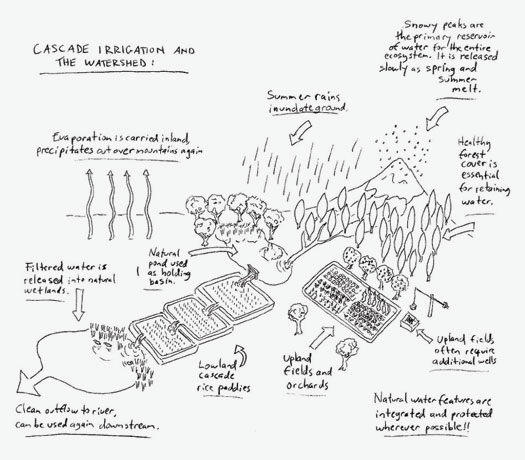
 One of the most important lessons is that the primary design response to material and energy shortages of the era was to seek multiform solutions, designs that solved many problems at once. ... the same attitude led to the development of rice paddy irrigation systems, which were almost entirely gravity-fed, acted as cascading filters for the water supply, and could function as solar-heated warm-water tanks for processing hemp and other plant-based textile fibers. The system allowed the paddies themselves to function as wetland habitat for many species in addition to growing food.

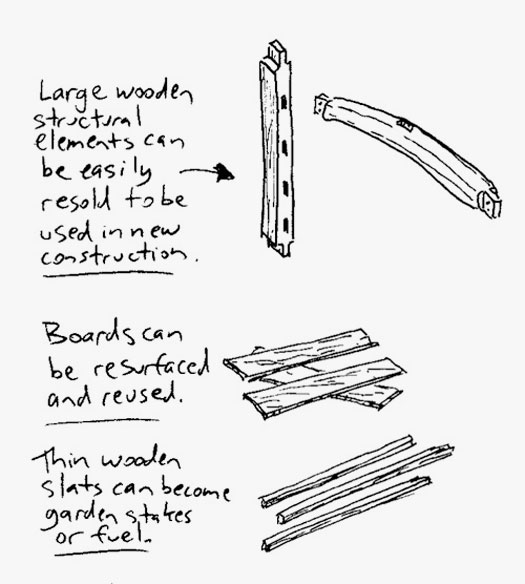
The design of the ubiquitous dismantleable Japanese jointed wooden building frame facilitated reusing the posts and beams elsewhere, helping to reduce the stress on forests for lumber supplies.

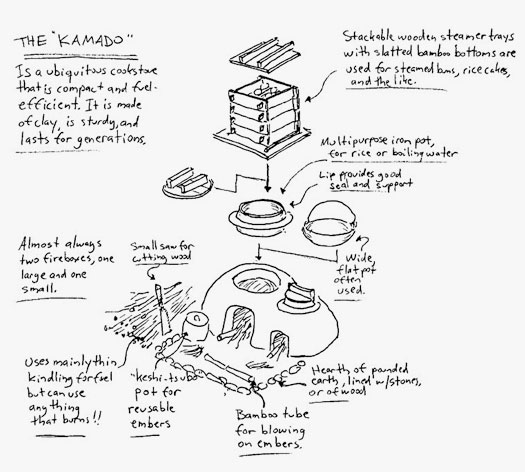
The constantly refined design of earthen cookstoves minimized fuel use and helped keep fuel consumption well within the available supply, further minimizing the stress on forests.

Forest management was recognized early on as essential for preserving the health of waterways that were vital for transportation and as a food source

 Metal, mainly iron, whose production depended upon a high expenditure of energy in the form of large quantities of charcoal, was an extremely valuable commodity.... The near total absence of metal nails in architectural structures, depending instead on mortises, tenons, pegs and wedges, and the fact that nails were carefully salvaged and reused whenever possible, attests as much to the desire to minimize energy consumption in the form of embodied energy as it does anything else.
 Can this be done without consuming fuel (like weaving)? Can it be made from a rapidly renewed material (bamboo for baskets, or reeds for thatch)? Can it take advantage of recycled material (a broken iron pot becomes a blade)? Is it scalable and able to be customized to suit specific regions, households or individuals (like kimono)? What is the desired degree of durability — is it better to make it last for generations (like cabinetry) or remade every year (like straw boots)? Is there a way to use the material at end-of-life (use the straw as fuel, convert worn cotton fabric to pouches)?
...by and large the intricately interconnected sustainable material production system broke down with the advent of the industrial revolution in Japan in the late 19th century. The widespread introduction of fossil fuels, coal primarily, broke the bond between people and the forests that had supported them..."

Sunday, March 14, 2010

If it is true, it will return. Recovering lost knowledge.

If the first Industrial Revolution had a motto, we like to joke, it would have been "If brute force doesn't work, you're not using enough of it."
- William McDonough & Michael Braungart : Cradle to Cradle
That is the world that was built for us and that we grew up in. A world of cheap power and the belief that wielding that power was the "best" answer to everything. From a building perspective, that led us to glass encased, sealed boxes in the desert. As long as you have the cheap power to cool (and heat) them, then things are fine. But when you don't, what do you do?

Turns out that our forebears knew and built differently.
- Verandas to shade large sections of the house.
- Trees and Ivy to shade the walls.
- Natural ventilation to draw cooler air in and push warm air out (double hung windows and high windows with ground floor doors in factories).
- Heavy earthen walls to act as thermal buffers.

When you couldn't count on brute force, you had to build differently.

And now, with the push to put a soft landing on climate change making "cheap power" decidedly not cheap, we're rediscovering that there are better ways to build.

A great example is Passivehaus.
In short: Seal and insulate the house to an extreme. Use passive solar (and appropriate shading), ground source heat and body heat to make the place warm. Use exhaust air heat exchange to keep the warmth inside. Use the most energy efficient fixtures and appliances available to keep electricity usage down.
Here is a recent example of Passivehaus in California!

And there is more to learn from nature itself via biomimetics (e.g. how termites manage to control climate in their mounds).

The truth is out there if we are willing to bend with nature rather than to try to break it.