Showing posts with label LEED. Show all posts

Wednesday, June 23, 2010

Comparing Light Sources - LEDs vs Fluorescents vs Metal Halide HID

From the previous post, one could conclude that LEDs, Fluorescents and Metal Halide HIDs were all pretty much the same: High efficacy, OK to good CRI and good color temperatures.

Yet what we see are fluorescent bulbs everywhere.

One way to compare these light sources is by bulb life vs cost per lumen output with efficacy taken into account. That looks like this: "Good" is high and to the left with a larger bubble.

One conclusion that immediately stands out is how expensive LED lights are relative to the alternatives. They may be 2x as efficient and last 5x as long, but they are ~38x - 175x the price. That makes adoption of LEDs very difficult for most applications that don't have some other needs specifically met by LEDs.

Some of those special needs:
  • LEED certification 
    • LED lighting is more efficient so it can be used towards energy efficiency credits (EAc1). If 25% of a commercial building's electricity usage goes towards lighting and you can cut that by 50%, that's a 12.5% reduction in electricity cost.
    • LED lighting is more easily controlled (dimmable) to allow for controllability of systems - lighting (EQ6.1).
  • Flicker
    •  For some tasks and working conditions, 60Hz cycling from fluorescents can cause eye strain, especially if it is used with other visual equipment that runs off 60Hz AC. LED lighting has a 120Hz cycling which means it is much more difficult to detect flicker and it is less likely to beat with other equipment running at 60Hz.
  • Dimming
    •  Commercial use fluorescent bulbs (T8, T10 and T12) are not easily dimmable due to the construction of the ballast that keeps them lit. LEDs are dimmable using standard dimming equipment. This is important for applications where light level control is desired.
  • Directionality
    •  LEDs are point sources that can be configured more easily to provide a variety of lighting patterns (focused to diffuse) while fluorescent bulbs are generally quite long making it more difficult to use as task lighting or for other special lighting purposes.
  • Toxic waste disposal concerns
    • Fluorescent bulbs contain mercury which is a hazardous substance. LEDs do not contain mercury, though they are still eWaste and need special handling for disposal.
  • Low temperature operation
    • LED lighting performs better at lower temperatures. In fact, life time if greatly reduced if they operate at too high temperatures (hence all the heat sinks on the LED bulbs). This makes LED lighting a natural fit for lighting refrigerated displays.
  • Green image
    • The current perception of LED lighting is that it is the next big thing in energy efficiency and is, therefore, green. Using this perception to advertise your greenness is good marketing.
While Metal Halide HID compares well on the cost/lm vs lifetime graph, it does have a major strike against it, besides the borderline CRI: restrike time. This is the time it takes for the bulb's arc tube to cool sufficiently to restart the plasma. This can be several (1 - 15) minutes. A long restrike time makes such bulbs very difficult to use in locations where individual light control is required (e.g. office spaces or residential). Using fast starting HIDs greatly shortens the life of the bulb.

So as the cost of LEDs drop (cost comes in line with alternatives), energy costs rise (efficacy difference becomes more important) and green building codes become more prevalent (raising the minimum energy efficiency requirements for new buildings), the ROI of LED lighting will rise vs fluorescents until LED lighting makes economic sense. 

It's just not quite there today.

Wednesday, March 31, 2010

Disney and Virtual Daylighting

Daylighting is great, not only because it lowers energy costs and carbon footprint, but because it keeps you in touch with your own body clock and daily signals. i.e. It makes you happier and more productive.

Daylighting, though, is hard to get into all areas of a multiple story, large floor area building.
Top floor - skylights.
Bottom floors... you could deal with this in new construction through good design of courtyards,  floor layouts and light shelves but options are limited for an existing building.

So what does Disney have to do with this?
Their latest cruise ship, the Dream, has virtual portholes for interior staterooms.

These operate by tying a video feed from exterior cameras to a video screen "porthole" in each interior room (with some playful CGI overlays). The cameras roughly correspond to the location and direction a real porthole would occupy for each stateroom.

So why not solve the daylighting problem the same way?

An array of lights with programmable illumination and color temperature controls tied to a sensor on or near an exterior window roughly adjacent to the light array could replicate the near window lighting experience throughout a section of the building. Repeat with multiple arrays tied to multiple sensors and you have virtual daylighting. User controlled task lighting, an override program for bad weather, nighttime or an offset to the illumination and color could make up for the cases where outside lighting was not ideal for work.

This would not get you LEED EB:O&M* EQ2.4 (daylighting) credit, but implement it with LED lighting arrays and integrated sensors and you could go a long way towards LEED EB:O&M EAc1 (energy efficiency), EQc2.2 (controllability of lighting systems) and maybe an Innovation credit too.

*For new construction, the credits are LEED NC EQ8.1 (daylighting), EAc1 (energy efficiency) and EQ6.1,(controllability of lighting systems). However, as noted above, for new construction you could design around the need for virtual daylighting so I focused on the existing building credits instead.

Monday, March 29, 2010

The Next Best Alternative & "LEED Washing"

This article from Treehugger "The Four Sins of LEEDwashing" highlights some of the silliness that can occur from the current LEED credit system.

If you break NC v3 down by credits per category, you get this:
After you fulfill some prerequisites:
  • having a construction site pollution prevention plan
  • meeting a 20% reduction in water usage
  • performing basic commissioning
  • meeting minimum energy performance standards
  • not using CFC based refrigerants
  • having recycling plan and facilities
  • having a minimum indoor air quality plan
  • controlling tabacco smoke exposure
all you need is 40 points to be LEED certified.
This can lead to some strange configurations that would not be sustainable at all. For example:
  • A new building in the middle of the desert, far away from any housing, other development or public transit, with a grass lawn that made no special effort to control energy use could be certified  if it took extra care to:
    • Control construction waste, reuse materials, use recycled, sustainable, FSC certified wood and materials. [8 points in Materials and Resources]
    • Put a huge number of solar panels on or near the building, buy green power contracts, control refrigerant types, commission the building more thoroughly and then put an M&V plan in place to ensure that those systems continue to work as designed for a year. [16 points in Energy and Atmosphere]
    • Make a really nice interior environment for its residents by supplying extra air, light and views. By controlling indoor pollutants, by letting inhabitants control their own lighting and environment and by designing and verifying that the environmental design and those environmental controls work as designed about a year later. [15 points in Indoor Environmental Quality]
    • Ensure that residents and visitors are "educated" on just how "green" this building is... or, if that is too ironic, use organic cleaning supplies... or that is too much to ask, find a LEED AP to be a principal on the project. [1 point in Innovation and Design]
That's not very green, but is it better than the alternative: Doing none of the above?

That's a tricky balancing act.
If the bar is too low then it risks becoming greenwashing and undermining real efforts.
If the bar is too high then it risks inaction and rejection as being "too much."


So USGBC probably has struck a good middle road by starting somewhere that is arguably credible and gradually ratcheting the requirements as public and industry sentiment and awareness improve.
Not perfect but better than the next best alternative.

Thursday, March 18, 2010

LEEDing to Better Building Control and Efficiency via Wireless Mesh Networks

LEED v3 has expanded the emphasis on measurement and verification (M&V) in order to offset concerns that green buildings don't maintain designed performance over time.

The rating system where this is most evident is in the LEED 2009 Existing Buildings: Operations & Maintenance (EB:O&M) If you dig through the credits with an eye towards the ones that:
  • Require or could benefit from some sort of real time or on-going monitoring
  • Could use a portable monitoring system comprised of sensors and small data network.
  • Address the toxicity and recycle-ability of the sensor & networking systems
You find that something on the order of half of the credits (around 46 of 92 when I last checked) could be affected by having a good sensor system available.

Sensors, of course, need a communication network to feed their data back to a building automation system, (BAS) or building management system (BMS). If you are forward thinking and lucky enough to be engaged in new construction, then you can build many of these networks into the plan. Then when you meet the USGBC requirement for ongoing performance monitoring by following the EB:O&M certification route, you will be ready. For new construction, this is probably a good way to go.

However, if you're in the position of having an already complete building and you want to obtain EB:O&M, getting such a network in place could cost a considerable sum due to the wire routing involved. In such cases, using a low power wireless network would be preferable. Given the large area to be covered by a wireless sensor network and the large number of discrete sensors needed, this kind of application lends itself to a wireless mesh network (ala IEEE 802.15). Basically a network that uses the nodes to communicate with each other rather than requiring all units to communicate with a central access point. The more nodes (sensors) in place, the better the network becomes... and it's low power enough to run on batteries for months at a time... important if you need to pay someone to replace all those batteries.

UC Berkeley has pioneered work on this topic, coining the phrase "smart dust," and spun off at least one company (Archrock) that aims to address this kind of market space.

Saturday, March 6, 2010

Sustainable water use - how much does fixing the dripping faucet matter?

While there is much focus on energy usage as a key issue in sustainable development, water usage is also a very important issue.

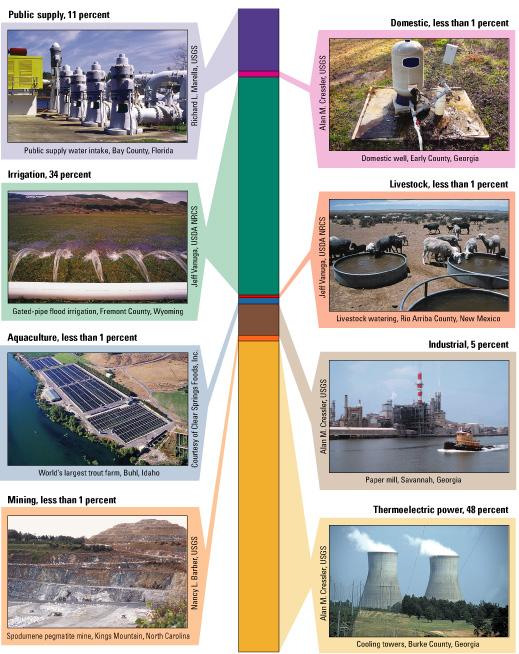
The USGS has an interesting summary of water usage in the United States for 2000.
One huge take-away is summarized in this figure from the report: A breakdown of total (fresh + salt) water usage.
 
  • 34% of water is used for agriculture
  • 48% of water is used for power generation
  • 11% of water is for domestic use
  • 5% of water is for industrial use
Reworking these numbers to show only fresh water usage:
  • 40% is for agriculture
  • 39% is for power generation
  • 13% is for domestic use
  • 5% is for industrial use
 So if all domestic and industrial buildings were to obtain the highest level of LEED v3.0 credit for water efficiency (WEp1 and WEc3 (40% reduction in total water usage for 4 points)), that would mean:
  • 8% is for domestic use
  • 3% is for industrial use
A total drop of ~7% vs the 79% combined agriculture and power generation usage.

Put another way:
  • If you could improve efficiency of agriculture's and power generation's water usage by 23%, that would equal all the water used by domestic and industrial consumers combined.
  • It would take less than a 10% improvement in agricultural + power generation water usage to be equivalent to making every home and business in the US maximally water efficient per the LEED v3.0 standard.
So in the big picture, leaky faucets probably don't matter in the way that making agriculture and power generation more efficient would matter... but you don't hear much about that in the news...