
Showing posts with label sustainable development. Show all posts

Friday, December 31, 2010

Saving the Savages = Breaking the System

I just finished reading The Wayfinders - Why Ancient Wisdom Matters in the Modern World by Wade Davis. Besides being one of the best arguments I've read on why sustainability matters and where we might "relearn" how to achieve it, there was a section on the consequences, however well intended, of misunderstanding the context of a culture and of applying the wrong solution to a problem because of it.

The story is of the people of the Kasuit desert in northern Kenya. For hundreds of years, they lived in this desert. They developed a culture that embraced the difficulties of living in the desert and, therefore, did just fine. Until severe drought, combined with nearby wars brought this region to the attention of the West. At which point, the United Nations took actions to "save" them from themselves.
Following is my summary of Wade's story.

The culture the originally developed worked like this:

To ensure that enough livestock survived severe drought, large herds of livestock were required.
To maintain large herds required large families, stewardship of the land and a nomadic lifestyle (so that the carrying capacity of any one area was not exceeded).
The requirement to have large families resulted in polygamy being common. But to maintain social harmony among the young men in a group where there were not enough women for every man, the culture developed rites around sending young men away to tend the herds. These rites bound together the men involved in them, creating life-long social bonds which reinforced the "commonness" of their use of the land (avoiding the "tragedy of the commons"). These rites also instilled a large amount of prestige in the men, allowing them to accept the situation which supported the large families.

Then the UN intervened and added a few things:
First they added the idea of private ownership of the land and, thereby, permanent settlement. This required the reduction of herd size which quickly led to dependence of outside aid to keep the people alive.
Outside aid included western education. The education broke the traditional rites of passage (by instilling the idea that such a life was "beneath" an educated man), which broke the personal ties which were necessary, among the other factors, to allow life in the harsh environment.

The entire culture collapsed and, along with it, the ability to sustain life in that place.
All with the best intentions...
...but without sufficient respect for the wisdom of the people who had learned to live within the limits of the place they inhabited.

Thursday, April 29, 2010

Necessity is a *Mother* ... oh... of invention

This is a short video of how one architect has used very limited space (344 sq. ft) to maximum effect (24 purposes built into that single space) in a city (Hong Kong) where space is at a premium.


I'm not saying this is how we should all strive to live or even how we'll end up living despite our ambitions, however, it does get one to thinking about what we'd do differently if we were faced with scarcity of this sort on more of our design problems.

  • Not enough space to have 3000 sq ft. per home.
  • Not enough fuel to drive 30 miles to work and back. To drive 10 miles for groceries. To ship groceries 1000s of miles to a supermarket.
  • Not enough water to "waste" it on grass or even on washing clothes.
  • Not enough chemical or electrical power to level mountains or keep our homes and workspace air conditioned or heated. Or lit for more than a few hours a day artificially.

I'm not a Luddite, but it seems like thinking as if we had these restrictions might actually result in some greener, more sustainable approaches.

Saturday, March 6, 2010

Sustainable water use - how much does fixing the dripping faucet matter?

While there is much focus on energy usage as a key issue in sustainable development, water usage is also a very important issue.

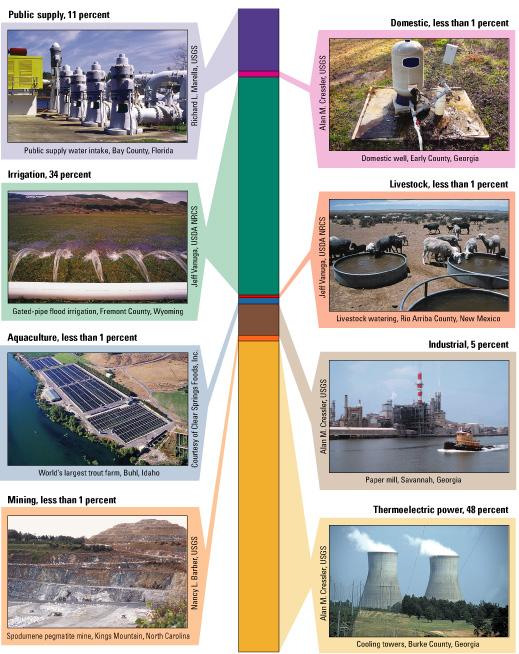
The USGS has an interesting summary of water usage in the United States for 2000.
One huge take-away is summarized in this figure from the report: A breakdown of total (fresh + salt) water usage.
 
  • 34% of water is used for agriculture
  • 48% of water is used for power generation
  • 11% of water is for domestic use
  • 5% of water is for industrial use
Reworking these numbers to show only fresh water usage:
  • 40% is for agriculture
  • 39% is for power generation
  • 13% is for domestic use
  • 5% is for industrial use
 So if all domestic and industrial buildings were to obtain the highest level of LEED v3.0 credit for water efficiency (WEp1 and WEc3 (40% reduction in total water usage for 4 points)), that would mean:
  • 8% is for domestic use
  • 3% is for industrial use
A total drop of ~7% vs the 79% combined agriculture and power generation usage.

Put another way:
  • If you could improve efficiency of agriculture's and power generation's water usage by 23%, that would equal all the water used by domestic and industrial consumers combined.
  • It would take less than a 10% improvement in agricultural + power generation water usage to be equivalent to making every home and business in the US maximally water efficient per the LEED v3.0 standard.
So in the big picture, leaky faucets probably don't matter in the way that making agriculture and power generation more efficient would matter... but you don't hear much about that in the news...