Thursday, September 9, 2010

A World of Connected Strangers Feels Bad

Here is perhaps an interesting way to look at how the world has become increasingly networked (connected) yet somehow we still remain strangers to each other.
Our livelihoods are either:
  • Dependent on others = My ability to survive and live the lifestyle I have become accustomed to depends the work output of others (or at least some specific others). 
  • Independent of others = My survival and/or lifestyle does not really require these other people.
Our ties to other people (on whom we depend or not) are either:
  • Intimate = I know these people well. I probably care about their well being.
  • Strangers = I don't know these people... maybe I've never even met them. Their well being is certainly not a deeply personal issue.
 This gives:
  • Independent Strangers = Groups of people who can live on their own and keep to themselves. The "outsiders" don't really matter.
  • Dependent Intimates = Groups of people who know each other very well and who live (and die) for each other. Fellow soldiers in battle captures the extreme of this idea. Members within a tribe would also qualify.
  • Independent Intimates = Groups of people who know each other well but whose relationship does not really affect their ability to live. It's very nice to be friends, or maybe they know too much about each other, but when they move away, nothing really changes.
  • Dependent Strangers = Groups of people who may not even know each other exist but whose lives depend on the existence and actions of each other. Who grows your food? Who makes the clothes you wear? Who buys the goods that pay for the services that your company pays you to deliver?
 My thought is that we're biologically wired to be dependent intimates and social units which meet that model have been the basis for humanity for most of our history.  In the modern world, however, we've become dependent strangers with occasional access to independent intimates.

Where it was once normal to be in a band of brothers, now it is a rare exception. That we treasure it when it happens speaks to the deepness of it's importance.

What does this have to do with sustainable business?
In this post, I was thinking about a sustainable business process. One that " makes my people and customers more fulfilled rather than just "less abused" in pursuit of the company's goals."
In a world of dependent strangers, I'm not sure this is possible.
So having some framework to assess the alternatives is helpful.

Friday, September 3, 2010

More about games and sustainability

In a previous post, I was thinking about how to connect the game world to the real world so that the game was not ABOUT sustainability, but actually required sustainable behaviors in order to play. In that post, I mentioned using smart meters as "input devices" and augmented reality as two possible approaches.

Here are a couple more thoughts:
Tweet-a-Watt
 Use the Kill-a-Watt product, modified to tweet your electricity usage, in order to easily report energy usage over time. By tracking usage changes, giving points for number of connected electricity monitors, creating special achievements that require certain energy usage behaviors and teaming up with others to pool points to perform in-game actions, you can link real energy usage to the game's outcome. By making the interface a tweet instead of a manual entry the game can focus on action rather than data entry.

Reverse my thought - pay for sustainability through proceeds of the game's sales or in-game economy
Maybe my thinking about requiring sustainable behaviors to play isn't the right way. Maybe a good alternative is to fund other peoples' sustainability activities by playing games. Puff Puff : Gulf Spill is an iPhone game that donates 10% (or 30% depending on whether the article or the video is correct) to habitat restoration. Donating proceeds from sales to a charitable cause is not a new thing, but attaching it to a game is new.
Attach it to a game with an in-game economy (e.g. World of Warcraft, Second Life, EvE Online, etc.) and give the option to the player to donate some of their in-game money to real world causes (instead of cashing it out as real-world money or selling it to someone else for real world money as is done on eBay) and it might be useful.

Friday, August 20, 2010

(more) TED on games as a way to make change

I posted earlier (here and here) about sustainability and using games to try to change peoples' behaviors toward the more sustainable.

Following is a TED video about that same topic (driving behavior changes with games) from someone whose work it is to drive business by getting people to play games that require interaction with the real world: in this case the companies that want you to visit them and buy their products.

Key take aways for me:
  • Last decade was the decade of social. This is the decade of games.
  • With 7 dynamics, you can get people to do anything.
  • Four dynamics presented in the video (the other 3 are "secret" so that the speaker still has a competitive advantage at the end of the talk :P).
    • Appointment dynamic = Do something at a certain time and place.
    • Influence and status = Offer things that convey social status
    • Progression dynamic = Offer a definition of "100% complete" and track progress against it. Level-up.  Unlock rewards over time.
    • Communal discovery = Everyone works together to achieve a common goal.

Saturday, August 14, 2010

Solar chargers for electric cars?

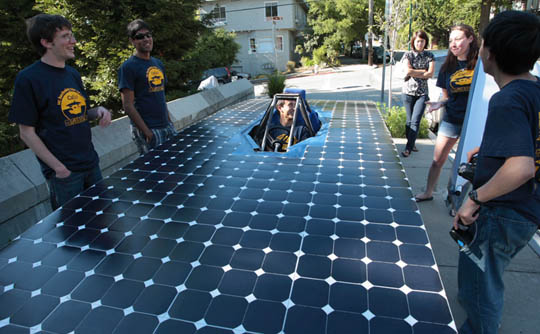
OK. This picture isn't what I'm actually talking about, but it does highlight part of the problem that would need to be solved:

Could you reasonably make a passenger car that charged itself using solar panels?

A few assumptions:
That would result in  ~16MJ of energy per day.
So you could recharge 11% of the battery a day, which would yield a range of ~10.8 miles.

If you assume the average commute is 33 miles each day (16.5 miles each way), that would mean:
  • To allow for a full trip home would take ~12 hrs of recharge time or
  • A panel that could generate ~0.9kW and be ~86 ft^2. That's more than 1.5x the area available on the car roof.
To give a sense of the size of the problem of solar charging exclusively:
  • To fully charge the battery would take ~73 hours or 
  • A panel that could generate 5.2 kW and be ~519 ft^2. That's more than 9x the area available on the car roof.
Most houses that get solar PV only go for 2 - 3 kW.

So self powered cars ALMOST make sense as long as you can recharge them from the grid after you get home. Fully self powered solar cars don't make sense.
It also strongly suggests that solar powered EV recharging stations (e.g. with the panels on a nearby roof or on the parking lot roof) actually make quite a bit sense.

Thursday, August 12, 2010

A better way for electric cars? A Better Place.

What are the two main things you worry about with electric cars?
  1. Price
  2. Range
Gasoline is great because it is a well established, subsidized fuel with very high energy density (1.3x10^8 J//kg). That makes it easy to carry around and get pretty far with. Plus, when you run out, there's always a gas station somewhere nearby. Price and range... not a problem.

Electric cars are limited by their batteries. Li-Ion battery's energy density is nowhere near as high as gasoline (5.2x10^5 - 7.2x10^5 J/kg - gasoline has >180 times more energy per kg of "fuel"). Even accepting that a gasoline engine is 30% efficient vs a 90% efficient electric motor (i.e. total energy that would be converted to work per kg of fuel is 3.9x10^7 J/kg for gasoline vs 6.5x10^5 J/kg for Li-ion), that yields ~60 times more energy per kg of "fuel" from gasoline than from batteries. So to get the same range as a gasoline car (from one tank of fuel), requires either:
  1. A very large battery -or-
    • If a typical car holds 15 gal of gasoline (@ ~2.7kg/gal = 40.5 kg) , a battery that contains the same effective energy would need to weigh ~2430kg ... where a Honda Civic weighs about 1270 kg... not practical to carry or to pay for.
  2. The ability to "refuel" the battery in less time than refueling a car 
    •  Even with the best recharger possible, it takes hours (~4 hrs for a Tesla roadster) vs maybe 5 minutes to refill a gas tank.
    • With a 100 mile range per battery charge, that would require about 4 battery charges per tank of gas (assuming CAFE standard of 27.5 mpg and 15 gal tank = 412 mile range). Sixteen hours (battery) vs 5 minutes (gasoline) (assuming both cars start empty).
 Those are pretty bad starting places to catch up from.

So Shai Agassi has an idea: Treat the electric car like a cell phone.
The customer buys miles and gets a subsidized car. The batteries are the medium for the "minutes." You never own them, you just use them.
Which means you can now swap batteries because you don't care about the specific battery that you have, only that you're getting the mileage you're paying for.
Suddenly the range problem goes away (~1min to change the battery).
Suddenly the price has a means of being subsidized (ala cell phone contracts that keep the price of the phone low for the end user).

Kind of like Blue Rhino propane tanks ... but way cooler.

And he created a company Better Place to do it:
  • Get the cars built
  • Get the battery swap system figured out
  • Get the infrastructure in place
  • Prove to the world that it can work
Check out this video (or the video below) of the system working in Tokyo. It's real.


So, admittedly, it only works where you have the infrastructure, but it certainly gives a new direction for addressing the two big problems of EVs.

Friday, August 6, 2010

Biking to work and energy efficiency

Bike to work and stop global warming.
Bike to work and get healthy.
Ok. Since it's so good for me and my planet and I'm only about 6 miles from work, I finally decided that I should give this a try.

I used a cool iPhone app (Runkeeper) to log how far I went and how fast I went there. As part of the app I got an estimated calorie usage... and that got me thinking about energy efficiency:

So my bicycle commute is more than 18 times more energy efficient than driving.
...And I drive a Prius.
If you use the CAFE Standard fuel efficiency for a passenger car in 2010 (27.5 mpg), then that bicycle commute is more than 28 times more energy efficient than driving.

To be as energy efficient as cycling, the car would need to use 0.01gal of gas for the 6 mile trip, which is 600 mpg! Whereas the current automotive X-Prize is only looking for 100 mpg... 6x short of what is needed.

So we REALLY need to be doing more of what Copenhagen is doing with making cycling mainstream:
"If you make the bicycle the fastest way to get around the city ... you're going to get everyone and their dog to do it."
  • Pervasive use of dedicated bicycle lanes.
  • 37% of all people commuting to work or school use bicycles.
  • 50% of all trips in the city are made by bicycle.
  • Double bike lanes to accommodate bike traffic volume in some places.
  • "Green wave" timed to give cyclists a no-stoplight flow into the center of the city for 6km (3.7mi).
  • Red LED lights on the bicycle lane demarcation that sense coming bicycles and flash to warn cars to avoid right turn conflicts.
  • Dedicated parking spots for cargo bikes (taking away 1 car parking spot for 4 cargo bike spots).


Picture credit: Adam Stein (terapass blog)

The Value of Uncertainty - Subjectivity and High Dynamic Range

It is generally agreed that 24 bit color provides more shades (~16.7 million) than the human eye can perceive (~10 million).
For grayscale, only about 100 shades can be distinguished while typical monitors can display 256 shades (8 bit).

Twenty four bit color is generated on a computer monitor by having 3 colored pixels (Red, Green and Blue) displaying up to 256 shades of brightness each (8 bits). Three colors x 8 bits per color = 24 bit color.

A typical digital camera uses 12 - 14 bit sensors, one for each color. This yields 36 - 42 bit color images. Why is this helpful? Even though the eye cannot see all the colors, a computer can still process them. By saving the additional information (i.e. saving the image in RAW format, instead of a compressed format like JPEG), the programs can rescale and process the images with much lower levels of artifacts. e.g. stretching the contrast can introduce bands in the colors called posturization.
 Another image processing option that the extra colors and range make more effective is High Dynamic Range (HDR) photography. In this computational photographic method multiple images of the same scene are combined to maximize the visibility of all areas of the photo. This can result in some very striking images but often only after a significant amount of manual tweaking to get just the right effect. Here-in lies the value.

"Existing tools are therefore likely to improve significantly; there is not currently, and may never be, an automated single-step process which converts all HDR images into those which look pleasing on screen, or in a print.  Good HDR conversions therefore require significant work and experimentation in order to achieve realistic and pleasing final images."

There is no simple answer to getting the "best" HDR rendering. Therefore hobbyists will pay for tools, new tools and more new tools to let them conquer the uncertainty - that there might be a better picture somewhere in the data.

Inspection Equipment
How can KLA-Tencor get away with a 60% gross margin selling hardware with substantial COGS?
That comes largely from the defect inspection groups vs the metrology groups. Why?
Value, in this case, comes from the lack of a definitive base-line. In metrology the standard is defined: a micron is a micron. Differentiation is hard because there is a clear definition of success. In inspection, there is always the fear that there might be a better result somewhere in the data... You don't know if it's good enough.

What does HDR have to do with this?
Humans can't see the difference between 10,000 gray levels but machines can. Setting up the algorithms to properly deal with this difference is hard. For example, one aspect of tuning comes from the bit depth of the sensor. Combinations of possible parameters increase from 8 bit (multiply combinations by 256) to, say, 14 bit (multiply combinations by 16384). Increasing the bit depth increases the amount of information and the possibility that there may be good results in the data, but it also makes comparisons even more difficult, i.e. higher risk.  Proving that you are the best at reducing this risk is hard. Customers pay a premium for what is hard to do.

Medical Imaging
Why are medical imaging devices constructed to such demanding specifications, particularly native bit depth (12 bit grayscale) processing and display, when the human eye can't see that many shades?

My guess (I have not seen a definitive answer): Liability - if a diagnosis was missed or rendered incorrect because of a conversion artifact or loss of data that would be bad.

The risk caused by subjective interpretation of images, particularly if those images have been modified in some way by the system, drives mitigation through rigorous technical specs (extended bit depth, color temperature control, white level balance, color matching, multiple monitor matching). Those specs increase material, installation and maintenance costs directly. They also reduce the number of vendors who can meet those specs further driving up price.
Are those specs and the associated costs really necessary? Fear (and / of lawyers) say "yes" so medical grade display systems sell at a significant premium vs commercial displays.

Thursday, July 22, 2010

A Video game ABOUT environmental responsibility

Speaking of games as a way to encourage people to make sustainability a part of their routines. I bumped into this article about Oceanopolis -
"a fun, interactive and educational game that engages players worldwide in stopping waste and recapturing resources using recycling & up-cycling principles."

This is a Facebook based game, created by the recycling company Greenopolis, that lets you perform a variety of waste management activities to keep your island clean and to earn points to buy in-game (or some real world) stuff. Basically it's a game ABOUT recycling (I'll get back to that in a minute) that is intended to make learning about the benefits of recycling fun and maybe a little cool.

So how does this stack up against some of the factors that I think make for a good game? i.e. the ones that keep you coming back for more...
[Full disclosure: I have not played the game. This analysis is based on the description of the games features, some feedback from players on the facebook page and experience with similar games]
  • Sense of progression
    • Achievements - The achievements seem to be centered around buying in-game stuff to build up your island. There is a promise of adding quests and so-forth in the future, but it is not clear if this gives you badges or other permanent signs of achievement or just the generic "point."
    • Discovery / story - New garbage? New up-cycled things you can make with your garbage? New animals to rescue?
  • progression measured vs others and yourself (normalizing scoreboard)
    • Points and the scoreboard - There appears to be a scoreboard in game that summarizes how much stuff you have collected and points earned. Not clear how public this is or that is is compared to others' boards.
    • Buying stuff - Progression becomes mostly about adding things to your island and your Avatar that others can see when they visit.
  • bragging rights - tell your friends
    • Facebook integration - presumably this game will spam your friends' walls with updates of what you have collected, built and bought.
    • In-game chat - not clear that there is a way to converse with other Avatars but you can visit other's islands and see what stuff they have on the island as well as on their Avatar.
  • Replay value
    • Get real world stuff - Points can be "...turned into cash donations, or exchanged for real discounts at thousands of restaurants, theaters and real-world establishments." So to the extent that getting these things is really interesting or helpful it might keep you coming back.
    • More islands - you get the opportunity to manage more islands... but it's hard to imagine that the experience on two islands will be much different than one island. It is a chance to keep playing, but it's not clear that it really ends or has a logical conclusion that you'd want to go back and see over and over.
So I'm not sure how "sticky" this game will be as it seems fairly one dimensional about a topic that most people don't find that interesting...

 Game ABOUT sustainability or a game that helps you be sustainable?
A more important idea that this game helps crystallize for me is the difference between a game ABOUT a thing and game that involves you in DOING a thing. To borrow a little terminology from Switch - How to change when change is hard [Chip and Dan Heath]:
  • A game "about" implies that the goal is to teach people and that will change behavior (motivating the rider).
  • A game of "doing" implies that the goal is to shape the path and include changed behavior as part of the criteria of winning the game.
Oceanopolis clearly falls into the "about" catergory despite its one real world link which is to get extra points for recycling at a Greenopolis recycling station.

MIT has been doing research on Augmented Reality (AR) games. These games put the player in the real world, doing real and virtual things in order to play. That is perhaps a little further than most want to go for a game but it does suggest the opposite extreme from games that are entirely about cerebral learning of what to do.

So... I'm still looking for that game that strikes the right balance of in-game progression and feedback using real world signals and behaviors (think Smart Meters!).

Monday, July 19, 2010

Edible drinking cups

Better than a cup that is recyclable or reusable, how about one that is compostable and edible?

These cups are made from agar, an extract from reg algae, frequently used in Asian desserts and biology experiments.

According to this material data about Agar:
  • It melts at 176F so holding it in your hand shouldn't be a problem. 
  • It is insoluble in cold water 
  • Is "completely resistent to the enzymes applied in the food technology area" ... which I take to mean it won't dissolve or react with things you'd want to eat or drink.
So as long as you're not looking to drink hot coffee or tea from it and aren't going to let it sit outside for too long (agar is a popular substrate for growing bacterial colonies), agar is a widely available, non-endangered plant product, so it does seem to solve that part of the "green" equation.

However, this material clearly has some problems with large scale use in an office:
  • Agar does not fold or compress without losing it's structural integrity so it would be difficult to transport or store in large numbers.
  • Agar is a nutrient so it probably needs to be refrigerated, further adding to the transportation and storage costs... unless you brew and mold your own cup on demand... which would be novel if not very efficient.
  • Agar is one of the more expensive gelatines, so compared to a foldable paper cup, it would be difficult to justify the cost per unit to give away by the hundreds and thousands per months.
oh well... it makes an interesting story.

Thursday, July 15, 2010

The essence of a drinking cup

How would you rebuild a disposable drinking cup if you had sustainability in mind?

  • minimum material per cup
  • use of renewable resources
  • use of recyclable materials
  • low cost
  • small storage and transportation foot print
  • high packing density (less restocking labor costs)
It might look a lot like this:

Opened to hold water. You would hold this and drink from it.

This is the dispenser next to the water cooler. That is a HUGE number of cups (100s) in a tiny space. 
Compare to the ~15 styrofoam cups in this picture stacked to roughly the same height as the paper cup dispenser box.


This won't work for hot drinks and it's difficult to use a single cup for more than a few drinks, but for it's intended purpose: getting a quick drink of water, it's quite effective.

It would be better to not use disposable cups at all but...


stacked Styrofoam cups photo credit: Dan Meyer @ http://blog.mrmeyer.com/?p=69

Wednesday, July 7, 2010

EDF Climate Corps Handbook

The Environmental Defense Fund (EDF) has published a free guide to making your office building more efficient system by system. It has:
  • An overview of how to approach the problem (7 steps)
    • Estimate baseline energy use intensity.
    • Commission an energy audit.
    • Consider interactions between systems.
    • Perform financial analysis of possible efficiency investments.
    • Prioritize options for investment.
    • Evaluate financing options.
    • Post-implementation follow up.
  • Tips for identifying and overcoming common barriers to implementing energy efficiency
    • Structural
      • Split incentives - one who bears cost of improvements does not accrue benefits
      • short lease terms - payback period is longer than least term
    • Organizational
      • Scarce resources
      • “Language barriers” between finance and facilities
      • Coordination challenges across finance, human resources and facilities
      • Limited accountability for green initiatives
    • Financial
      • Payback period expectations are unrealistically short
      • Large up-front costs to implement some improvements
      • lack of awareness of  tax incentives or utility subsidies
  • Simple, practical suggestions for which systems to look at first (lowest cost for highest impact)
    • Which systems exist and which you should go after first
      • Lighting
      • HVAC
      • Office equipment
      • Water heaters
      • Building Automation Systems  / Energy Management Systems
      • Data centers
      • Fleet vehicles
    • Which areas to focus on and which to skip within each system
      • Behavioral and policy changes
      • Retrofits
      • Equipment replacement
    • Tips on prioritizing which improvements to make
    • Key questions to ask and information to gather around each system
  • Case studies to help justify implementing changes in any particular area.
e.g. Financial case study: Until 2001, the 1.4-million-square-foot Hewlett Packard (HP) campus in Roseville, California, was operating an EMS with limited automation, which required labor-intensive manual adjustment of controls in order to curtail energy loads during peak demand events. Using funds available from the California Energy Commission and the local municipal utility (Roseville Electric), HP upgraded its EMS and added additional sensor and control points for ventilation and lighting systems. The changes gave HP the capability to shed 1.5 MW of its 10.9 MW peak demand without disrupting occupants. HP now uses the EMS load-shedding capabilities on a day-to-day basis, saving $1.5 million annually in energy costs as a result. The EMS upgrade cost $275,000, but incentives covered $212,000 of the project cost, giving HP a payback of less than one month on the project.6
  • Ideas for presenting financial and non-financial arguments to the appropriate stakeholders in the organization.
  • High level primers and key-word dictionaries on main building systems and links to more information about them to help focus one's learning.
The EDF also has a program where companies can host a Climate Corps member (MBA student) and have that student come on site for ~10 weeks to implement an energy efficiency program based on the guidelines in this handbook.

A very interesting package for kick-starting energy efficiency at your company.

Tuesday, July 6, 2010

The Intersection of Cats, Video Games and Conservation

Why is it so difficult to train cats to stop doing something?
As predators, they evolved to deal well with intermittent reinforcement : 9 out of 10 times, it won't catch the mouse, but the 1 time it does is enough to keep it hunting for another day. It it quit every time the mouse escaped it wouldn't be a very good predator.

What do we love about the really addictive video games?
More intermittent rewards for making progress against some goal, spaced just right in time to maintain a sense of progress and recorded for ourselves and others to see how much progress we've made.

Why is conserving resources so hard?
Our predator nature loves intermittent reinforcement but conserving resources is, generally, a slow cumulative, silent process.
  • There are no achievements, trophies or (annoying) progress messages to your friends.
  • No normalizing scoreboard that tells you how well you're doing against "the best" or against "100%."
  • No updates, patches, new weapons, armor, new recipes or new quests. No $5 DLC packs.
  • Replay value is pretty bad. In fact, the first game never ends.
Why would I play *THAT* game?

Whoever can turn conservation and efficiency into a game, a really good, addictive game, will win for all of us.

Thursday, July 1, 2010

A Framework for Sustainable Business

Sustainability
"The ability to provide for the needs of the world's current population without damaging the ability of future generations to provide for themselves. When a process is sustainable, it can be carried out over and over without negative environmental effects or impossibly high costs to anyone involved."
This definition is nice but how to make it actionable?
A checklist would be nice, but that is probably too simplistic. Rather, there seems to be a few key ideas that lead from this definition that give a framework for answering the question: "Is this sustainable?" in whatever context it might arise. The first question is: sustainable for whom? Which leads to...

Triple Bottom Line (TBL)
""People" (human capital) pertains to fair and beneficial business practices toward labour and the community and region in which a corporation conducts its business. A TBL company conceives a reciprocal social structure in which the well-being of corporate, labour and other stakeholder interests are interdependent."
""Planet" (natural capital) refers to sustainable environmental practices. A TBL company endeavors to benefit the natural order as much as possible or at the least do no harm and curtail environmental impact. "
""Profit" is the economic value created by the organisation after deducting the cost of all inputs, including the cost of the capital tied up."
To understand if something has unacceptable costs to anyone involved, you must first identify all of the stakeholders. The simplest embodiment of this idea is in the triple bottom line: Expanding accountability to the stakeholders rather than just the shareholders. Who are the stakeholders?
  • Your people
  • Your planet
  • Your profit (i.e. the economy in which you live and on which you depend).
Once you begin trying to account for all the stakeholders' costs and benefits you are led naturally to...

Full Cost Accounting (FCA)
  1. Accounting for costs rather than outlays
  2. Accounting for hidden costs and externalities
  3. Accounting for overhead and indirect costs
  4. Accounting for past and future outlays
  5. Accounting for costs according to lifecycle of the product

FCA requires explicit acknowledgement of costs that are typically ignored in traditional cost / benefit analyses. It requires systems thinking to understand the scope and source of these costs. The points of FCA that seem, to me, to be particularly relevant to sustainability are:
  • What does it really cost to obtain, use and replace a resource? Natural resource usage is a good example: prices reflect extraction costs rather than replacement costs (it's not sustainable if I run out with no replacement). So using resource price as the cost of resources is insufficient to account for the impact of using that resource. Oil is cheap to extract but difficult to replace.
  • Externalities are acknowledged as costs of business rather than someone else's problem. Passing the cost to someone else does not make the cost go away - it's just theft from that person. A good example is the effect of overworking employees. What is the cost of a crumbling family or of the loss of a parent from workplace induced illness or stress related disease? In traditional accounting, such concerns are not the business' concern so efforts to improve employee well-being are are difficult to justify.
  • Future outlays to deal with preventing externalities are also planned for. This encourages reuse and encourages building recycling and collection into the product design and business model. It is good business to have people buy a new cell phone every year, until you have to pay for the safe disposal of every one of those phones or the impact on health and environment loss from improperly disposed phones. Wouldn't it be more economically effective to plan on collecting and reusing the materials?

If you include in the costing the environment as the source of all resources and that a better environment results in more plentiful, higher quality, more productive resources (material and labor), then you reach...

Cradle to Cradle Design
"Cradle to Cradle design perceives the safe and productive processes of nature’s ‘biological metabolism’ as a model for developing a ‘technical metabolism’ flow of industrial materials. Product components can be designed for continuous recovery and reutilization as biological and technical nutrients within these metabolisms."

This is about making the world better with each unit produced rather than just making things "less bad."
While Cradle to Cradle emphasizes product design, to me the idea logically extends to sustainable business processes as well: How do I design a business process that makes my people and customers more fulfilled rather than just "less abused" in pursuit of the company's goals?

  • Trust marketing: respect your customers and their interests to build more business.
  • Foster and direct intrinsic motivation (Drive... see TED video below) to get the most from employees.


Put another way: sustainability seems to be about approaching business with Aikido in mind (blend and direct) rather than with Taekwondo in mind (block, strike and smash).