Friday, August 6, 2010

Biking to work and energy efficiency

Bike to work and stop global warming.
Bike to work and get healthy.
Ok. Since it's so good for me and my planet and I'm only about 6 miles from work, I finally decided that I should give this a try.

I used a cool iPhone app (Runkeeper) to log how far I went and how fast I went there. As part of the app I got an estimated calorie usage... and that got me thinking about energy efficiency:

So my bicycle commute is more than 18 times more energy efficient than driving.
...And I drive a Prius.
If you use the CAFE Standard fuel efficiency for a passenger car in 2010 (27.5 mpg), then that bicycle commute is more than 28 times more energy efficient than driving.

To be as energy efficient as cycling, the car would need to use 0.01gal of gas for the 6 mile trip, which is 600 mpg! Whereas the current automotive X-Prize is only looking for 100 mpg... 6x short of what is needed.

So we REALLY need to be doing more of what Copenhagen is doing with making cycling mainstream:
"If you make the bicycle the fastest way to get around the city ... you're going to get everyone and their dog to do it."
  • Pervasive use of dedicated bicycle lanes.
  • 37% of all people commuting to work or school use bicycles.
  • 50% of all trips in the city are made by bicycle.
  • Double bike lanes to accommodate bike traffic volume in some places.
  • "Green wave" timed to give cyclists a no-stoplight flow into the center of the city for 6km (3.7mi).
  • Red LED lights on the bicycle lane demarcation that sense coming bicycles and flash to warn cars to avoid right turn conflicts.
  • Dedicated parking spots for cargo bikes (taking away 1 car parking spot for 4 cargo bike spots).


Picture credit: Adam Stein (terapass blog)

The Value of Uncertainty - Subjectivity and High Dynamic Range

It is generally agreed that 24 bit color provides more shades (~16.7 million) than the human eye can perceive (~10 million).
For grayscale, only about 100 shades can be distinguished while typical monitors can display 256 shades (8 bit).

Twenty four bit color is generated on a computer monitor by having 3 colored pixels (Red, Green and Blue) displaying up to 256 shades of brightness each (8 bits). Three colors x 8 bits per color = 24 bit color.

A typical digital camera uses 12 - 14 bit sensors, one for each color. This yields 36 - 42 bit color images. Why is this helpful? Even though the eye cannot see all the colors, a computer can still process them. By saving the additional information (i.e. saving the image in RAW format, instead of a compressed format like JPEG), the programs can rescale and process the images with much lower levels of artifacts. e.g. stretching the contrast can introduce bands in the colors called posturization.
 Another image processing option that the extra colors and range make more effective is High Dynamic Range (HDR) photography. In this computational photographic method multiple images of the same scene are combined to maximize the visibility of all areas of the photo. This can result in some very striking images but often only after a significant amount of manual tweaking to get just the right effect. Here-in lies the value.

"Existing tools are therefore likely to improve significantly; there is not currently, and may never be, an automated single-step process which converts all HDR images into those which look pleasing on screen, or in a print.  Good HDR conversions therefore require significant work and experimentation in order to achieve realistic and pleasing final images."

There is no simple answer to getting the "best" HDR rendering. Therefore hobbyists will pay for tools, new tools and more new tools to let them conquer the uncertainty - that there might be a better picture somewhere in the data.

Inspection Equipment
How can KLA-Tencor get away with a 60% gross margin selling hardware with substantial COGS?
That comes largely from the defect inspection groups vs the metrology groups. Why?
Value, in this case, comes from the lack of a definitive base-line. In metrology the standard is defined: a micron is a micron. Differentiation is hard because there is a clear definition of success. In inspection, there is always the fear that there might be a better result somewhere in the data... You don't know if it's good enough.

What does HDR have to do with this?
Humans can't see the difference between 10,000 gray levels but machines can. Setting up the algorithms to properly deal with this difference is hard. For example, one aspect of tuning comes from the bit depth of the sensor. Combinations of possible parameters increase from 8 bit (multiply combinations by 256) to, say, 14 bit (multiply combinations by 16384). Increasing the bit depth increases the amount of information and the possibility that there may be good results in the data, but it also makes comparisons even more difficult, i.e. higher risk.  Proving that you are the best at reducing this risk is hard. Customers pay a premium for what is hard to do.

Medical Imaging
Why are medical imaging devices constructed to such demanding specifications, particularly native bit depth (12 bit grayscale) processing and display, when the human eye can't see that many shades?

My guess (I have not seen a definitive answer): Liability - if a diagnosis was missed or rendered incorrect because of a conversion artifact or loss of data that would be bad.

The risk caused by subjective interpretation of images, particularly if those images have been modified in some way by the system, drives mitigation through rigorous technical specs (extended bit depth, color temperature control, white level balance, color matching, multiple monitor matching). Those specs increase material, installation and maintenance costs directly. They also reduce the number of vendors who can meet those specs further driving up price.
Are those specs and the associated costs really necessary? Fear (and / of lawyers) say "yes" so medical grade display systems sell at a significant premium vs commercial displays.

Thursday, July 22, 2010

A Video game ABOUT environmental responsibility

Speaking of games as a way to encourage people to make sustainability a part of their routines. I bumped into this article about Oceanopolis -
"a fun, interactive and educational game that engages players worldwide in stopping waste and recapturing resources using recycling & up-cycling principles."

This is a Facebook based game, created by the recycling company Greenopolis, that lets you perform a variety of waste management activities to keep your island clean and to earn points to buy in-game (or some real world) stuff. Basically it's a game ABOUT recycling (I'll get back to that in a minute) that is intended to make learning about the benefits of recycling fun and maybe a little cool.

So how does this stack up against some of the factors that I think make for a good game? i.e. the ones that keep you coming back for more...
[Full disclosure: I have not played the game. This analysis is based on the description of the games features, some feedback from players on the facebook page and experience with similar games]
  • Sense of progression
    • Achievements - The achievements seem to be centered around buying in-game stuff to build up your island. There is a promise of adding quests and so-forth in the future, but it is not clear if this gives you badges or other permanent signs of achievement or just the generic "point."
    • Discovery / story - New garbage? New up-cycled things you can make with your garbage? New animals to rescue?
  • progression measured vs others and yourself (normalizing scoreboard)
    • Points and the scoreboard - There appears to be a scoreboard in game that summarizes how much stuff you have collected and points earned. Not clear how public this is or that is is compared to others' boards.
    • Buying stuff - Progression becomes mostly about adding things to your island and your Avatar that others can see when they visit.
  • bragging rights - tell your friends
    • Facebook integration - presumably this game will spam your friends' walls with updates of what you have collected, built and bought.
    • In-game chat - not clear that there is a way to converse with other Avatars but you can visit other's islands and see what stuff they have on the island as well as on their Avatar.
  • Replay value
    • Get real world stuff - Points can be "...turned into cash donations, or exchanged for real discounts at thousands of restaurants, theaters and real-world establishments." So to the extent that getting these things is really interesting or helpful it might keep you coming back.
    • More islands - you get the opportunity to manage more islands... but it's hard to imagine that the experience on two islands will be much different than one island. It is a chance to keep playing, but it's not clear that it really ends or has a logical conclusion that you'd want to go back and see over and over.
So I'm not sure how "sticky" this game will be as it seems fairly one dimensional about a topic that most people don't find that interesting...

 Game ABOUT sustainability or a game that helps you be sustainable?
A more important idea that this game helps crystallize for me is the difference between a game ABOUT a thing and game that involves you in DOING a thing. To borrow a little terminology from Switch - How to change when change is hard [Chip and Dan Heath]:
  • A game "about" implies that the goal is to teach people and that will change behavior (motivating the rider).
  • A game of "doing" implies that the goal is to shape the path and include changed behavior as part of the criteria of winning the game.
Oceanopolis clearly falls into the "about" catergory despite its one real world link which is to get extra points for recycling at a Greenopolis recycling station.

MIT has been doing research on Augmented Reality (AR) games. These games put the player in the real world, doing real and virtual things in order to play. That is perhaps a little further than most want to go for a game but it does suggest the opposite extreme from games that are entirely about cerebral learning of what to do.

So... I'm still looking for that game that strikes the right balance of in-game progression and feedback using real world signals and behaviors (think Smart Meters!).

Monday, July 19, 2010

Edible drinking cups

Better than a cup that is recyclable or reusable, how about one that is compostable and edible?

These cups are made from agar, an extract from reg algae, frequently used in Asian desserts and biology experiments.

According to this material data about Agar:
  • It melts at 176F so holding it in your hand shouldn't be a problem. 
  • It is insoluble in cold water 
  • Is "completely resistent to the enzymes applied in the food technology area" ... which I take to mean it won't dissolve or react with things you'd want to eat or drink.
So as long as you're not looking to drink hot coffee or tea from it and aren't going to let it sit outside for too long (agar is a popular substrate for growing bacterial colonies), agar is a widely available, non-endangered plant product, so it does seem to solve that part of the "green" equation.

However, this material clearly has some problems with large scale use in an office:
  • Agar does not fold or compress without losing it's structural integrity so it would be difficult to transport or store in large numbers.
  • Agar is a nutrient so it probably needs to be refrigerated, further adding to the transportation and storage costs... unless you brew and mold your own cup on demand... which would be novel if not very efficient.
  • Agar is one of the more expensive gelatines, so compared to a foldable paper cup, it would be difficult to justify the cost per unit to give away by the hundreds and thousands per months.
oh well... it makes an interesting story.

Thursday, July 15, 2010

The essence of a drinking cup

How would you rebuild a disposable drinking cup if you had sustainability in mind?

  • minimum material per cup
  • use of renewable resources
  • use of recyclable materials
  • low cost
  • small storage and transportation foot print
  • high packing density (less restocking labor costs)
It might look a lot like this:

Opened to hold water. You would hold this and drink from it.

This is the dispenser next to the water cooler. That is a HUGE number of cups (100s) in a tiny space. 
Compare to the ~15 styrofoam cups in this picture stacked to roughly the same height as the paper cup dispenser box.


This won't work for hot drinks and it's difficult to use a single cup for more than a few drinks, but for it's intended purpose: getting a quick drink of water, it's quite effective.

It would be better to not use disposable cups at all but...


stacked Styrofoam cups photo credit: Dan Meyer @ http://blog.mrmeyer.com/?p=69

Wednesday, July 7, 2010

EDF Climate Corps Handbook

The Environmental Defense Fund (EDF) has published a free guide to making your office building more efficient system by system. It has:
  • An overview of how to approach the problem (7 steps)
    • Estimate baseline energy use intensity.
    • Commission an energy audit.
    • Consider interactions between systems.
    • Perform financial analysis of possible efficiency investments.
    • Prioritize options for investment.
    • Evaluate financing options.
    • Post-implementation follow up.
  • Tips for identifying and overcoming common barriers to implementing energy efficiency
    • Structural
      • Split incentives - one who bears cost of improvements does not accrue benefits
      • short lease terms - payback period is longer than least term
    • Organizational
      • Scarce resources
      • “Language barriers” between finance and facilities
      • Coordination challenges across finance, human resources and facilities
      • Limited accountability for green initiatives
    • Financial
      • Payback period expectations are unrealistically short
      • Large up-front costs to implement some improvements
      • lack of awareness of  tax incentives or utility subsidies
  • Simple, practical suggestions for which systems to look at first (lowest cost for highest impact)
    • Which systems exist and which you should go after first
      • Lighting
      • HVAC
      • Office equipment
      • Water heaters
      • Building Automation Systems  / Energy Management Systems
      • Data centers
      • Fleet vehicles
    • Which areas to focus on and which to skip within each system
      • Behavioral and policy changes
      • Retrofits
      • Equipment replacement
    • Tips on prioritizing which improvements to make
    • Key questions to ask and information to gather around each system
  • Case studies to help justify implementing changes in any particular area.
e.g. Financial case study: Until 2001, the 1.4-million-square-foot Hewlett Packard (HP) campus in Roseville, California, was operating an EMS with limited automation, which required labor-intensive manual adjustment of controls in order to curtail energy loads during peak demand events. Using funds available from the California Energy Commission and the local municipal utility (Roseville Electric), HP upgraded its EMS and added additional sensor and control points for ventilation and lighting systems. The changes gave HP the capability to shed 1.5 MW of its 10.9 MW peak demand without disrupting occupants. HP now uses the EMS load-shedding capabilities on a day-to-day basis, saving $1.5 million annually in energy costs as a result. The EMS upgrade cost $275,000, but incentives covered $212,000 of the project cost, giving HP a payback of less than one month on the project.6
  • Ideas for presenting financial and non-financial arguments to the appropriate stakeholders in the organization.
  • High level primers and key-word dictionaries on main building systems and links to more information about them to help focus one's learning.
The EDF also has a program where companies can host a Climate Corps member (MBA student) and have that student come on site for ~10 weeks to implement an energy efficiency program based on the guidelines in this handbook.

A very interesting package for kick-starting energy efficiency at your company.

Tuesday, July 6, 2010

The Intersection of Cats, Video Games and Conservation

Why is it so difficult to train cats to stop doing something?
As predators, they evolved to deal well with intermittent reinforcement : 9 out of 10 times, it won't catch the mouse, but the 1 time it does is enough to keep it hunting for another day. It it quit every time the mouse escaped it wouldn't be a very good predator.

What do we love about the really addictive video games?
More intermittent rewards for making progress against some goal, spaced just right in time to maintain a sense of progress and recorded for ourselves and others to see how much progress we've made.

Why is conserving resources so hard?
Our predator nature loves intermittent reinforcement but conserving resources is, generally, a slow cumulative, silent process.
  • There are no achievements, trophies or (annoying) progress messages to your friends.
  • No normalizing scoreboard that tells you how well you're doing against "the best" or against "100%."
  • No updates, patches, new weapons, armor, new recipes or new quests. No $5 DLC packs.
  • Replay value is pretty bad. In fact, the first game never ends.
Why would I play *THAT* game?

Whoever can turn conservation and efficiency into a game, a really good, addictive game, will win for all of us.

Thursday, July 1, 2010

A Framework for Sustainable Business

Sustainability
"The ability to provide for the needs of the world's current population without damaging the ability of future generations to provide for themselves. When a process is sustainable, it can be carried out over and over without negative environmental effects or impossibly high costs to anyone involved."
This definition is nice but how to make it actionable?
A checklist would be nice, but that is probably too simplistic. Rather, there seems to be a few key ideas that lead from this definition that give a framework for answering the question: "Is this sustainable?" in whatever context it might arise. The first question is: sustainable for whom? Which leads to...

Triple Bottom Line (TBL)
""People" (human capital) pertains to fair and beneficial business practices toward labour and the community and region in which a corporation conducts its business. A TBL company conceives a reciprocal social structure in which the well-being of corporate, labour and other stakeholder interests are interdependent."
""Planet" (natural capital) refers to sustainable environmental practices. A TBL company endeavors to benefit the natural order as much as possible or at the least do no harm and curtail environmental impact. "
""Profit" is the economic value created by the organisation after deducting the cost of all inputs, including the cost of the capital tied up."
To understand if something has unacceptable costs to anyone involved, you must first identify all of the stakeholders. The simplest embodiment of this idea is in the triple bottom line: Expanding accountability to the stakeholders rather than just the shareholders. Who are the stakeholders?
  • Your people
  • Your planet
  • Your profit (i.e. the economy in which you live and on which you depend).
Once you begin trying to account for all the stakeholders' costs and benefits you are led naturally to...

Full Cost Accounting (FCA)
  1. Accounting for costs rather than outlays
  2. Accounting for hidden costs and externalities
  3. Accounting for overhead and indirect costs
  4. Accounting for past and future outlays
  5. Accounting for costs according to lifecycle of the product

FCA requires explicit acknowledgement of costs that are typically ignored in traditional cost / benefit analyses. It requires systems thinking to understand the scope and source of these costs. The points of FCA that seem, to me, to be particularly relevant to sustainability are:
  • What does it really cost to obtain, use and replace a resource? Natural resource usage is a good example: prices reflect extraction costs rather than replacement costs (it's not sustainable if I run out with no replacement). So using resource price as the cost of resources is insufficient to account for the impact of using that resource. Oil is cheap to extract but difficult to replace.
  • Externalities are acknowledged as costs of business rather than someone else's problem. Passing the cost to someone else does not make the cost go away - it's just theft from that person. A good example is the effect of overworking employees. What is the cost of a crumbling family or of the loss of a parent from workplace induced illness or stress related disease? In traditional accounting, such concerns are not the business' concern so efforts to improve employee well-being are are difficult to justify.
  • Future outlays to deal with preventing externalities are also planned for. This encourages reuse and encourages building recycling and collection into the product design and business model. It is good business to have people buy a new cell phone every year, until you have to pay for the safe disposal of every one of those phones or the impact on health and environment loss from improperly disposed phones. Wouldn't it be more economically effective to plan on collecting and reusing the materials?

If you include in the costing the environment as the source of all resources and that a better environment results in more plentiful, higher quality, more productive resources (material and labor), then you reach...

Cradle to Cradle Design
"Cradle to Cradle design perceives the safe and productive processes of nature’s ‘biological metabolism’ as a model for developing a ‘technical metabolism’ flow of industrial materials. Product components can be designed for continuous recovery and reutilization as biological and technical nutrients within these metabolisms."

This is about making the world better with each unit produced rather than just making things "less bad."
While Cradle to Cradle emphasizes product design, to me the idea logically extends to sustainable business processes as well: How do I design a business process that makes my people and customers more fulfilled rather than just "less abused" in pursuit of the company's goals?

  • Trust marketing: respect your customers and their interests to build more business.
  • Foster and direct intrinsic motivation (Drive... see TED video below) to get the most from employees.


Put another way: sustainability seems to be about approaching business with Aikido in mind (blend and direct) rather than with Taekwondo in mind (block, strike and smash).

Monday, June 28, 2010

Sustainable vs Green

"Green" and "Sustainable" seem to be used as if they mean the same thing in mainstream media. However they are not the same:

Green but not sustainable:
Michael Pollan has a good example of this in his book The Omnivore's Dilemma: industrial organic food. The food is raised without artificial fertilizers or pesticides. However, it is raised in a giant monoculture. This means that a single disease could wipe out the entire crop. It also means that the land is not replenished by the crop growth so more and more fertilizers are needed to keep up yield.

Another example is in the common complaint about LEED not being green enough. I think, this could be a complaint about LEED not being as strong about sustainability as some might like. A recycled, refurbished, bright and airy building with solar panels constructed in the middle of nowhere is not sustainable to operate or for occupants to get to... yet it can still be LEED certified - a "green" building.

Sustainable but not green:
A small community raises pigs and chickens in a factory farm in addition to having a number of farms to supply food to the animals and people. The waste is rotated between a number of storage ponds where the land is severely polluted but the waste is broken down at a rate such that additional land is not required to contain it. The water supply is contaminated but sufficient rain falls that cachement supplies the required amount year-round. By having multiple animal types, a cull due to disease outbreak in one population does not result in a total loss of income or food supply.
This is, I will admit, a bit contrived but is within the realm of possibility for a small enough community without economic growth as a primary goal. It would be impossible to call this situation green but it, arguably, could be sustained.

The relationship between sustainability and green does exist. Namely that it is very hard for a planet of 6.8 billion people to be sustainable without being green because the environmental impact of our current technology is too high. To ensure that we can continue to live here, for human life to be "sustainable", our impact needs to be moderated. The best way we know to do that is by being "green."

It also highlights that "sustainability" is about the entire system. There cannot be "waste" and inputs cannot come exclusively from limited supplies when the population is too large. Or, as William McDonough puts it, "Waste equals food."

Maybe it is fair to say that the missing distinction is that sustainability requires systems thinking while green is about point solutions?

Friday, June 25, 2010

Lighting Labels coming in 2011

Better information for comparing light bulbs is coming next year.

Read this this earlier post to understand what these terms mean.


  • Brightness = Luminous flux
  • Brightness / Energy Used = Efficacy
  • Light appearance = Color Temperature

Wednesday, June 23, 2010

Comparing Light Sources - LEDs vs Fluorescents vs Metal Halide HID

From the previous post, one could conclude that LEDs, Fluorescents and Metal Halide HIDs were all pretty much the same: High efficacy, OK to good CRI and good color temperatures.

Yet what we see are fluorescent bulbs everywhere.

One way to compare these light sources is by bulb life vs cost per lumen output with efficacy taken into account. That looks like this: "Good" is high and to the left with a larger bubble.

One conclusion that immediately stands out is how expensive LED lights are relative to the alternatives. They may be 2x as efficient and last 5x as long, but they are ~38x - 175x the price. That makes adoption of LEDs very difficult for most applications that don't have some other needs specifically met by LEDs.

Some of those special needs:
  • LEED certification 
    • LED lighting is more efficient so it can be used towards energy efficiency credits (EAc1). If 25% of a commercial building's electricity usage goes towards lighting and you can cut that by 50%, that's a 12.5% reduction in electricity cost.
    • LED lighting is more easily controlled (dimmable) to allow for controllability of systems - lighting (EQ6.1).
  • Flicker
    •  For some tasks and working conditions, 60Hz cycling from fluorescents can cause eye strain, especially if it is used with other visual equipment that runs off 60Hz AC. LED lighting has a 120Hz cycling which means it is much more difficult to detect flicker and it is less likely to beat with other equipment running at 60Hz.
  • Dimming
    •  Commercial use fluorescent bulbs (T8, T10 and T12) are not easily dimmable due to the construction of the ballast that keeps them lit. LEDs are dimmable using standard dimming equipment. This is important for applications where light level control is desired.
  • Directionality
    •  LEDs are point sources that can be configured more easily to provide a variety of lighting patterns (focused to diffuse) while fluorescent bulbs are generally quite long making it more difficult to use as task lighting or for other special lighting purposes.
  • Toxic waste disposal concerns
    • Fluorescent bulbs contain mercury which is a hazardous substance. LEDs do not contain mercury, though they are still eWaste and need special handling for disposal.
  • Low temperature operation
    • LED lighting performs better at lower temperatures. In fact, life time if greatly reduced if they operate at too high temperatures (hence all the heat sinks on the LED bulbs). This makes LED lighting a natural fit for lighting refrigerated displays.
  • Green image
    • The current perception of LED lighting is that it is the next big thing in energy efficiency and is, therefore, green. Using this perception to advertise your greenness is good marketing.
While Metal Halide HID compares well on the cost/lm vs lifetime graph, it does have a major strike against it, besides the borderline CRI: restrike time. This is the time it takes for the bulb's arc tube to cool sufficiently to restart the plasma. This can be several (1 - 15) minutes. A long restrike time makes such bulbs very difficult to use in locations where individual light control is required (e.g. office spaces or residential). Using fast starting HIDs greatly shortens the life of the bulb.

So as the cost of LEDs drop (cost comes in line with alternatives), energy costs rise (efficacy difference becomes more important) and green building codes become more prevalent (raising the minimum energy efficiency requirements for new buildings), the ROI of LED lighting will rise vs fluorescents until LED lighting makes economic sense. 

It's just not quite there today.

Sunday, June 20, 2010

Comparing Light Sources

One of the low hanging fruit in energy efficiency is replacing incandescent lights with fluorescent ones.
OK.
Then there is much news about how big LED lighting, outside of TV and LCD monitor back-lighting, will be:
So LED lighting is where it's at.
OK.
So which is it and why?

First some terms:
How lighting is measured:
  • Photometry: The science of radiated energy as observed by the human eye. Metrics of photometry incorporate wavelength and sensitivity of the human eye at various wavelengths (luminosity function).
    • vs Radiometry, which is the science of radiated energy without regard to human perception of the radiated energy.
  • Luminous Intensity: measured in Candela (cd). Defined as:
    • The luminous intensity, in a given direction, of a source that emits monochromatic radiation of frequency 540 × 1012 hertz (~550 nm) and that has a radiant intensity in that direction of 1683 watt per steradian
  • Luminous Flux: measured in Lumens (lm). The light produced by a light source that emits one candela of luminous intensity over a solid angle of one steradian. Light bulbs usually label the output of the bulb in Lumens somewhere on the package.
  • Illuminance: measured in Lux (lx) or Foot Candles (fc). The total luminous flux incident on a surface, per unit area.
    • For metric units: Lux = lm/m^2
    • For English units: Foot Candles = lm/ft^2
How light sources are characterized:
  • Efficacy: The amount of illuminance generated per watt of energy input.
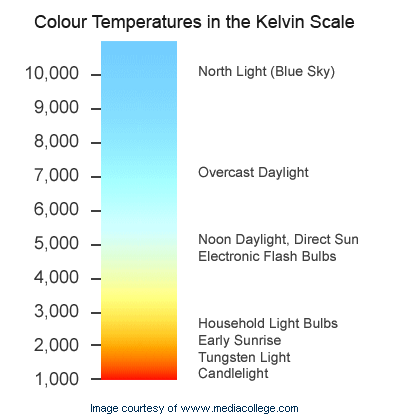
  • Color Temperature (CT) / Correlated Color Temperature (CCT): The "whiteness" of light generated from a source. Correlated to the color of light produced by a radiating black body of that temperature (K).
  • Color Rendering Index (CRI): The ability of a light source to correctly reflect accurate colors in the environment. CRI = 100 is perfect reproduction. CRIs in the range of 75-100 are considered excellent, while 65-75 are good. The range of 55-65 is fair, and 0-55 is poor.
I plotted the source characteristics for some common light sources below to show how they relate to each other. "Good" translates to high, to the right(ish) and with a large sized bubble.


What does that mean?
  • Incandescent and halogen bulbs are what most homes use today so they are the baseline against which all other lighting is most easily compared. 
    • It has good CRI, medium-low CT and very low efficacy. 
    • i.e. objects appear to be the "right" color when illuminated and the light itself is "warm (reddish)" but takes significant energy to produce very much of.
  • Fluorescent lights are very common, particularly in commercial lighting and are the other light source which you've probably encountered frequently. There is large variation in the characteristics available depending on phosphors used but:
    • Newer bulb types have reasonably good CRI, a wide range of CCTs (med - high) and high efficacy.
    • i.e. objects appear to be nearly the right color, light can be anywhere from "warm" to "cool (white)" (depending on the bulb) and energy is efficiently converted to light (~5x incandescent).
  • Metal Halide High Intensity Discharge (HID) are more common as outdoor lighting (and a variant - Xenon HID in car headlights).
    • It has borderline good CRI, medium CT and high efficacy. 
    • i.e. objects appear to be the "almost right" color when illuminated, the light itself is "cool (white)" and energy is efficiently converted to light (~7x incandescent).
  • Low Pressure Sodium lighting is the the yellow street lamp you've probably seen in the parking lot that made it impossible to figure out which car was yours because they all looked grey.
    • It's very good at converting energy to light, but it's not light you want to look at... unless you are an astronomer and want to filter out the city of San Jose's light pollution from your observations...
  • LED lighting is still fairly rare but is starting to show up in some more efficient building designs,  vending machines and refrigerated display cases.
    • Newer LED types have reasonably good CRI, a wide range of CCTs (med - high) and high efficacy.
    • i.e. objects appear to be nearly the right color, light can be anywhere from "warm" to "cool (white)" (depending on the phosphor used) and energy is efficiently converted to light (~10x incandescent).
Conclusion: modern fluorescents are quite good from a light quality standpoint, modern LEDs are similar as are (some) HID lamps. LEDs are clearly more "efficient" but adoption is still low. From this basic data one would expect that HID penetration would be higher too. Why is it not?

I'll get into more characteristics of these light sources later to better understand why the lighting situation looks like it does today, but hopefully this post went a good way towards explaining why the forerunners are what they are.
At least this proposed light bulb label should now makes sense:

Tuesday, June 15, 2010

Interesting Mixed Metaphor - BP Oil Spill and Energy Efficiency

This story from Treehugger highlights an interesting quantification of the BP Oil Spill in terms of energy being wasted.
  • The estimated cost to clean up the oil spill ($40 B) is many times greater than the cost to retrofit 75,000 houses ($1 B) and save the energy equivalent of the gulf oil spill every year.
  • 75,000 houses = mid-sized U.S. city or large suburb of a major city, like Chattanooga, Tenn. or Providence, R.I.
  • A typical home energy retrofit costs around $10,000 per house -- before any utility or governments energy rebates are applied.  
Of course, wasted energy is only a small part of the problem. There is the matter of millions of barrels (>114 million gallons = ~2.7 million barrels in worst case estimate or ~30M gal for a more conservative estimate) of crude oil in the water:
  • Oil washing up in coastal habitats killing animals, destroying ecosystems and heading towards Florida and the Atlantic Ocean.
  • Tons (>1.2 Million gal) of toxic chemicals being sprayed on it (dispersants) with unknown long term impact
  • The effect of the dispersed oil droplets sinking in the water column impacting sub-surface life.
  • Tons of methane, >20x more potent than CO2 as a green house gas, that have been released (around 2900 cu ft of methane per barrel of oil = 7.8 billion cu ft = ~112,000 metric tons = ~ equivalent to green house gas effect of emissions from 20,400 cars)
  • Increased hyopxic "dead zone" in the gulf (between 8% and 30% larger than normal) possibly from all the methane being pumped into the water along with the oil, further impacting the ecosystem.
  • The short and long term cost of health effects from the oil, chemical and gas exposure on clean up volunteers.
  • The resulting economic and job loss throughout the market chain as people cannot catch fish, sell fish, buy fish, so fishermen can't buy things thereby hurting local businesses which rely on the fishermen's income. (1% of Lousiana's economic output according to NPR)
  • More economic loss from the moratorium on deep water drilling (16% of the economic activity of Louisiana according to NPR).
  • The loss in stock value of BP impacting the retirement income and viability of retirement portfolios for large numbers of people, bringing further economic hardship on people already in the middle of one of the worst recessions in recent history.
So interesting comparison: yes... but sort of missing the big picture.